
What if the TPMS warning points to a sensor problem, not a flat tyre? It’s easy to mistake a system fault for low pressure, but the two need different responses. A safe tyre pressure monitoring system fault fix starts by checking the tyres themselves before you reset anything or continue driving as usual.
If the warning remains, see our TPMS fault diagnosis and tyre pressure sensor service in Umm Ramool, Dubai for workshop details and booking.
If the light stays on, flashes, or returns after you’ve adjusted the pressure, the tyre may still be underinflated, or a sensor may have failed. Separating those possibilities matters: resetting the alert won’t repair a damaged or unresponsive sensor.
This guide covers safe first checks, what warning patterns may indicate, and when a reset is appropriate. You’ll also learn when to stop relying on the dashboard reading and arrange a professional diagnosis. If basic checks don’t resolve the issue, MonacoPro Auto Garage in Umm Ramool, Dubai, provides car computer diagnostics and TPMS sensor programming to help identify the next step.
Key Takeaways
- Use the vehicle’s tyre-pressure placard for target pressures, and check each tyre with a reliable gauge rather than relying only on the dashboard.
- A tyre pressure monitoring system fault fix may involve correcting pressure, following the vehicle’s relearn procedure, or diagnosing a sensor issue. A reset alone won’t repair a puncture or faulty sensor.
- Note whether the warning is steady, flashing, or paired with a specific message. These details can help narrow down the cause.
- After recent tyre or wheel work, share that information when arranging diagnosis. It can help guide the fault assessment.
- MonacoPro Auto Garage in Umm Ramool, Dubai, provides car computer diagnostics and TPMS sensor programming when basic checks don’t clear the warning.
What a TPMS Fault Warning Means, and What to Check First
A tyre pressure monitoring system (TPMS) checks tyre pressure and alerts you when it detects a possible issue. Depending on the vehicle, it may measure pressure directly at the wheels or infer a pressure change through other vehicle sensors. The Tire-pressure monitoring system overview explains these general system types, but your handbook is the best guide to your car’s specific warnings.
A low-pressure alert means one or more tyres may need attention. A system-fault message, by contrast, indicates that the monitoring system may not be reporting correctly. The warning deserves prompt attention, but it doesn’t automatically mean a tyre is about to fail. Check the tyres and pressure before deciding what to do next. A fault may need diagnosis even if the tyres look normal.
How to tell a pressure alert from a system fault
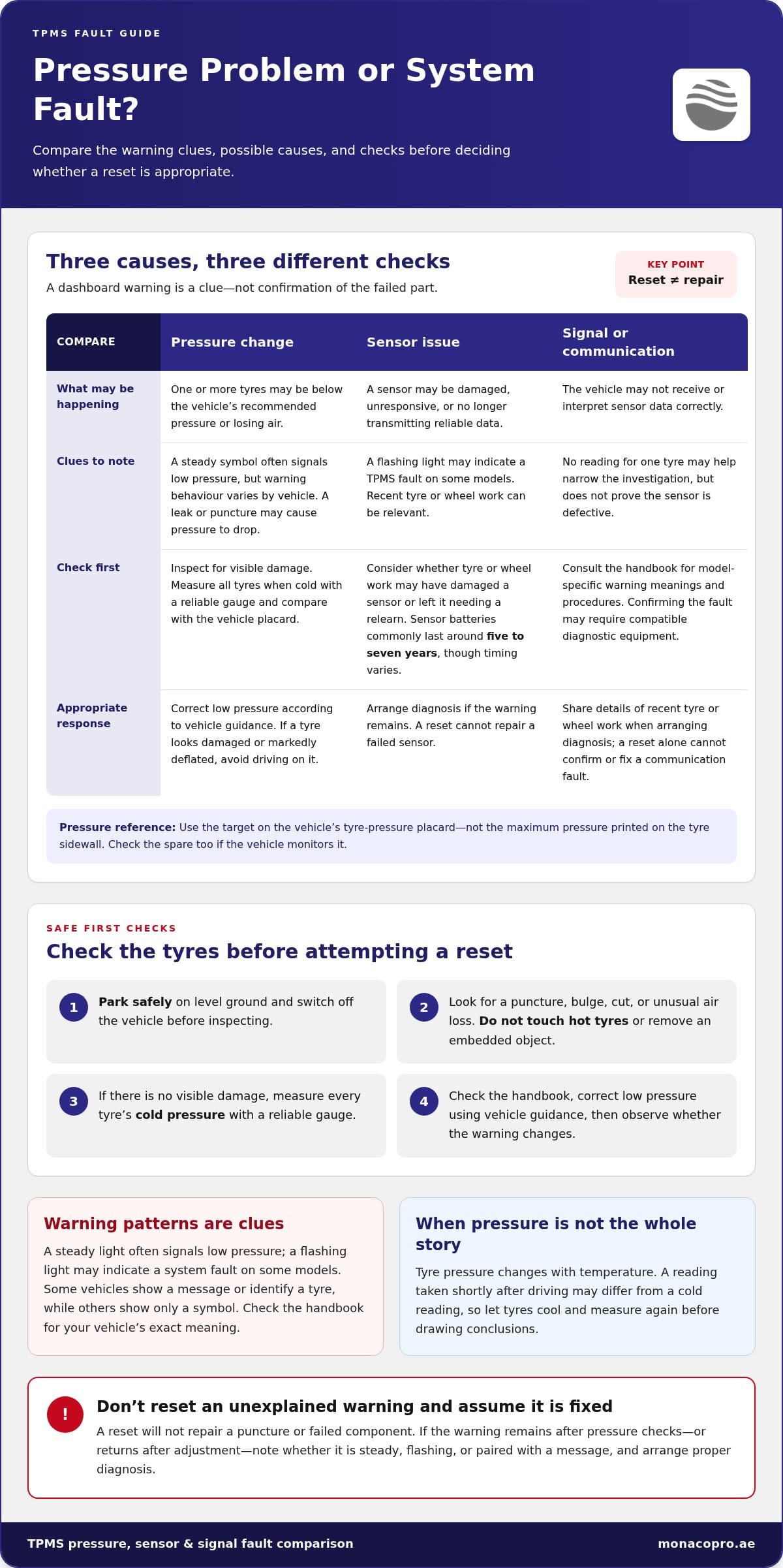
Dashboard behaviour varies by vehicle. A steady symbol often signals low pressure, while a flashing light may indicate a TPMS fault on some models. Some cars show a written message or identify a particular tyre; others display only a warning symbol. Treat these patterns as clues, not a diagnosis. The light alone can’t confirm which sensor or component is affected, so consult the handbook for the exact meaning and any model-specific instructions.
Safe first checks before attempting a reset
Start with the vehicle parked securely on level ground. Look over every tyre for an obvious puncture, bulge, cut, or unusual loss of air. Don’t touch a hot tyre, and don’t try to remove an object embedded in the tread. If a tyre looks damaged or markedly deflated, avoid driving on it because continuing could create additional risk.
If there’s no visible damage, measure the pressure in all tyres with a reliable gauge when the tyres are cold. Compare each reading with the pressure target on the vehicle placard, not the figure printed on the tyre sidewall. Check the spare as well if your vehicle monitors it. Correct any low reading according to the vehicle guidance, then observe whether the warning changes.
- Park in a safe place and switch off the vehicle before inspecting the tyres.
- Check for visible damage or deflation without touching hot tyre surfaces.
- Measure cold pressure and compare each reading with the vehicle placard.
- Refer to the handbook for the warning’s meaning and the correct next step.
Don’t use a reset as the first response to an unexplained warning. The right tyre pressure monitoring system fault fix depends on whether the issue is low pressure or a system fault, and a reset can’t repair a puncture or failed component. If the warning remains after pressure checks, note its behaviour and arrange a proper diagnosis rather than assuming the system has cleared the underlying problem.
Common TPMS Fault Causes: Pressure, Sensors, and Signal Issues
A TPMS warning can point to a tyre-pressure change, a monitoring fault, or both. These conditions aren’t interchangeable: a tyre can be underinflated while the system also has a sensor or communication problem. The dashboard message is useful evidence, but it doesn’t identify the failed part by itself. Consider these causes separately rather than replacing a sensor based on the warning alone.
Pressure changes and warning behaviour
Start with actual pressure readings. Compare them with the vehicle placard, which gives the recommended target for that car and tyre setup. The maximum pressure moulded onto a tyre’s sidewall is not the vehicle’s recommended setting. Tyre pressure also changes with temperature: air inside a tyre warms during driving, so a reading taken shortly after a journey may differ from a cold reading. If you checked after driving, allow the tyres to cool and measure again before drawing conclusions.
Dubai’s warm conditions make it especially useful to note whether a pressure check was done before or after driving, but a dashboard alert alone can’t establish why a reading changed. A genuine pressure drop may result from a leak or puncture, while a system-fault message can indicate that pressure data isn’t being received or processed correctly. If both appear, assess the tyre condition and monitoring system as related but distinct concerns.
Sensor, battery, and communication faults
Other communication issues can prevent the vehicle from receiving or interpreting a sensor’s signal. A display that shows no reading for one tyre may narrow the investigation, but it doesn’t prove that the sensor itself is defective. Confirming sensor status and identifying where communication breaks down may require compatible diagnostic equipment and vehicle-specific procedures.
- Pressure: A tyre may be below the placard target or losing air.
- Sensor: Damage or an unresponsive unit can interrupt pressure reporting.
- Power: An ageing internal battery may stop a sensor from transmitting.
- Communication: The car may not receive or interpret sensor data correctly.
- Recent wheel service: Work can leave a sensor damaged, mismatched, or needing a relearn.
These possibilities call for different responses, so a reset is not a substitute for checking pressure or diagnosing a persistent system fault. For a tyre pressure monitoring system fault fix, accurate assessment helps establish whether the concern is pressure-related or needs sensor diagnosis and programming. If the warning persists after basic checks, professional TPMS diagnostics and sensor programming can be the next step.
TPMS Reset or Sensor Repair: Which Fix Fits the Fault?
The right response depends on what happens after you’ve checked the tyres and set them to the vehicle’s recommended pressures. Correcting the pressure addresses an underinflated tyre. A vehicle-prescribed relearn helps the car recognise sensor information after certain service or wheel changes. Professional diagnosis is appropriate when the warning points to a system fault or continues despite correct pressure and the specified relearn.
These steps aren’t interchangeable. A reset can clear or recalibrate a warning under the conditions described in the owner’s manual, but it won’t seal a puncture, repair a damaged sensor, or resolve a communication problem. If the alert returns, treat that as useful information rather than simply clearing it again.
When a vehicle-prescribed reset may be appropriate
Follow a reset or relearn procedure only when the owner’s manual recommends it for your vehicle and situation. Some vehicles may require a relearn after pressure correction or wheel changes so the system can associate sensor readings with the correct positions. The method varies by model, so avoid copying a sequence from a different car or relying on a general button-press instruction.
Use the procedure only after addressing any low pressure and checking for visible tyre damage. If the warning clears and stays off, continue to monitor it as directed in the handbook. Repeatedly clearing the alert without finding out why it returns can hide a persistent fault without fixing its cause.
When professional TPMS service is the better option
- Pressure is below the placard target: Correct it according to the vehicle guidance, then monitor the warning.
- Wheel work has just been completed: Follow the manual’s relearn instructions if applicable.
- The fault persists or returns: Arrange professional diagnosis instead of repeatedly resetting the system.
This decision path is the practical starting point for a tyre pressure monitoring system fault fix: correct the condition you can verify, use only the vehicle-prescribed relearn, and seek diagnosis when the system still reports a fault. For more detail on sensor-related warning causes and assessment, see the TPMS malfunction diagnosis guide.
How to Troubleshoot a TPMS Fault Safely: A Step-by-Step Plan
Driver checks: inspect, measure, and record
Follow this sequence in a safe parking area. Use the pressure targets on the vehicle placard and the owner’s manual for model-specific instructions. Keep a note of the readings and warning behaviour so you can give a technician useful details if the issue persists.
- Park securely. Choose a stable, safe place away from moving traffic, switch off the vehicle, and allow the tyres to cool before taking pressure readings.
- Inspect each tyre. Look for cuts, bulges, embedded objects, visible punctures, or one tyre sitting noticeably lower than the others. Don’t touch a hot tyre or try to remove anything lodged in the tread.
- Measure pressure. Use a reliable gauge and compare each reading with the vehicle placard. Don’t use the tyre sidewall’s maximum pressure as the target. If a tyre is low and has no visible damage, follow the vehicle guidance to correct its pressure.
- Reassess and record. Note whether the alert is steady, flashing, or accompanied by a message. After correcting pressure, follow the handbook for any reset or relearn steps, then record whether the warning clears or returns.
Workshop diagnosis: identify the fault before repair
After tyre replacement, rotation, or other wheel work, a warning may relate to a sensor that was disturbed or a system that needs the correct relearn. Share what work was done, your pressure readings, and how the warning changed. This context helps guide assessment without assuming that a sensor has failed.
Don’t dismantle a valve or attempt sensor programming at home. If the warning remains, arrange a TPMS assessment at MonacoPro Auto Garage in Umm Ramool, Dubai, where car computer diagnostics and TPMS sensor programming support an informed repair decision. Arrange a TPMS fault assessment.
TPMS Sensor Programming and Fault Repair in Umm Ramool, Dubai
If the warning remains after safe pressure checks, the next useful step is an assessment that separates a tyre-pressure issue from a TPMS system fault. Sharing what you’ve observed helps the technician understand the pattern and choose an appropriate diagnostic path. At MonacoPro Auto Garage in Umm Ramool, Dubai, car computer diagnostics and TPMS sensor programming help address alerts that basic checks haven’t resolved.
What to share when arranging a TPMS assessment
Prepare a brief history of the warning. Note the exact dashboard message or symbol, when it first appeared, and whether it stays on or comes and goes. Include any pressure readings and whether they were taken before or after driving. These details can help distinguish a pressure change from an intermittent reporting concern.
- The warning message or symbol and whether it is steady, flashing, or intermittent.
- Recent tyre replacement, wheel changes, rotation, or other tyre work.
- Pressure checks or adjustments you’ve made, including which tyre was affected.
- Your vehicle details and handbook, especially if it describes a specific reset or relearn procedure.
Clear information helps avoid guesswork. For example, a warning that began after a tyre change gives the technician useful context, but it doesn’t prove that a sensor was damaged or needs programming.
From diagnosis to sensor programming
The repair approach should follow the diagnostic finding, not assume that every TPMS warning calls for a new sensor. A pressure concern may need attention at the tyre, while a system fault may call for further checks of sensor response or communication. Car computer diagnostics help assess vehicle fault information; the results guide whether pressure correction, sensor service, or another step is appropriate.
TPMS sensor programming is relevant when a sensor needs setup for the vehicle’s system. Programming is not a substitute for identifying the cause of the warning, and it won’t repair a puncture or restore a damaged component. An assessment first helps match the work to the issue and reduces the risk of treating a symptom while overlooking its cause.
For a persistent warning, bring your pressure-check results and recent service details to MonacoPro Auto Garage in Umm Ramool. This gives the workshop a practical starting point for car computer diagnostics and any relevant TPMS sensor programming. It’s a clear next step toward a tyre pressure monitoring system fault fix based on the vehicle’s reported condition, rather than trial-and-error resets.
Contact MonacoPro Auto Garage to arrange TPMS sensor service at the Umm Ramool workshop.
Take the Next Step With Confidence
A warning that remains after your checks doesn’t have to leave you guessing. Note what the dashboard shows and what you’ve observed, then use that information to move from trial-and-error resets toward a considered diagnosis. The right tyre pressure monitoring system fault fix depends on what the vehicle’s system and sensors are reporting, not on clearing the warning and hoping it stays away.
At MonacoPro Auto Garage in Umm Ramool, Dubai, car computer diagnostics can help assess the fault, while TPMS sensor programming addresses setup when needed. Sharing the warning message, pressure-check results, and any recent tyre work gives the assessment a useful starting point.
Arrange TPMS sensor diagnosis and programming with MonacoPro Auto Garage in Umm Ramool, Dubai, to identify the appropriate next step for your vehicle.
Frequently Asked Questions
Can I drive with a TPMS fault light on?
Is a TPMS fault the same as low tyre pressure?
No. Low pressure means a tyre reading is below the vehicle’s recommended target; a TPMS fault means the monitoring system may not be reporting accurately. The two can occur together, so a warning alone doesn’t tell you which condition is present. For example, a tyre could be losing air while its sensor also fails to communicate. Check the pressure independently, then use the vehicle’s displayed message and manual to understand the system alert.
Can I reset a TPMS fault myself?
You can perform a reset or relearn yourself only if the vehicle handbook describes that procedure and the stated conditions are met. Some models use vehicle controls, while others may require a particular drive or workshop tool. Don’t use a generic sequence found online for a different car. If the warning returns after the manual’s procedure, stop clearing it repeatedly and arrange diagnosis so the underlying issue isn’t overlooked.
Why does my TPMS warning return after I inflate the tyres?
The pressure may still be outside the recommended range, or a tyre may have a slow leak that lowers it again. The system may also need a vehicle-specific relearn, or a sensor may not be transmitting reliable information. Recheck all tyres with a gauge under comparable conditions and note which readings change. If the pressures remain correct but the warning persists or returns, a diagnostic check can distinguish a pressure issue from a system fault.
Can hot weather in Dubai affect tyre pressure readings?
Yes. Air inside a tyre warms as the tyre heats up, including during driving, and the pressure reading can rise. That’s why a reading taken after a journey may differ from a cold reading. For a useful comparison with the vehicle placard, check pressure when the tyres are cold and avoid releasing air from a warm tyre just to match a cold-pressure target. Follow your vehicle handbook if it gives additional checking guidance.
Does a TPMS sensor need programming after tyre replacement?
How do I know whether a TPMS sensor has failed?
A missing pressure reading for one wheel or a persistent system warning can suggest a sensor or communication issue, but neither confirms a failed sensor on its own. The cause could also involve a relearn or another fault in the system. A tyre pressure monitoring system fault fix should be based on diagnostic findings, not the dashboard symbol alone. At MonacoPro Auto Garage in Dubai, car computer diagnostics and TPMS sensor programming support an accurate assessment.