
Most drivers in the UAE believe that the darker your windows are, the cooler your car will stay. In reality, a clear ceramic film often outperforms a cheap, pitch-black tint when the Dubai sun hits 50°C. Choosing the wrong film doesn’t just leave you sweating; it can also lead to an AED 1,500 fine if you exceed the legal 50% light transmission limit. Getting car window tinting Dubai right is about balancing high-performance heat rejection with strict RTA compliance.
We understand the frustration of watching your luxury leather upholstery crack under UV rays or waiting ten minutes for the AC to make the cabin bearable. You want a solution that offers peace of mind and genuine protection without the risk of legal trouble. This guide provides everything you need to know about the latest 2026 regulations and the best technologies available to safeguard your vehicle. We’ll break down the differences between dyed, carbon, and nano-ceramic films, explain the specific rules for front windshields, and give you the expert tips needed to keep your car’s interior pristine and comfortable all year round.
Key Takeaways
- Understand the current RTA regulations regarding the 50% Visible Light Transmission (VLT) limit to ensure your vehicle remains legal and avoids heavy fines.
- Compare the performance of dyed, carbon, and ceramic films to determine which technology offers the best heat rejection for the intense UAE climate.
- Learn how to verify UV and Infrared Rejection (IRR) ratings so you can select a film that truly protects your skin and your car’s interior.
- Discover why professional installation in a dust-free, temperature-controlled booth is the only way to achieve a bubble-free, long-lasting result.
- Master the essentials of car window tinting Dubai to significantly reduce cabin temperatures and preserve your luxury upholstery.
Dubai Car Tinting Laws: Staying Compliant in 2026
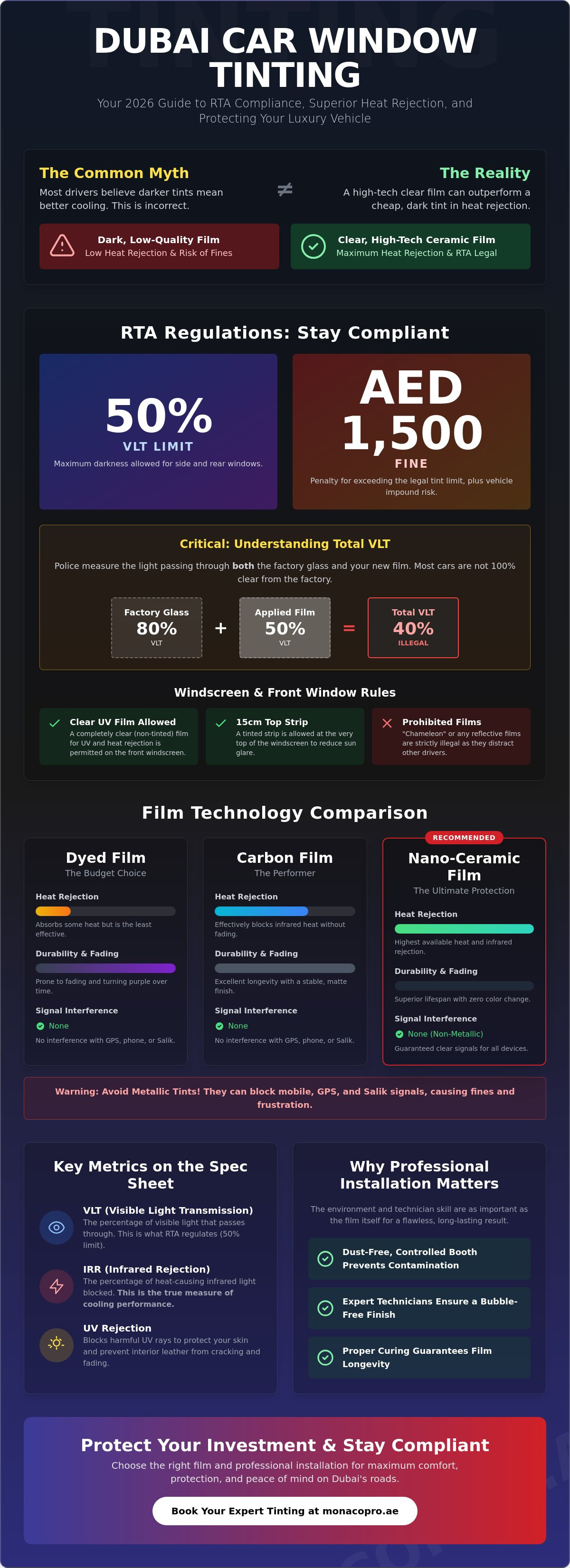
Staying on the right side of the law is just as important as staying cool. In Dubai, the Roads and Transport Authority (RTA) maintains strict standards for vehicle modifications to ensure road safety. As of 2026, the legal limit for Window film on private vehicles is 50% Visible Light Transmission (VLT). This applies specifically to the side and rear windows. If you choose a tint that exceeds this darkness, you risk an immediate fine of AED 1,500 and the possibility of your vehicle being impounded during police inspections.
One detail many drivers overlook is the “Total VLT” calculation. Most modern luxury cars arrive with a slight factory tint already embedded in the glass, usually around 70% to 85% VLT. When you apply an aftermarket film, the police measure the combined transparency of both the glass and the film. If your factory glass is already at 70% and you add a 50% film, the resulting VLT is actually 35%. This makes the car illegal. We always recommend testing your glass with a light meter before starting any car window tinting Dubai project to avoid these costly surprises.
Exemptions to these rules are rare. Only individuals with specific medical conditions requiring enhanced UV protection can apply for a permit to go darker. You must carry this official RTA authorization in the car at all times. For everyone else, staying within the 50% limit is the only way to guarantee a smooth experience during your annual vehicle registration renewal.
Understanding VLT Percentages
VLT is the amount of visible light that passes through the film and glass combined. Dubai Police use digital light meters to verify this during roadside checks. It’s a common mistake to assume that a darker tint automatically means better cooling. A high-quality ceramic film can block over 90% of infrared heat while remaining 100% legal. Conversely, a cheap, dark dyed film might only block 20% of heat despite being dangerously opaque. Focus on the heat rejection specs rather than just the shade.
Windscreen and Front Window Regulations
The rules for the front windscreen are the most rigid for safety reasons. You aren’t allowed any tinting on the main area of the front glass. However, you can apply a completely clear UV-rejection film that provides protection without changing the glass’s appearance. A small 15 cm strip is permitted at the very top to block the afternoon glare. Avoid “chameleon” or reflective films; these are strictly prohibited because they distract other drivers. Your side mirrors must also remain completely unobstructed to pass the RTA safety inspection and ensure you have a clear view of the road at all times.
Comparing Tint Types: Ceramic vs. Carbon vs. Dyed
Choosing the right film for car window tinting Dubai involves more than just picking a shade of black. The material you select determines how well your car handles the heat and how long the film lasts before it begins to peel or bubble. There are three primary technologies available in the market today, each offering a different balance of price and performance.
Dyed window film is the most accessible entry point for many drivers. It uses a layer of dye placed between the adhesive and a protective top coating to absorb solar heat. While it provides excellent privacy and a classic look, its heat rejection capabilities are limited. In the intense UAE sun, dyed films are prone to fading over time, often turning a purple hue after a few seasons of exposure. It’s a functional choice for those on a strict budget, but it lacks the long-term durability required for luxury vehicles.
Carbon film offers a significant step up in quality. It contains no dyes; instead, it uses carbon particles that are highly effective at blocking infrared light. This material provides a distinct matte finish that doesn’t fade over time. Carbon films are excellent for keeping interiors cool and protecting your upholstery from UV damage. However, for those seeking the ultimate level of protection, ceramic film stands as the industry benchmark. These films use nano-ceramic particles that are non-conductive and non-metallic. They offer the highest heat rejection rates available without needing a dark, illegal shade to be effective.
A critical warning for Dubai drivers is to avoid metallic tints. While these films reflect heat well, the tiny metal particles inside can act as a shield against electronic signals. This leads to frustrating issues with mobile phone reception, GPS accuracy, and, most importantly, Salik gate communication. If your film interferes with your RFID tag, you might face account errors or missed toll payments. If you are unsure which film suits your driving habits, our team at MonacoPro provides expert guidance on high-performance tinting, polishing, and upholstery services tailored for the local climate.
The Science of Heat Rejection (TSER)
Total Solar Energy Rejection (TSER) is the only metric you should trust when evaluating a film’s performance. As recommended by the International Window Film Association, TSER measures a film’s ability to block three things: UV light, visible light, and infrared radiation. Ceramic particles are incredibly efficient because they specifically target infrared rays, which are responsible for the “burning” sensation on your skin. This technology allows a 50% legal tint to outperform a 100% dark dyed film in total cooling power.
Signal Interference and Connectivity
Modern vehicles are rolling computers that rely on seamless connectivity. Non-conductive ceramic and carbon films ensure that your internal sensors, such as the Tyre Pressure Monitoring System (TPMS) and satellite navigation, function perfectly. Unlike metallic options, these advanced films allow radio waves to pass through the glass without obstruction. This ensures your Salik tag is read instantly every time you pass through a toll gate, providing a frictionless driving experience across the city.
The Car Window Tinting Selection Checklist
Selecting the right package for car window tinting Dubai requires looking beyond the price tag. While many shops offer similar-looking films, the technical specifications determine whether your car stays cool or simply looks dark. Use this checklist to ensure you receive a high-standard, road-ready result that protects your investment.
- Target 99% UV Protection: Harmful ultraviolet rays are responsible for fading your dashboard and cracking leather seats. Ensure the film specifically mentions 99% UV rejection to preserve your car’s interior.
- Verify Infrared Rejection (IRR): As we discussed in the comparison of film types, IRR is what actually keeps the heat out. A premium film should offer an IRR of 80% or higher to make a noticeable difference in cabin temperature.
- Inspect for Visual Clarity: Low-grade films often have a “hazy” or “milky” appearance when viewed against direct sunlight. Hold a sample up to the light; it should be crystal clear with no distortion or orange-peel texture.
- Balance Privacy with Visibility: While the 50% VLT limit is the legal standard, consider how the shade affects your ability to see side mirrors at night. A high-quality 50% tint offers better outward visibility than a cheap 30% tint.
Don’t settle for verbal promises during your consultation. A reliable provider will show you the technical data sheets for the specific film being applied to your vehicle. This transparency gives you peace of mind that the product matches the performance you’re paying for.
Evaluating Warranty Terms
A “lifetime warranty” can be misleading if the shop doesn’t have a physical presence to back it up. In the harsh Dubai climate, even good films can occasionally fail. Look for a local warranty that specifically covers bubbling, peeling, and adhesive failure. A guarantee from a reputable workshop in Umm Ramool or Al Quoz is far more valuable than an international brand promise that is difficult to claim. Keep your original receipt and warranty card in the glovebox; you’ll need these if an RTA inspector ever questions the legality of your film during your annual registration.
Night Driving and Visibility
Safety is the most important factor when driving on unlit desert roads or through busy city intersections. Budget films often use heavy dyes that impair your vision when the sun goes down, making it difficult to spot pedestrians or cyclists. Premium ceramic films use advanced technology to maintain high-definition clarity regardless of the lighting conditions. Visual clarity is a safety feature that separates premium films from budget alternatives. By investing in higher-quality materials, you ensure that your 50% legal tint provides maximum heat rejection without compromising your safety during night-time commutes.
Professional Installation: Why the Environment Matters
Even the most expensive ceramic film will fail if it’s applied in a dusty car park or an open-air garage. The quality of car window tinting Dubai depends heavily on the environment where the work takes place. Dubai’s air is filled with microscopic sand and dust particles that are invisible to the naked eye but become painfully obvious once trapped under a fresh layer of film. These contaminants prevent the adhesive from bonding correctly, leading to those unsightly bubbles that never go away.
A professional installation requires a temperature-controlled, sealed environment. Heat affects how the film stretches and how the adhesive cures. If the bay is too hot, the film may dry prematurely, making it impossible to achieve a perfect, edge-to-edge finish. Precision is another factor that separates experts from amateurs. While some shops still hand-cut film directly on your car’s glass, we prefer computer-cut technology. This ensures every piece is measured to your vehicle’s exact specifications, eliminating the risk of accidental blade scratches on your glass or rubber seals.
The first 48 hours after installation are the most critical. This is known as the curing period. During this time, the moisture between the film and the glass evaporates. You’ll need to be patient to ensure the result stays “road-ready” for years to come. If you want to ensure your vehicle receives this level of precision and care, you can book our professional tinting, polishing, and upholstery services today.
The Dust-Free Standard in Umm Ramool
Dubai’s fine sand particles are the enemy of a clean tint. Even a single grain of sand can create a permanent “white spot” under the film. This is why MonacoPro Auto Garage invests in a specialised, clean-room detailing bay. By controlling the airflow and maintaining a pristine workspace, we eliminate the risk of contamination. This controlled environment is essential for luxury vehicles where a flawless finish is the only acceptable outcome.
Post-Tinting Maintenance Tips
To protect your investment, follow these simple rules during the first few days. Don’t roll down your windows for at least 2 days; doing so can peel the edges before the adhesive has fully set. When it’s time for a wash, instruct your detailer to avoid ammonia-based cleaners. Ammonia is a harsh chemical that breaks down the protective layers of the film, leading to premature fading or cloudiness. Stick to pH-neutral soaps and microfibre cloths to keep the surface scratch-free and clear. If you notice small water pockets in the first week, don’t press on them. These are a natural part of the drying process and will disappear as the film fully cures in the sun.
Premium Detailing and Tinting at MonacoPro Auto Garage
At MonacoPro Auto Garage, we treat every vehicle with the precision it deserves. Whether you drive a luxury sedan or a daily commuter, our approach to car window tinting Dubai is rooted in technical expertise and premium hospitality. We’ve hand-selected high-performance films specifically engineered to withstand the unique challenges of the Arabian sun. These films provide the maximum Infrared Rejection (IRR) discussed in previous sections, ensuring your cabin remains cool even during the peak of summer.
Our expert technicians bring years of experience to our Umm Ramool workshop. We don’t just apply a film; we provide a comprehensive solution for your vehicle’s longevity. By combining our advanced tinting techniques with professional upholstery restoration, we offer total protection for your car’s interior. This synergy prevents the sun from damaging your leather and fabric, keeping your car’s resale value high and your driving experience comfortable. Our team understands the nuances of different glass types and ensures every application is flawless.
Your One-Stop Auto Care Centre in Dubai
We’re conveniently located in Umm Ramool, making it easy for you to access professional service without the hassle. MonacoPro is a full-service garage designed to handle all your automotive needs under one roof. Beyond aesthetic detailing, our team is equipped for battery replacement, oil changes, and car computer diagnostics. We believe in complete transparency. You’ll receive clear technical specifications for your chosen film and straightforward information on every service we provide. There are no hidden fees or guesswork; just honest, high-quality craftsmanship that gets you back on the road quickly.
The MonacoPro Hospitality Experience
Entering our garage feels like stepping into a premium establishment where your time and comfort are valued. We’ve created a welcoming environment that mirrors the care we put into your vehicle. Our goal is to provide peace of mind through a road-ready quality guarantee. We ensure that every edge is perfectly aligned and every window is free from contaminants before you drive away. Every vehicle undergoes a final inspection to ensure it meets our rigorous standards for clarity and adhesion. If you’re ready to protect your vehicle and improve your daily commute, book your professional car window tinting at MonacoPro Auto Garage today. Our team is standing by to guide you through the best options for your specific car and lifestyle.
Upgrade Your Driving Comfort and Protection Today
Securing the right car window tinting Dubai is one of the most effective ways to preserve your vehicle’s value and your daily comfort. We’ve explored how staying within the 50% VLT limit ensures you remain RTA-compliant while advanced ceramic technologies provide the heat rejection you truly need. By focusing on high-IRR films and professional installation, you avoid the common pitfalls of bubbling, fading, and signal interference. Your car deserves a solution that stands up to the extreme Arabian sun without compromising on clarity or legality.
Our expert technicians in Umm Ramool are dedicated to delivering a high-standard, road-ready result for every client. We provide clear, RTA-compliant legal guidance alongside premium high-IRR ceramic film options that specifically target infrared heat. Whether you want to protect luxury upholstery or simply make your summer commute more bearable, we have the expertise to help you choose with confidence.
Take the next step in safeguarding your vehicle and your peace of mind. Get a Quote for Premium Car Window Tinting at MonacoPro and experience the difference that professional craftsmanship makes. We’re here to ensure you stay cool, protected, and fully compliant on every journey.
Frequently Asked Questions
What is the maximum legal window tint percentage in Dubai?
The maximum legal window tint limit for private vehicles in Dubai is 50% Visible Light Transmission (VLT). This regulation applies specifically to the side and rear windows to ensure driver visibility remains safe for all road users. Exceeding this limit can result in a fine of AED 1,500. It’s essential to account for any factory tint already present in your glass when choosing your film to stay fully compliant.
Does car window tinting really reduce the temperature inside the car?
High-quality car window tinting Dubai significantly reduces cabin temperatures by blocking infrared radiation and solar energy. While the car will still get warm if left in direct sunlight for hours, the tint prevents the “burning” sensation on your skin and helps your AC cool the interior much faster. Premium ceramic films are particularly effective at this, blocking a high percentage of heat-producing infrared rays.
How long does it take to tint a car in Dubai?
A professional tinting installation typically takes between 2 and 4 hours depending on the vehicle size and the number of windows. We value your time and work efficiently to ensure a precise, bubble-free application within this window. It’s best to book an appointment in advance to ensure our temperature-controlled bay is ready for your arrival, allowing for a seamless end-to-end journey.
Can I tint my front windscreen in the UAE?
You cannot apply a dark or coloured tint to your front windscreen under UAE law. However, you are permitted to install a completely clear UV-rejection film that protects your dashboard and skin without affecting visibility. Additionally, a small sun-shield strip up to 15 cm wide is allowed at the very top of the windscreen to help reduce glare during sunrise and sunset.
Why are there bubbles in my new window tint?
Small, hazy moisture bubbles are a normal part of the curing process and usually disappear within 48 to 72 hours as the water evaporates. If you see bubbles containing visible specks of sand or dust, these are permanent and usually indicate a poor installation environment. Choosing a provider with a sealed, dust-free detailing bay is the only way to avoid these frustrating imperfections and ensure a road-ready result.
Is ceramic tint worth the extra cost compared to carbon tint?
Ceramic film is definitely worth the investment for drivers who prioritize maximum cooling and long-term durability. While carbon film is a great mid-range option, ceramic technology offers superior infrared rejection and better visual clarity. It doesn’t interfere with electronic signals like GPS or Salik tags, making it a reliable choice for modern vehicles equipped with advanced navigation and communication systems.
Does window tinting affect my car’s insurance or warranty?
Applying a legal 50% tint generally does not affect your car’s insurance or manufacturer warranty in the UAE. Most insurance providers view car window tinting Dubai as a standard protective measure rather than a performance modification. However, it’s always a good idea to inform your insurance company of any changes and ensure your film is applied by a professional to avoid damaging window seals or electronic sensors.
How do I clean my tinted windows without damaging the film?
You should use a soft microfibre cloth and an ammonia-free glass cleaner to maintain your tinted windows. Ammonia is a harsh chemical that can cause the film to turn purple, peel, or lose its heat-rejection properties over time. Simply spray the cleaner onto the cloth rather than the glass to prevent liquid from seeping into the edges, ensuring your tint remains clear and effective for years.