
What if the simple act of starting your engine in the Dubai summer was actually the most stressful part of your day? We all know the sinking feeling of a slow crank or a silent ignition when the temperature outside hits 45°C. It’s more than just a nuisance; it’s a genuine safety risk that often happens at the most inconvenient moments. Most drivers in the UAE understand that the extreme heat is a silent killer for lead-acid components, yet many are still caught off guard when their vehicle refuses to turn over.
You likely want a reliable start every single time you turn the key, without the fear of being stranded in the heat. This guide provides everything you need for a professional car battery change in 2026. You’ll learn how to identify early failure signs, choose between AGM and EFB technologies, and why a garage-based installation is vital for modern vehicle electronics. We also look at how to verify your alternator health and navigate warranty terms in the local market. This overview ensures you understand why a precise, diagnostic-led approach is the only way to protect your car’s sophisticated systems and ensure long-term performance.
Key Takeaways
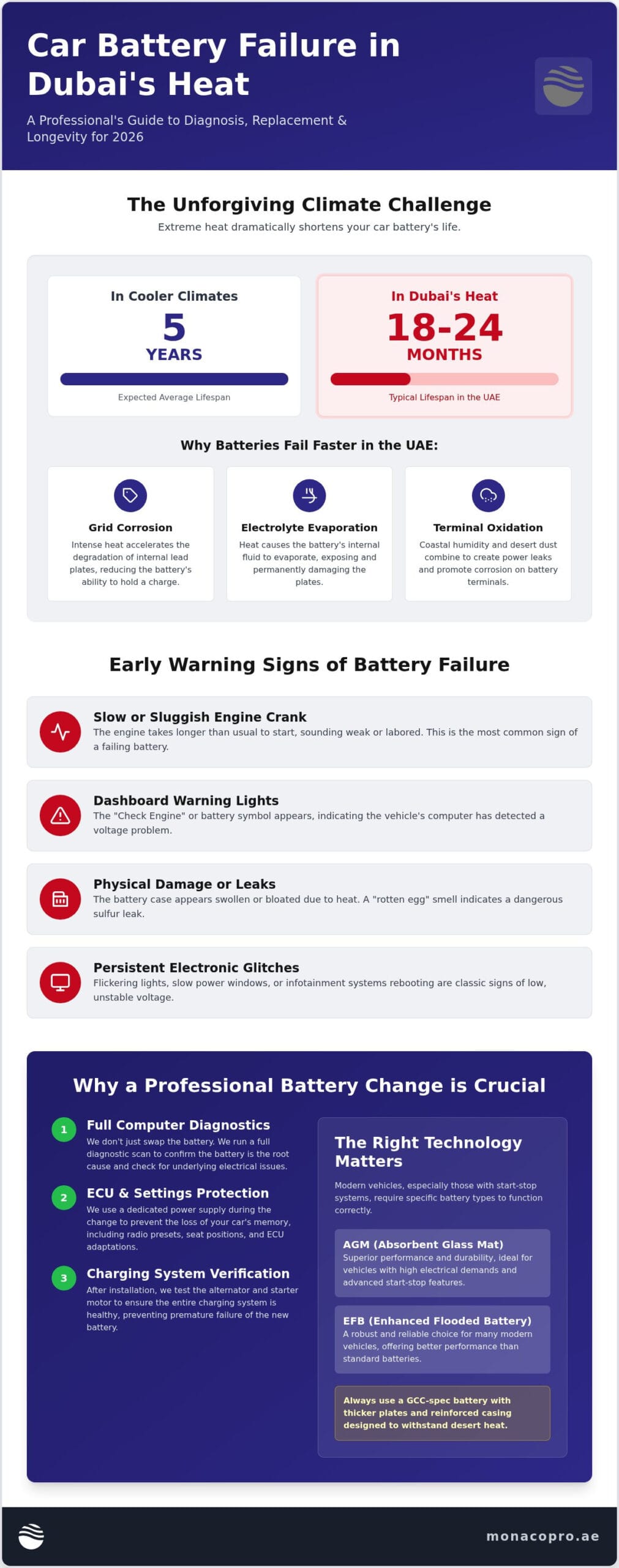
- Understand how the intense Dubai climate impacts lead-acid components, typically limiting battery lifespan to between 18 and 24 months.
- Recognize the critical warning signs of failure, such as a sluggish engine crank or persistent dashboard warning lights, to avoid being stranded.
- Determine the correct battery technology for your vehicle, specifically comparing AGM and EFB options for modern start-stop systems.
- Learn why a professional car battery change must include computer diagnostics and power backup to protect your vehicle’s sensitive electronic settings.
- Ensure long-term reliability by verifying the health of the entire charging system, including the alternator and starter motor, during every replacement.
Understanding the Impact of Dubai Climate on Car Battery Life
Dubai’s environment is unforgiving for vehicle components. While a standard Automotive battery might last five years in cooler climates, the intense heat of the UAE significantly accelerates internal chemical reactions. This leads to a process called grid corrosion, where the internal lead plates degrade much faster than intended. In Dubai, it’s a well documented industry reality that the average lifespan of a battery is just 18 to 24 months. If you haven’t scheduled a car battery change within this window, you’re likely operating on borrowed time.
Local factors in industrial hubs like Umm Ramool also play a role. Proximity to the coast means humidity levels can be high, and when this moisture combines with fine desert dust, it settles on battery terminals. This mixture creates a subtle conductive path that allows the battery to leak power even when the car is off, while also promoting terminal oxidation. Using a battery specifically engineered for the GCC is essential. These units feature thicker plates and specialized alloys compared to standard imports designed for temperate regions, which simply can’t handle the thermal stress of a desert summer.
Heat-Induced Electrolyte Evaporation
High ambient temperatures cause the liquid electrolyte inside the battery to evaporate. Even in modern Sealed Maintenance-Free (SMF) batteries, which are the standard choice in the UAE, excessive heat causes pressure to build and gases to escape through safety vents. Once this fluid level drops, the internal plates are exposed to air and become permanently damaged. High quality casings are designed to dissipate this heat more effectively, but they can only do so much when the asphalt temperature exceeds 60°C. This is why choosing a battery with a reinforced casing is a practical necessity for local drivers.
The “Summer Surge” of Battery Failures
The majority of battery related breakdowns occur during the first true spike of summer heat. This happens because the chemical degradation from the previous months finally reaches a breaking point under the added strain of the air conditioning system. In Dubai, your AC works at maximum capacity, placing an immense load on the electrical system. If your battery’s health is already marginal, the extra demand from cooling fans and compressors will likely cause it to fail. We recommend preventative testing before the peak heat arrives to determine if a car battery change is necessary before you find yourself stranded.
Recognising the Warning Signs: Is it Time for a Car Battery Change?
Most drivers only think about their battery when the car won’t start. However, your vehicle usually provides subtle hints before a total failure occurs. Understanding how heat shortens the lifespan of the battery is the first step in being proactive. A slow engine crank is the most frequent indicator. If the engine sounds sluggish or takes longer than usual to fire up, the battery is struggling to provide the necessary cold cranking amps to the starter motor. This is a clear signal that the internal chemistry is failing.
The “Check Engine” or battery symbol on your dashboard shouldn’t be ignored. These lights often trigger when the onboard computer detects that the voltage is fluctuating outside of safe parameters. Physical changes are also frequent in the UAE. Extreme heat causes the battery case to swell or bloat, which is a visible sign that its internal structure is compromised. If you notice a pungent, “rotten egg” smell near the hood, you likely have a sulfur leak. This is a dangerous situation that requires an immediate car battery change to prevent acid damage to your engine bay and surrounding components.
Electronic Glitches and Low Voltage
Modern cars are essentially computers on wheels. When voltage drops even slightly, you’ll start to see “ghost” errors. This often manifests as false TPMS warnings or sensor failures that seem to disappear and reappear without reason. Flickering interior lights and slow-moving power windows are also classic symptoms of a dying cell. Since infotainment systems and digital clusters require a stable current, they’re often the first systems to lag, dim, or reboot unexpectedly when the battery is weak. If you’ve noticed these electrical inconsistencies, a professional car computer diagnostic can confirm whether the issue lies with the battery or a deeper electrical fault.
Visual Inspection Checklist
A quick look under the hood can save you from a breakdown. Look for these specific issues during your weekly check:
- Terminal Corrosion: White, ashy powder on the metal connectors prevents the alternator from charging the battery effectively.
- The Magic Eye: Many UAE batteries have a built-in indicator; if it’s clear or yellow instead of green, the state of charge is critically low.
- Frayed Wiring: Heat makes plastic brittle, leading to cracked insulation or loose cables that cause intermittent power loss.
Catching these signs early ensures you can schedule a car battery change on your own terms rather than waiting for an emergency. It’s a simple step that preserves the health of your alternator and starter motor over the long term.
Selecting the Right Battery for Your Vehicle in the UAE
Choosing the correct unit for a car battery change involves more than just finding a box that fits under the hood. In the UAE, drivers often focus on Cold Cranking Amps (CCA), a metric designed for freezing climates. While CCA is still relevant for the initial ignition, Reserve Capacity (RC) is arguably more important for Dubai’s conditions. RC indicates how many minutes the battery can continue to power essential electronics, such as your air conditioning and headlights, if the alternator fails or while the engine is idling in heavy traffic. A higher RC provides a vital safety buffer when the external temperature is peaking.
Physical compatibility is another non-negotiable factor. Every vehicle requires a specific “Group Size,” which defines the battery’s length, width, height, and terminal orientation. Installing an incorrect size can lead to loose mounting or cables that are stretched too thin, both of which cause intermittent power loss or even short circuits. If your vehicle features Start-Stop technology, you must use specialized battery types. These systems demand a battery that can handle frequent discharge and rapid recharge cycles without losing its structural integrity.
AGM vs. Flooded Batteries
Absorbent Glass Mat (AGM) batteries are the premium choice for luxury cars and high-performance SUVs. Unlike standard flooded lead-acid batteries, AGM units use a glass mat separator to soak up the electrolyte, making them spill-proof and highly resistant to vibration. This is a significant advantage when navigating Dubai’s varied road surfaces and speed bumps. While the upfront cost is higher, AGM batteries offer a longer service life and faster charging. For most modern vehicles with high electrical demands, the extra investment in an AGM unit during your car battery change pays for itself through increased reliability and fewer unexpected failures.
Warranty and Brand Reliability
Brand reputation is your best defense against the heat. We recommend top-tier names like Varta, Bosch, and Amaron, as these manufacturers specifically engineer units for high-heat environments. In the UAE, a 24-month warranty is the gold standard for premium batteries, but it’s essential to understand that these warranties usually cover manufacturing defects rather than wear and tear from neglect. Many reputable providers now favor “dry-charged” batteries. These units are shipped without acid and are only activated at the point of sale, ensuring you receive a “factory fresh” product that hasn’t spent months degrading on a warehouse shelf before installation.
The Professional Garage Installation Process: Beyond the Simple Swap
A professional car battery change is far more technical than a simple part exchange. While roadside services focus on speed, a garage-based installation ensures the longevity of your vehicle’s entire electrical ecosystem. Speed is often the enemy of accuracy; a rushed swap can lead to lost data or damaged control modules. At MonacoPro, our workflow follows a methodical sequence designed to protect your investment. We begin with a comprehensive diagnostic of the charging system to confirm that the battery is indeed the culprit, rather than a failing starter motor or alternator.
Our technical team follows these five essential steps for every installation:
- Step 1: Charging System Diagnostic: We test the alternator and starter under load to ensure they aren’t the root cause of your power issues.
- Step 2: Memory Preservation: We use a temporary power backup to maintain your car’s internal memory, preserving radio presets, seat positions, and clock settings.
- Step 3: Terminal Maintenance: Terminals are professionally cleaned and treated with anti-corrosion spray to prevent the ashy buildup common in Dubai’s humidity.
- Step 4: Battery Registration: For modern European and Asian vehicles, we code the new battery into the engine control unit (ECU).
- Step 5: Final Verification: We perform a total system health check, including TPMS sensor verification to ensure all safety systems are communicating correctly.
Why Battery Registration Matters
Modern vehicles use intelligent charging systems that adjust the alternator’s output based on the age and health of the battery. As a battery gets older, the car charges it more aggressively. If you perform a car battery change without “coding” or registering the new unit, the vehicle will continue to overcharge the new battery as if it were the old one. This mistake can shorten a premium battery’s life by 50% or trigger persistent electrical faults. Our workshop in Umm Ramool utilizes specialized car computer diagnostics to ensure your ECU recognizes the new installation perfectly.
Testing the Alternator and Starter Motor
Installing a new battery is often just a band-aid if your alternator isn’t providing a steady 13.5 to 14.5 volts. We perform voltage drop testing to identify hidden electrical drains that might be “bleeding” your battery dry overnight. This thoroughness ensures you won’t be stranded again in a week due to a secondary mechanical fault. If you suspect your electrical system is underperforming, book a professional inspection at MonacoPro Auto Garage today to ensure every component of your charging system is in peak condition.
Reliable Car Battery Change Services at MonacoPro Auto Garage
MonacoPro Auto Garage serves as a premier destination for a professional car battery change in Dubai. Our facility is strategically located in Umm Ramool, the city’s central automotive hub, making us easily accessible for residents and business professionals alike. We operate under an “Efficient Expert” service model, which means we’ve refined every detail of the customer journey to respect your time while maintaining the highest technical standards. Our team doesn’t just swap parts; we manage the entire logistical and mechanical process with a focus on hospitality and precision.
Modern vehicle electronics require more than just a wrench and a new cell. We utilize high-precision diagnostic tools that are compatible with all major vehicle makes and models, ensuring that your car’s computer systems are correctly updated. This level of care is especially important for safety systems. For instance, a sudden loss of power often causes tire pressure monitoring faults. We provide seamless integration with TPMS sensor programming to clear these errors and ensure your safety sensors are calibrated perfectly before you leave the workshop.
A One-Stop Solution in Umm Ramool
We’ve designed our service suite to be a comprehensive solution for your vehicle’s health. While your car is in for a battery service, our technicians can perform a complimentary health check on other vital systems. Many clients choose to combine their battery replacement with an oil change or a brake inspection to save time and ensure total vehicle reliability. You’ll receive a transparent, digital report on your vehicle’s electrical health, including the current state of the alternator and starter motor. This methodical approach removes the guesswork and provides the peace of mind that your car is ready for the road.
Book Your Professional Battery Health Check
Scheduling your visit is a straightforward process. You can book an appointment through our website or contact our service advisors directly to find a time that fits your schedule. When you arrive, it’s helpful to bring any existing service history or warranty cards for your current battery, as this helps our team understand the lifespan of your previous components. We’re committed to providing a polished, business-like experience that reflects the high caliber of our work. If you’re ready for a reliable start every time you turn the key, visit us for the highest quality car battery replacement Dubai has to offer.
Secure Your Vehicle’s Reliability for the Road Ahead
A reliable vehicle starts with a healthy electrical foundation. By acknowledging that the Dubai climate typically limits battery life to roughly two years, you can plan your maintenance before a failure occurs. It’s vital to remember that a modern car battery change is no longer a simple mechanical swap. It’s a digital integration that requires precise coding and system verification to protect your car’s sophisticated electronics. Choosing the right technology, such as AGM for luxury models, ensures your vehicle handles the thermal stress of the UAE with ease.
At MonacoPro Auto Garage, we provide a complete solution in the heart of Umm Ramool. Our service includes expert computer diagnostics to verify your alternator health and specialized TPMS programming to ensure your safety sensors remain active. We manage every detail so you can enjoy a stress-free driving experience. Book Your Professional Car Battery Change at MonacoPro Dubai today and ensure your car is ready for the summer surge. We look forward to providing the expert care your vehicle deserves.
Frequently Asked Questions
How often should I change my car battery in Dubai?
You should typically plan for a car battery change every 18 to 24 months in Dubai. The extreme summer temperatures accelerate chemical degradation within the unit. While batteries in cooler regions might last five years, the thermal stress in the UAE significantly shortens this lifespan. Regular testing during your routine oil change helps you identify a weakening cell before it fails completely and leaves you stranded in the intense desert heat.
Can I jump-start my car if the battery is completely dead?
You can jump-start a car with a dead battery, but it’s only a temporary solution to reach a service center. Modern vehicles contain sensitive electronic control units that can be damaged by sudden voltage spikes during a jump-start. If the battery is completely discharged, the alternator is forced to work at maximum capacity to recharge it, which can lead to premature alternator failure. It’s always safer to seek professional diagnostics at a workshop.
Why is my battery light on even after a car battery change?
If the battery light remains illuminated after a car battery change, it usually indicates an issue with the charging system or a sensor that hasn’t been reset. The alternator might not be providing sufficient voltage, or there could be a fault in the wiring. In many modern cars, the onboard computer needs to be notified of the new battery to clear the warning light. A professional diagnostic tool is required to identify the specific error.
What is the difference between a car battery shop and a professional garage service?
A dedicated battery shop often focuses on a quick roadside swap without checking the broader electrical system. In contrast, a professional garage like MonacoPro provides a comprehensive health check. We use advanced diagnostic tools to test your alternator and starter motor, ensuring the new battery isn’t being installed into a faulty system. We also handle complex tasks like battery registration and TPMS programming that simple retail shops aren’t equipped to perform.
Do I need to register my new battery with the car’s computer?
Yes, most modern European and high-end Asian vehicles require battery registration with the engine control unit. This process tells the car’s computer that a new battery is installed so it can adjust the charging profile accordingly. Without registration, the alternator may overcharge the new battery based on the old one’s wear patterns. This oversight often leads to a significantly shorter lifespan for the new unit and causes potential electrical glitches across the vehicle’s systems.
Will a dead battery cause my TPMS light to come on?
A dead or weak battery frequently triggers the TPMS light because tire pressure sensors require a stable voltage to communicate with the car’s computer. When the battery charge drops, the system may lose contact with individual sensors, causing a malfunction warning on your dashboard. At MonacoPro, we specialize in TPMS sensor programming to ensure these safety systems are correctly synchronized and calibrated immediately following your battery replacement or any other electrical service in our workshop.
What are the best car battery brands for the UAE heat?
The best brands for the UAE heat include Varta, Bosch, and Amaron, as these manufacturers produce units specifically engineered for high-temperature environments. It’s essential to choose a battery that meets GCC specifications, featuring reinforced internal plates and heat-resistant casings. These premium brands offer better reserve capacity and durability compared to standard imports. Always verify that the battery is factory fresh and hasn’t been sitting in a non-climatized warehouse for an extended period.
How long does a professional car battery replacement take?
A professional car battery replacement typically takes between 30 and 60 minutes. This timeframe allows our technicians to perform a full charging system diagnostic, preserve your vehicle’s electronic memory, and complete the physical installation. We also include the necessary computer registration and a final system health check within this period. Our efficient workflow ensures that your vehicle is returned to you promptly without compromising on the technical precision required for modern automotive electronics.