
The thickest oil isn’t automatically the best choice for the UAE. The best oil for my car in the UAE climate is the viscosity grade and specification recommended by its manufacturer, matched to the engine and how the car is driven. Heat matters, but switching to a thicker oil without checking the vehicle’s requirements can mean using the wrong type.
It makes sense to consider summer temperatures, traffic and long periods of idling when choosing engine oil. The right match lubricates moving parts while meeting your car’s specific requirements.
This guide explains how to find the recommended viscosity and oil specification, and how engine type and vehicle age can affect the choice. You’ll also learn the differences between mineral, synthetic and synthetic-blend oils, and how UAE heat and driving conditions may influence oil-change intervals. The aim is a practical way to choose oil for your car without relying on a one-grade-fits-all rule.
Key Takeaways
- Use the oil viscosity and specification recommended for your engine, rather than choosing by climate alone.
- Mineral, synthetic-blend and full-synthetic oils suit different engine requirements and driving patterns.
- Heat, dust, idling and frequent short trips can affect how soon your oil needs changing.
- A higher viscosity grade isn’t automatically better for UAE summers; the right choice depends on your vehicle’s requirements.
Choosing oil according to engine type and vehicle requirements
Engine oil lubricates moving parts, helps carry heat away and suspends contaminants. The right viscosity and specification depend on the engine and the vehicle manufacturer’s recommendations.
Matching Oil to Engine Requirements
Start with the owner’s manual, which lists the required viscosity and performance specification for each engine. Petrol and diesel engines may call for different ratings, so a grade suitable for one vehicle may not suit another. For example, API uses “S” categories for petrol engines and “C” categories for diesel engines. Matching the listed requirements helps protect the engine without relying on climate alone.
Oil Types for UAE Heat
Mineral, synthetic-blend, and full-synthetic oils differ in how they handle temperature and engine demands. Mineral oil can suit an older vehicle designed for it, while synthetic oil maintains viscosity across a wider temperature range. A grade such as 5W-40 or 10W-40 may appear suitable for UAE conditions, but only use it if the manual allows it. A higher second number is not a reason to override the specified grade.
Effects of Heat, Dust, and Traffic
UAE summer heat, dusty roads and long idling can shorten engine-oil life. Stop-and-go driving and frequent short trips also put different demands on oil than steady highway travel. Oil can change over time, which may affect how well it lubricates moving parts. These conditions matter when setting service intervals, so follow the manual and account for how the car is actually used.
For brands, compare the oil’s specifications and manufacturer approvals, not just its name. API SP is a petrol-engine rating; API CK-4 is an example diesel rating. European vehicles may require ACEA categories or a specific approval code, such as VW 504.00 or Ford 913A. Choose a brand whose product carries the specification your vehicle requires, then follow the stated interval.
Can I use mineral oil instead of synthetic oil in the UAE?
Mineral oil may be suitable if your engine was designed for it and the vehicle manual specifies it. UAE heat alone doesn’t make synthetic oil mandatory: the engine’s requirements and your driving conditions determine the suitable type.
Comparing Mineral and Synthetic Oils
Mineral, or conventional, oil is refined from crude oil, while synthetic oil is engineered for more consistent performance across temperatures. A synthetic blend, also called semi-synthetic, combines mineral and synthetic base oils. These differences affect how oil handles heat, pressure and time in service. Mineral oil may suit an older engine designed for it, while a newer engine may require a specific synthetic formulation.
Synthetic Oil in UAE Conditions
Full-synthetic oil resists thermal breakdown better than conventional oil and maintains viscosity across a wider temperature range. This can be useful in UAE conditions, where summer heat and congested traffic place added demands on lubrication. Synthetic oil still needs the correct viscosity and performance specification for the engine. Choosing a different grade just because it is synthetic doesn’t guarantee the right protection.
High-mileage oils contain additives intended to address wear and oil leaks in older or higher-mileage engines. They may be an option when age or mileage is a concern, but the oil must still meet the vehicle’s requirements. Changing oil type won’t repair a leak or reverse engine wear.
Use these distinctions when comparing options:
- Mineral: suitable for engines designed to use conventional oil; it generally needs more frequent changes than synthetic oil.
- Synthetic blend: combines mineral and synthetic oils, balancing enhanced protection with a less expensive formulation than full synthetic.
- Full synthetic: offers stronger resistance to heat-related breakdown, provided its specifications match the engine.
For a correctly specified replacement, professional oil change service can help keep the selected oil aligned with your vehicle’s requirements.
Oil change intervals for severe driving conditions
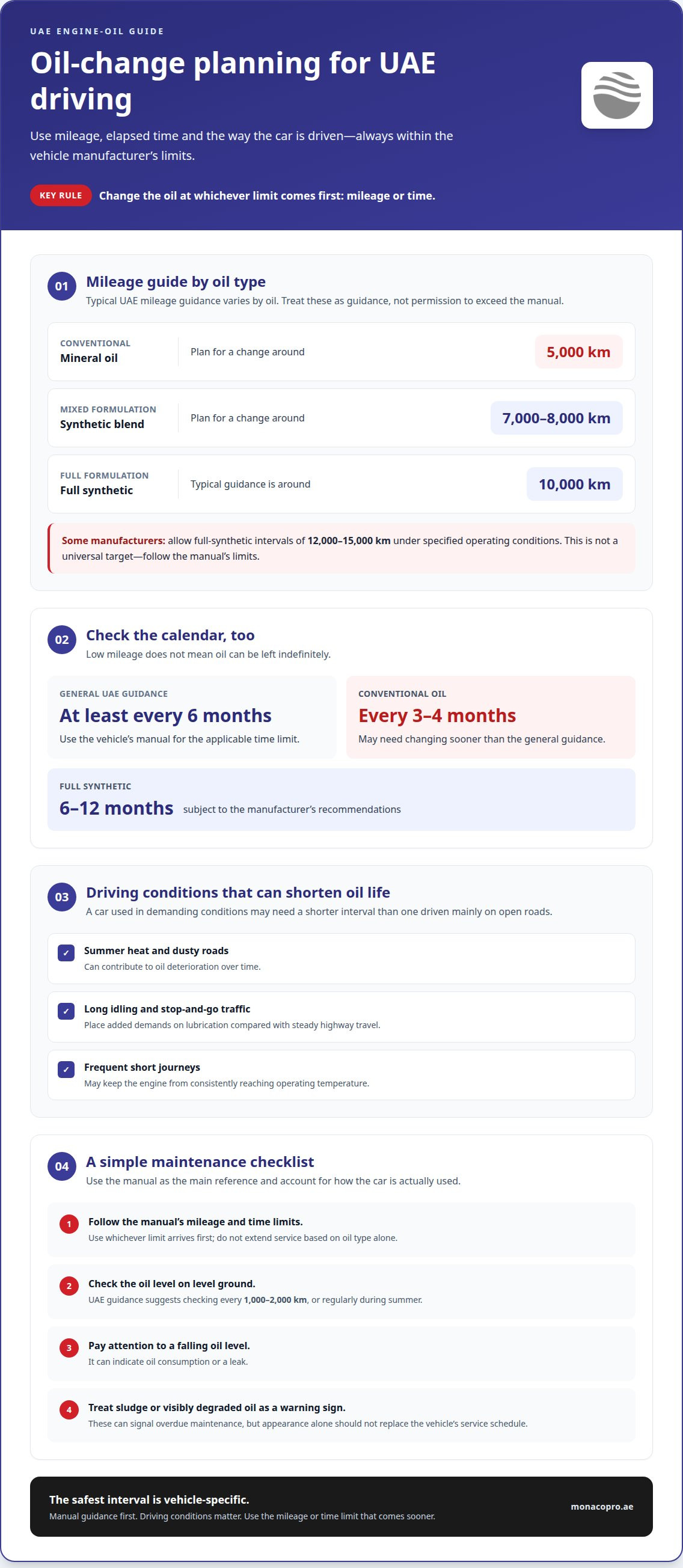
UAE heat, dust, long idling and frequent short trips can shorten engine-oil life. Use the vehicle manual as your main guide, then consider your driving conditions and oil type when planning change intervals.
Typical UAE mileage guidance varies by oil: conventional or mineral oil is changed around every 5,000 km; synthetic blend, around 7,000-8,000 km; and full synthetic, around 10,000 km. Some manufacturers allow full-synthetic intervals of 12,000-15,000 km under specified operating conditions. Those longer intervals aren’t a universal target. Follow the manual’s limits, including any time interval, rather than extending service based on oil type alone.
Time matters even when a vehicle covers few kilometres. UAE guidance commonly recommends changing engine oil at least every six months, while conventional oil may need changing every 3-4 months. Full synthetic intervals may range from 6-12 months, subject to manufacturer recommendations. Use the mileage or time limit specified for the vehicle, whichever arrives first.
Frequent short journeys and demanding city driving can keep an engine from consistently reaching operating temperature, placing different demands on oil than steady highway travel. Dust, summer heat and extended idling also contribute to oil deterioration. A vehicle used in these conditions may need a shorter interval than one driven mainly on open roads.
Oil level checks help identify a separate issue from oil-change timing. Check the dipstick on level ground; UAE guidance suggests checking every 1,000-2,000 km, or regularly during summer. A falling level can indicate oil consumption or a leak. Sludge or visibly degraded oil can also signal that maintenance is overdue, but follow the vehicle’s service schedule rather than relying on appearance alone.
Regular oil changes help maintain lubrication and limit deposits as oil ages. Record the mileage and service date to make the next interval easier to track, especially if you drive in severe conditions.
Choosing oil for warm climates
UAE summer heat can exceed 45°C, but the thickest oil isn’t automatically the right choice. Start with the vehicle manufacturer’s recommended viscosity and oil specification. Then consider the engine’s design and driving conditions. A higher viscosity grade may suit some engines in hot conditions, but using one outside the manual’s recommendations can be a poor match.
Read both numbers in a grade such as 5W-40. The number before “W” relates to cold-start performance; the second indicates viscosity at operating temperature. A 5W-40 and 10W-40 share the same second number, while 5W-40 performs like 5W-30 at low temperatures and resists thinning more at high temperatures. That does not make either grade universally suitable.
Grades such as 10W-40, 15W-40, or 15W-50 may be options for warm or extreme summer conditions, but only when the manufacturer permits them. A 20W-50 may suit some older vehicles or heavy-load use when specified in the manual. For a newer engine designed for 5W-30, switching to a thicker oil solely because of UAE heat ignores its requirements.
- Mineral or conventional oil: appropriate for engines designed for that formulation, with intervals guided by the manual.
- Synthetic oils: maintain viscosity across a wider temperature range, which can be useful during hot-weather driving.
- Full synthetic: still needs the correct grade and specification; the oil type alone doesn’t determine suitability.
Traffic also matters. Frequent idling and stop-and-go journeys expose oil to demanding operating conditions, while steady highway driving creates a different pattern. Match the grade to the engine first, then follow the recommended interval for your car and its use.
Get help choosing the right oil for your vehicle based on its requirements and UAE driving conditions.
MonacoPro Auto Garage
MonacoPro Auto Garage helps Dubai drivers turn oil guidance into practical maintenance. If you’re unsure when your next service is due, book an oil change to keep maintenance aligned with your vehicle’s schedule. The owner’s manual remains the reference for the required oil specification and interval, while your driving conditions can explain why service may be needed sooner.
If an oil warning appears or engine performance changes, a car computer diagnostic can help identify potential issues. MonacoPro Auto Garage also provides battery and tyre replacement when needed, keeping related vehicle care in one place without confusing it with oil selection.
For help with your vehicle’s maintenance needs, contact MonacoPro Auto Garage.
Make your next maintenance decision with confidence
To identify the best oil for your car in the UAE climate, include your vehicle’s maintenance record in the decision. Keep the oil grade, specification, service date and odometer reading together. This gives you a clear reference at the next service and helps avoid guesswork if your driving pattern changes, such as shifting from regular highway journeys to frequent city traffic.
Share that record when arranging maintenance so the service can be considered in context, rather than as an isolated oil choice. If you’re unsure what your vehicle needs next, MonacoPro Auto Garage provides maintenance including oil changes, battery replacement and car computer diagnostics. Bring your vehicle’s requirements and recent service details when booking.
Contact MonacoPro Auto Garage to discuss your vehicle’s maintenance needs and move forward with a clear plan.
Frequently Asked Questions
Which Engine Oil is Best for My Car?
The best oil for your car in the UAE climate is the one that meets its manufacturer’s viscosity and performance requirements. For example, a petrol car and a diesel vehicle may require different API categories, even in Dubai’s heat. Start with the vehicle manual, then match the oil container’s grade and specification to the listed requirements. Brand preference comes after compatibility.
How Does Oil Viscosity Impact My Car in the UAE?
Viscosity describes how readily engine oil flows at different temperatures, affecting how it moves through the engine during operation. In UAE traffic, a vehicle may face hot-weather driving alongside repeated idling and acceleration. The viscosity grade helps the oil suit those conditions, but it must remain within the manufacturer’s approved choices. Choosing a thicker grade based on climate alone can lead to a mismatch.
How Do I Choose the Best Oil for My Car?
Choose oil by matching three details: the viscosity grade, the required performance category, and any vehicle-maker approval in your manual. For example, a European car may list an ACEA category or an approval code such as VW 504.00. Then consider whether mineral, blend, or synthetic oil is permitted. This comparison helps narrow the options without treating one oil type as right for every vehicle.
Is synthetic oil worth it in the UAE?
Synthetic oil can be worthwhile for an engine that requires it or for driving that places sustained demands on lubrication. Its resistance to thermal breakdown can be useful in hot weather. However, a synthetic label alone doesn’t make an oil suitable. If your manual specifies mineral oil or requires a particular grade or approval, follow those requirements.
What happens if I use the wrong engine oil viscosity?
Oil that is too thin or too thick for an engine can interfere with the intended flow of lubrication. This may increase friction or make it harder for oil to circulate as designed, particularly during start-up or under load. The effect depends on the engine and how far the oil differs from its specification. If the wrong grade was added, arrange an oil change using the required specification.
What to Look For When Buying Oil?
Read the label for the exact SAE viscosity grade, API or ACEA performance category, and any manufacturer approval listed in your manual. For example, a bottle marked 5W-40 is not automatically suitable just because the grade appears commonly in warm climates. Check that every required specification matches. Also select mineral, blend, or full-synthetic oil only if that type is compatible with your vehicle.