
A TPMS sensor for Toyota Land Cruiser needs more than physical installation: its sensor ID must be synchronized with the vehicle. A professional can register the new IDs with a TPMS learning tool or clone the original IDs onto replacement sensors, then confirm that the vehicle recognizes them. After IDs are registered through the vehicle menu, recognition may take about 5 minutes of driving.
A compatible replacement sensor includes a valve stem and comes pre-programmed for the vehicle. Pre-programming prepares it for installation, but its ID still needs to be synchronized so the Land Cruiser recognizes it. The valve stem and fit kit also matter during wheel installation.
This guide explains the initialization process, what comes with the sensor, and the temperature range and measurement accuracy: -40 to 125 °C, pressure accuracy of ±10 kPa, and temperature accuracy of ±5 °C. You’ll also learn which details affect fit and why professional programming helps complete the setup.
Key Takeaways
- Factor in the separate fit kit: each wheel needs a nut, rubber seal and metal washer alongside the sensor.
- For initialization, the replacement sensors need to be set up so the vehicle can recognize them.
- Use the 315 MHz frequency and part number 42607-76020 as compatibility details when identifying a suitable sensor.
- Read the operating temperature range separately from pressure and temperature accuracy to understand what each specification tells you.
Included valve stem and pre-programming
A replacement TPMS sensor for a Toyota Land Cruiser includes a valve stem and comes pre-programmed for the vehicle. This prepares the sensor for fitment, but does not complete the vehicle-side setup. The Land Cruiser must still recognize its sensor ID. Until synchronization, the vehicle may not associate readings with the replacement sensor.
The valve stem is part of the sensor assembly at the wheel. A separate fit kit is also needed for each wheel. It consists of a nut, rubber seal and metal washer, which secure the assembly at the valve opening. These parts are distinct from the sensor and its included valve stem. Knowing what is included helps clarify what installation requires.
A listed set for 2024-2025 Toyota Land Cruiser models contains four sensors. The listing includes the Land Cruiser 1958. This set quantity describes that particular listing, not every replacement purchase. A single sensor may be needed when replacing one failed unit. A four-sensor set may suit a vehicle receiving replacements at all wheels. Fitment depends on the Land Cruiser’s model and sensor compatibility.
Pre-programming and ID synchronization are separate steps. Pre-programming prepares the sensor for the vehicle application; synchronization enables the vehicle to recognize its unique ID. A pre-programmed sensor still needs its ID registered in the vehicle. Alternatively, the original ID can be cloned onto a replacement sensor. The right method depends on the replacement setup.
During professional installation, the technician fits the sensor and required hardware, then registers or clones the sensor ID. This connects the physical replacement to vehicle recognition. A compatible sensor alone does not complete the setup, and an included valve stem does not replace the separate nut, seal and washer. These details matter whether you are replacing one sensor or a full set.
When choosing a TPMS sensor for a Toyota Land Cruiser, confirm whether the purchase is for one sensor or four. Distinguish the included valve stem from the separate fit kit. Pre-programming prepares the sensor, while ID synchronization completes the vehicle-side setup. This clarifies what the part includes and what installation still requires.
How Does a Professional Initialize a TPMS Sensor for a Toyota Land Cruiser?
Toyota Land Cruiser TPMS sensors are direct sensors: each wheel sensor measures pressure and sends its own data. An indirect system estimates pressure changes using wheel-speed information instead. For the vehicle to recognize direct sensors, their IDs must be registered or cloned onto the replacements.
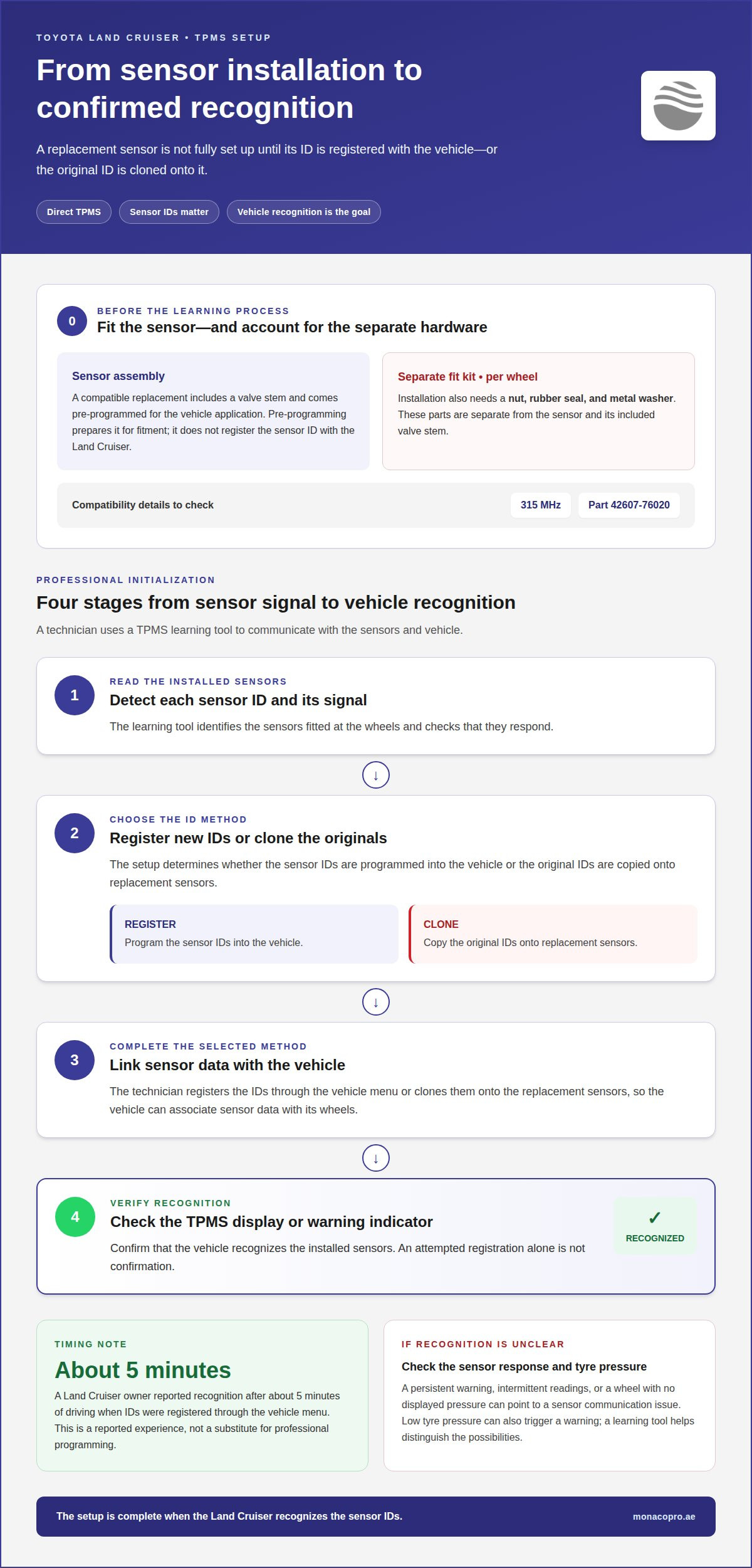
A technician uses a TPMS learning tool to communicate with the sensors and vehicle. The installation process typically includes these steps:
- Read the sensor IDs. The technician uses the learning tool to detect each installed sensor and its signal.
- Choose the registration method. The IDs can be programmed into the vehicle, or original IDs can be cloned onto replacement sensors.
- Register or clone the IDs. The technician completes the selected method so the vehicle can associate the sensor data with its wheels.
- Confirm recognition. The vehicle’s TPMS display or warning indicator helps show whether registration has succeeded.
After IDs are registered through the vehicle menu, a Land Cruiser owner reported recognition after about 5 minutes of driving. That period is a reported recognition experience, not a substitute for professional programming. A learning tool can help identify whether a sensor responds before the vehicle is driven.
Replacing a sensor alone does not determine warranty coverage; the vehicle’s warranty terms govern related coverage. UAE inspection is a separate assessment, so a functioning TPMS and clear warning status are relevant to the vehicle’s condition.
A TPMS warning light that stays on after initialization may indicate an unresolved sensor or pressure issue. Intermittent readings or a wheel with no displayed pressure can also point to a sensor communication problem. Low tyre pressure can trigger a warning too, so a technician uses a learning tool to distinguish a pressure issue from a failed sensor response.
Professional initialization is useful after sensor replacement, wheel work or a warning that persists despite correct tyre pressure. For a Toyota Land Cruiser, the important result is confirmed ID recognition across the installed sensors, not merely an attempted registration.
Temperature range and accuracy
The sensor’s temperature range is -40 to 125 °C. Its temperature measurement accuracy is ±5 °C. These figures describe different limits. The range indicates the temperatures the sensor is specified to measure. Accuracy describes the possible difference between a reported reading and the measured temperature. For example, a displayed 25 °C reading could differ by up to 5 °C. The range is not an accuracy rating.
Pressure has its own specifications. The sensor’s pressure range is 0-800 kPa, with pressure measurement accuracy of ±10 kPa. A displayed pressure reading of 250 kPa could therefore differ by up to 10 kPa. The range describes the measurement span, not the tyre’s recommended inflation pressure. Use the vehicle’s specified tyre pressure for inflation, rather than treating 800 kPa as a target.
Keep the four values distinct when comparing sensor specifications:
- Temperature range: -40 to 125 °C
- Temperature accuracy: ±5 °C
- Pressure range: 0-800 kPa
- Pressure accuracy: ±10 kPa
For a Toyota Land Cruiser, the TPMS sensor measures pressure and temperature at the wheel. The vehicle display shows the reported data, while accuracy describes the allowed measurement difference. Interpret a reading close to a warning threshold with that tolerance in mind. Sensor measurement capability does not replace the vehicle’s tyre-pressure guidance.
During professional assessment, the technician can compare sensor readings with measured tyre pressure. If the displayed value differs by more than the stated ±10 kPa accuracy, the reading deserves further assessment. Temperature readings should likewise be understood against the ±5 °C accuracy. These comparisons help distinguish a measurement concern from a tyre-pressure issue.
In Dubai, these specifications help describe the sensor’s operating limits without implying that every reading is exact. The stated temperature range spans -40 to 125 °C, while pressure measurement spans 0-800 kPa. Accuracy remains separate: ±5 °C for temperature and ±10 kPa for pressure. Reviewing all four figures gives a clearer picture of the sensor’s measurement performance.
What TPMS sensor frequency and part number does a Toyota Land Cruiser use?
The commonly identified Toyota Land Cruiser OEM TPMS sensor part number is 42607-76020. The vehicle has been reported to detect sensors transmitting at 315 MHz. These details answer different fitment questions: the part number identifies a sensor, while frequency describes its transmission. A matching frequency alone doesn’t establish that every sensor fits a particular Land Cruiser.
Compatibility also depends on the vehicle’s model year and configuration. The sensor is listed for Toyota Land Cruiser vehicles from October 2015 through December 2026. That broad application range is useful when narrowing options, but the exact vehicle still matters. A sensor listed for one model year shouldn’t be assumed suitable for every Land Cruiser in that range.
Part-number references can differ. PTR42-3507B appeared in a Toyota parts search by VIN, while a dealer advised ordering 42607-76020 instead. This example shows why a listed reference shouldn’t be treated as interchangeable automatically. The VIN helps identify the vehicle application, and the part number helps distinguish the sensor specified for it.
Use these details together when identifying a replacement:
- Frequency: 315 MHz
- Commonly identified OEM part number: 42607-76020
- Alternative reference encountered: PTR42-3507B
- Application listing: October 2015 through December 2026
A Pacific Industries/Denso sensor number discussed by Land Cruiser owners was reported to work on a 2019 vehicle. That example doesn’t establish fitment for other model years. For a TPMS sensor for Toyota Land Cruiser, a technician can use the VIN, vehicle year, frequency, and part-number reference to guide identification before programming. Matching those details reduces the chance of selecting a sensor that the vehicle can’t recognize.
Keep the part number and frequency available during professional TPMS sensor programming. Review sensor compatibility as part of the fitment process.
MonacoPro Auto Garage: TPMS sensor+ programming
MonacoPro Auto Garage provides TPMS sensor programming for drivers who need replacement sensor IDs registered or cloned. It is a practical next step after choosing a compatible sensor, particularly if the Land Cruiser’s warning remains on or the vehicle does not recognize the replacement. Programming connects the installed sensors to the vehicle’s monitoring system.
The service addresses the vehicle’s sensor setup so the Land Cruiser can recognize replacement units. If a warning persists, car computer diagnostics can help assess related vehicle-system concerns. The right service depends on the issue, whether it is sensor programming or a separate diagnostic need.
For help with TPMS sensor programming, contact MonacoPro Auto Garage.
Keep Your Land Cruiser’s TPMS Ready for the Road
A warning light or unrecognized sensor is a prompt to address the system before it becomes a distraction. Arrange professional attention if readings remain unavailable or the warning continues after tyre pressure has been corrected. Even a compatible TPMS sensor for a Toyota Land Cruiser must be recognized by the vehicle, making programming a practical step after replacement.
MonacoPro Auto Garage also provides battery replacement, oil changes and car computer diagnostics in Dubai. These services can address other maintenance or diagnostic needs during your visit, while TPMS sensor programming focuses on sensor recognition.
For support with your Land Cruiser’s sensor setup, contact MonacoPro Auto Garage. Take the next step toward clear TPMS readings and greater confidence on the road.
Frequently Asked Questions
Which TPMS sensor fits a Toyota Land Cruiser by model year and trim?
Fitment depends on the Land Cruiser’s model year and trim. Part number 42607-76020 and 315 MHz are commonly identified references, with an application listing spanning October 2015 through December 2026. A set listed for 2024-2025 models includes the Land Cruiser 1958. The vehicle’s VIN and exact configuration help narrow down the suitable sensor.
How Does a Professional Program or Relearn a TPMS Sensor on a Toyota Land Cruiser?
A professional uses a TPMS learning tool to register sensor IDs with the vehicle or clone existing IDs onto replacement sensors. The technician can then assess whether the vehicle recognizes the sensors. After registration through the vehicle menu, recognition may occur after about 5 minutes of driving. If a sensor isn’t detected, its compatibility and signal response need assessment.
Can a TPMS sensor battery be replaced, or must the whole sensor be changed?
When a TPMS sensor battery dies, the sensor is typically replaced as a complete unit. Sensor batteries commonly last 4-6 years, though service life varies. A warning or missing reading can also result from other issues, so a technician can assess sensor response before replacement. This helps distinguish a depleted battery from a sensor fault or another TPMS concern.
How do OEM and aftermarket TPMS sensors compare for the Toyota Land Cruiser?
The commonly identified OEM part number is 42607-76020. A replacement sensor must match the Land Cruiser’s fitment and have its ID synchronized with the vehicle; verify compatibility for the specific model year.