
A polished exterior and quiet engine aren’t enough to judge a used car. A peace of mind used car check looks beyond what’s visible, assessing the cabin, mechanical systems, diagnostic warnings and road performance. In Dubai, inspection findings can help you understand the vehicle’s condition before deciding whether to buy.
This guide explains what a pre-purchase inspection can reveal, including air-conditioning performance, signs of past damage, diagnostic warnings, tyre and brake condition, and unusual noises on a test drive. You’ll also learn how to use the findings to choose your next step with greater confidence.
Key Takeaways
- Use a structured pre-purchase inspection to uncover issues that a visual check alone may miss, and use the findings to guide your buying decision.
- Test the air conditioning, airbags, windows and infotainment system, while looking for signs of moisture or interior damage.
- Compare the car’s mileage with its age and review its service records, VIN history, ownership details and any outstanding fines.
- Pay attention to engine, transmission, brake, suspension and tyre condition, then assess how the car performs during a test drive.
- A diagnostic scan can reveal electronic faults, while unusual noises or warning signs on the road can point to issues that need closer attention.
Why is a pre-purchase car inspection important?
A pre-purchase inspection can reveal faults that a short viewing or drive may miss. Its findings give you a clearer basis for proceeding, negotiating, requesting repairs or walking away. A peace of mind used car check should follow a checklist and document observations, not rely on a quick visual scan.
Inspection time depends on the vehicle’s make, model, condition, and the depth of testing. Published Dubai estimates range from up to 90 minutes to 1.5 to 2.5 hours. When booking, share the vehicle details, agree on a time with the seller, and confirm that the car can be accessed for checks and a road test. Ask for a written report that records findings, not just a verbal summary.
For a mobile pre-purchase inspection in Sharjah or another UAE emirate, the inspection takes place where the vehicle is available, if the service operates there. Arrange access with the seller and give the inspector the exact location. A fixed workshop inspection follows the same purpose, but requires the vehicle to be brought to the inspection site. In either case, the checklist should cover the exterior, cabin, mechanical condition, tyres, and brakes.
In the UAE, an RTA inspection is still required for vehicle registration. A pre-purchase check does not replace that inspection; it helps assess the vehicle’s condition before you commit to buying. Confirm that the registration is current and required inspections are complete. The seller’s documents and vehicle details should match before ownership transfer.
Use the report as a practical decision tool. Ask the inspector to distinguish safety concerns, repairs needing prompt attention and routine maintenance. A risk rating is useful when the report explains each category and identifies supporting evidence, such as uneven tyre wear or a brake concern. There is no universal rating scale, so read the observations behind each label.
- Use documented faults to negotiate a lower purchase price or request repairs before finalising the sale.
- Estimate repair needs from the written findings, then compare the total ownership cost with the vehicle’s condition.
- Walk away if serious problems, missing records, or inconsistent vehicle details make the purchase unsuitable.
A report cannot make the decision for you, but it can replace guesswork with specific findings. Keep it with the vehicle’s service history and registration details, then decide whether the results support your purchase.
Checking interior features and air conditioning
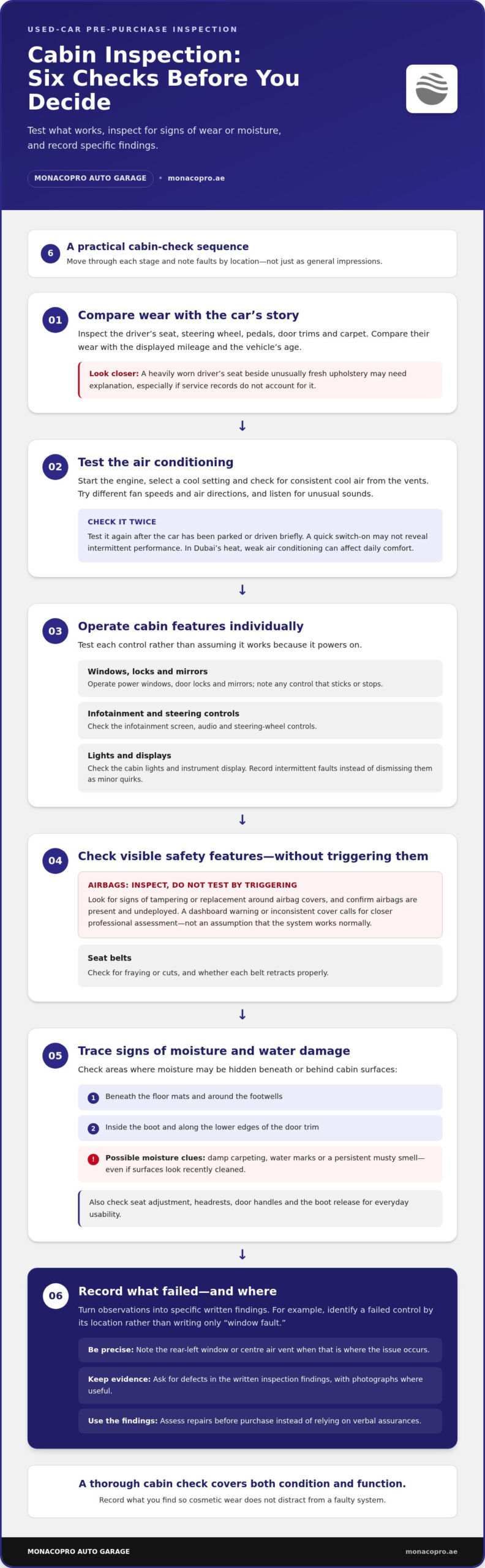
During a car inspection, assess the cabin as carefully as the exterior. Start with the driver’s seat, steering wheel, pedals, door trims, and carpet. Compare wear across these areas with the displayed mileage and the vehicle’s age. A heavily worn driver’s seat beside unusually fresh upholstery may deserve closer examination, especially if the seller’s service records offer no explanation.
Test the air conditioning before buying. Start the engine, select a cool setting and check whether the vents produce consistent cool air. Try different fan speeds and air directions, and listen for unusual sounds. Check it again after the car has been parked or driven briefly, since a quick switch-on may not reveal intermittent performance. In Dubai’s heat, weak air conditioning can affect daily comfort.
Operate each electronic feature individually. Test the power windows, door locks, mirrors, infotainment screen, audio and steering-wheel controls. Check the cabin lights and instrument display, too. Record intermittent faults, such as a window that stops midway, as specific findings rather than dismissing them as minor quirks.
Check the airbags and visible safety systems without attempting to trigger them. Look for signs of tampering or replacement around airbag covers, and confirm that airbags are present and undeployed. Inspect seat belts for fraying, cuts or difficulty retracting. A dashboard warning or inconsistent airbag cover calls for closer professional assessment, not an assumption that the safety system works normally.
Look for moisture and water damage inside the cabin. Check beneath the floor mats, around the footwells, inside the boot and along the lower edges of the door trim. Damp carpeting, water marks or a persistent musty smell can indicate moisture hidden by surface cleaning. Also check seat adjustment, headrests, door handles and the boot release, since these affect everyday use.
- Record each failed control by location, such as the rear-left window or centre air vent.
- Ask for defects to appear in the written inspection findings, with photographs where useful.
- Use the results to assess repairs before purchase, rather than relying on a seller’s verbal assurance.
A thorough inspection checks cabin condition alongside function, so cosmetic wear doesn’t distract from a faulty system. If you’re arranging a pre-purchase inspection, include air conditioning, cabin electronics, and visible airbag condition in the assessment scope.
Checking vehicle condition, fines and accident history in Dubai and the UAE
Assess the vehicle’s visible condition alongside its records before deciding whether the asking price reflects its history. In Dubai, combining a physical inspection with VIN-based research can reveal discrepancies that matter to your purchase decision.
Structural, Chassis, and Underbody Checks
Walk around the exterior in daylight and compare paint colour across adjoining panels. Look for dents, scratches, rust, uneven panel gaps and inconsistent paint. Check for uneven tyre wear, which can point to alignment or suspension concerns. These clues don’t prove accident damage, but they indicate where a closer mechanical assessment may be needed.
Ask for the chassis and underbody to be examined for visible damage, corrosion, repairs or components that appear out of place. Structural repairs may not show in exterior photographs, so a professional inspection should consider the vehicle from underneath as well as above. Record concerns and ask how they could affect safety, operation or future repair needs.
Look for repaired panels or replacement parts that don’t match the surrounding areas. A clean finish alone cannot establish that the underlying structure is sound. Record specific observations, such as a mismatched door panel or damaged underbody area, and compare them with the seller’s account and inspection report.
Flood, Ownership, and Service Records
Check for possible water exposure inside the vehicle and boot. Damp carpet, water marks or a persistent musty smell deserve attention, particularly in concealed areas beneath floor mats. Ask the inspector to document evidence rather than relying only on the seller’s description. Flood-related moisture can affect cabin materials and electrical components.
Use the vehicle identification number, or chassis number, to obtain a history report where records are available. In the UAE, vehicle history may be accessible through official channels depending on registration history. Buyers can also search the Emirates Vehicle Gate using the VIN or chassis number. Review accident entries, previous owners, mileage, service records, title issues and liens, then compare the report with the vehicle’s condition and the seller’s account.
Request service and maintenance records, and look for regular servicing and timely maintenance. Compare recorded mileage across documents with the odometer and vehicle age. Confirm that the seller is the legitimate owner and that the original registration card matches the vehicle. Check outstanding fines through relevant UAE traffic authority channels, and verify that pending loans or lawsuits won’t interfere with ownership transfer.
Raise any mismatch with the seller before agreeing to buy. For example, an accident entry alongside fresh paintwork may justify further structural assessment. Consistent records and vehicle details support an informed decision; unresolved discrepancies are a reason to pause or walk away.
Engine, transmission, brakes, suspension, and electronics checks
A used car inspection should cover the engine, transmission, brakes, suspension, steering, tyres, electronics and visible body damage. It should identify issues such as fluid leaks, worn components, warning lights, unusual noises and damage that could affect safe operation.
Check the engine before and after it reaches operating temperature. Look for fluid leaks beneath the vehicle, unusual exhaust smoke, rough idling or dashboard warning lights. Note whether the engine starts smoothly and responds consistently when you press the accelerator. Record and assess a rough idle or repeated hesitation rather than guessing at the cause.
Assess the transmission while the car is operating, not only when it’s parked. Check whether gear changes feel smooth and listen for clunks, whining or grinding. In an automatic, note delayed engagement when selecting drive or reverse. In a manual, observe clutch response and whether gears engage cleanly. These symptoms can indicate wear, but a technician should establish their cause before purchase.
Inspect the brakes for wear and performance. During a controlled drive, note whether the pedal feels firm and the vehicle slows evenly. Pulling to one side, vibration or scraping sounds can indicate problems that need further assessment. The brake discs, pads and related components should also be examined directly, since road feel alone cannot reveal their full condition.
Check the suspension and steering for fluid leaks, damaged components and uneven tyre wear. On a short test drive, listen for knocks over bumps and note whether the car feels unstable or pulls away from a straight path. A loose-feeling wheel or uneven steering response deserves attention. These observations can help distinguish a tyre issue from a concern involving steering or suspension components.
Inspect all four tyres for cuts, bulges, cracks and uneven wear. Compare wear across the inner and outer edges, and check that the tyres are appropriate for the vehicle. Tyre condition affects grip and handling, while irregular wear may point to alignment or suspension problems. Record each tyre’s condition separately rather than describing all four as “worn.”
Check the dashboard electronics and operate the vehicle’s main controls. Warning lights that remain on after startup, intermittent displays or controls that fail should be recorded in the inspection findings. A computerised diagnostic scan can identify stored fault codes, but they need to be interpreted alongside the vehicle’s symptoms and physical condition.
Follow a consistent sequence for the purchase inspection: stationary checks, component inspection, then a road test. A written report should link each concern to its likely impact, helping you distinguish routine maintenance from repairs that could change your decision.
Computerised diagnostic scans and test drives
A computerised scan and a road test reveal different information. A scan reads fault codes from a modern vehicle’s electronic systems, while a test drive shows how its components behave under real driving conditions. Together, they can reveal details that a visual inspection or seller’s description may miss.
During a diagnostic scan, a technician connects equipment to the vehicle’s communication system and checks accessible electronic modules. Results may identify stored fault codes linked to systems such as the engine, transmission or safety electronics. A code points to a fault area, not necessarily a failed part. The technician should interpret it alongside symptoms, inspection findings and service history.
Ask for scan findings to be recorded clearly, including the affected system and recommended follow-up. For example, consider an engine-related code alongside how the engine starts, idles and accelerates. A dashboard warning, stored code and rough-running engine together provide stronger evidence than any one clue. This helps distinguish a repair needing further diagnosis from a minor electronic issue.
A test drive should cover ordinary driving situations where it’s safe and permitted. Listen for unusual engine or mechanical noises as the vehicle starts, accelerates, changes gear and slows. Notice delayed response, vibration, pulling or a warning light that appears during the drive. These observations add context to scan results and may reveal a fault that isn’t obvious while the car is stationary.
Keep the route consistent and note how the vehicle responds at different speeds and during turns. A clunk over a road bump, for example, may mean a component needs closer inspection, while hesitation during acceleration may warrant engine or transmission checks. Don’t let a brief, smooth drive outweigh a fault code or documented repair concern. Record when each symptom appears, such as during braking or gear changes.
- Compare diagnostic codes with dashboard warnings, service records, and physical symptoms.
- Ask the seller for repair invoices when records mention earlier electronic or mechanical faults.
- Have the report distinguish observed symptoms from repairs that need further diagnosis.
A scan does not replace a road test, and a road test cannot read stored electronic faults. Use both methods to build a more complete picture before deciding on repairs or purchase. For electronic fault insights before buying, book a car computer diagnostic.
MonacoPro Auto Garage: Battery Replacement
If an inspection identifies a battery that needs replacement, MonacoPro Auto Garage provides battery replacement. A weak battery may cause slow starting or unreliable electrical operation, so addressing this finding can help prepare the vehicle for regular use. The garage also offers oil changes, computer diagnostics and tyre replacement when an inspection identifies these specific maintenance needs.
Use the inspection findings to decide what needs attention first. A battery concern can be addressed with battery replacement, while an electronic warning may call for a diagnostic scan. These services address identified issues; they don’t replace the inspection or your purchase decision.
For service information or to arrange a next step, contact MonacoPro Auto Garage or visit monacopro.ae.
Make your next move with confidence
A peace of mind used car check is most useful when its findings point to a clear next step. Decide which issues need attention before purchase, which repairs can be planned and whether the car still suits your needs. Keep the report with the vehicle documents so you can refer to it after the sale.
When a report identifies work that needs attention, MonacoPro Auto Garage offers Battery Replacement, Oil Change and Car Computer Diagnostic services. These can address specific maintenance or diagnostic needs identified during your assessment.
Contact MonacoPro Auto Garage to book an inspection and take your next step with a clearer view of the vehicle. A considered decision today can help you approach ownership with greater confidence.
Frequently Asked Questions
How much does a used car inspection cost in Dubai?
Inspection costs in Dubai vary by provider and assessment level. A basic check and a more comprehensive assessment may cover different systems, while the vehicle’s make, model and condition affect the work involved. Compare the scope, including whether it covers a road test, diagnostic scan and written findings. This helps you assess what the service covers rather than comparing prices alone.
How to avoid overpaying for a used car in the UAE?
Compare the asking price with similar UAE listings for the same make, model, age and condition. Then account for maintenance, insurance, registration fees and repairs identified during the inspection. A competitively priced car may cost more overall if it needs immediate work. Use the report to support a negotiation or decide that the vehicle no longer fits your budget.
What are common hidden issues found in used cars in the Emirates?
Common concerns include mechanical faults, previous accident damage, water exposure, electronic problems and wear that doesn’t match the displayed mileage. A polished vehicle may still have problems beneath the surface or in concealed areas. Review the findings alongside service records and vehicle history. Unresolved mechanical faults can lead to costly repairs after purchase, so factor them into your decision.
What should I check before buying a used car in Dubai?
Before paying, match the original registration card to the vehicle and confirm that the seller is its legitimate owner. Review the VIN-based history, service documents and mileage records, then check outstanding fines through relevant UAE traffic authority channels. Establish whether pending loans or lawsuits could interfere with ownership transfer. Keep copies of the records you rely on, so you can compare vehicle details with the seller’s claims.
What should I look for in a used car inspection in the UAE?
Look for a defined checklist, clear observations and written findings that distinguish urgent concerns from routine maintenance. The report should describe the evidence behind each issue, such as a warning light, fluid leak or uneven tyre wear. Check that it covers the cabin, body, mechanical components, electronics and road behaviour. Specific findings help you assess repairs and decide what to discuss with the seller.
What does a peace of mind used car check include in the UAE?
A peace of mind used car check can examine the cabin, air conditioning, exterior, mechanical condition and electronic systems, alongside available history records. A diagnostic scan and road test can reveal issues that may not appear during a stationary viewing. Ask for clear written observations of repair concerns. Use the results with the seller’s documents to make a considered purchase decision.
How much does a used car inspection cost in the UAE?
Across the UAE, inspection costs depend on the provider and assessment level. The scope matters: examining more systems or including diagnostic testing and road performance involves a different process from a limited visual check. For a fair comparison, review inspection coverage and report format alongside the quoted cost. Include likely repairs in your ownership budget before agreeing to buy.
Where can I get an independent used car inspection in Dubai, Abu Dhabi, or Sharjah?
For a used car in Dubai, MonacoPro Auto Garage offers a pre-purchase inspection at its Umm Ramool workshop. Arrange the assessment before finalising the purchase, so the findings can inform your decision while the seller still has the vehicle. The inspection can identify concerns for follow-up and give you a clearer basis for discussing the car’s condition and maintenance needs.