
You’re navigating the mid-day heat of Umm Ramool when a sudden amber glow on your dashboard disrupts your focus. It’s the tire pressure warning, and even after you’ve topped up the air, that persistent icon refuses to disappear. It’s a common frustration for Dubai drivers, especially as 2026 regulations now make TPMS verification a mandatory part of vehicle inspections. You want to ensure your car is safe without the constant annoyance of a false alarm. This guide shows you exactly how to reset tpms light systems across various car brands while ensuring your tires remain compliant with RTA standards.
We’ll move beyond simple button presses to explore why Dubai’s extreme road temperatures often cause sensor desynchronization. You’ll learn the specific steps for manual resets, the difference between a simple air pressure issue and a failing sensor, and when professional programming is the only way to clear the fault. By the end of this article, you’ll have a clear path to a dark dashboard and the peace of mind that your vehicle is fully prepared for your next journey.
Key Takeaways
- Understand the 2026 RTA inspection requirements and why a functional TPMS is now essential for passing your vehicle’s annual registration in Dubai.
- Learn the exact steps to reset tpms light warnings using manual inflation techniques and the correct PSI data found on your vehicle’s door jamb.
- Discover why a persistent warning often stems from a forgotten sensor in your spare tire or a depleted battery in sensor models approaching the end of their lifespan.
- Distinguish between a simple system reset and the need for professional sensor programming using specialized diagnostic tools when DIY methods fail.
- See how maintaining your tire pressure monitoring system contributes to better fuel efficiency and prevents heat-related tire failure on Dubai roads.
Understanding the Tyre Pressure Monitoring System (TPMS) Alert
The Tyre Pressure Monitoring System (TPMS) is a sophisticated electronic safety feature designed to monitor the air pressure inside your vehicle’s pneumatic tyres. It acts as a digital guardian, constantly relaying data to your dashboard to ensure your tyres operate within a safe range. The primary goal of this system is to alert you when a tyre becomes significantly under-inflated, helping you avoid potential accidents caused by reduced traction or a sudden blowout. By providing real-time feedback, the system allows you to address pressure drops before they compromise your safety.
In Dubai, the environment plays a massive role in how these sensors behave. When temperatures climb above 45°C, the air inside your tyres expands, which leads to fluctuating readings. This “Dubai Heat Factor” often causes drivers to struggle when they try to reset tpms light indicators, as the system may trigger a warning simply due to intense thermal expansion rather than a physical puncture. With 2026 regulations now requiring functional TPMS for vehicle inspections, understanding these alerts is essential for staying road-legal and passing your annual registration.
Neglecting a persistent warning light can have serious repercussions for your vehicle’s performance. Under-inflated tyres increase rolling resistance, which leads to poor fuel economy and uneven tread wear that necessitates premature replacement. More importantly, mechanical failures contribute to 22% of road accidents in the UAE, making it vital to address any dashboard warnings immediately. Maintaining the correct pressure ensures your car handles predictably and stops efficiently during emergency braking maneuvers on busy highways like Sheikh Zayed Road.
Solid Light vs. Flashing Light: What Do They Mean?
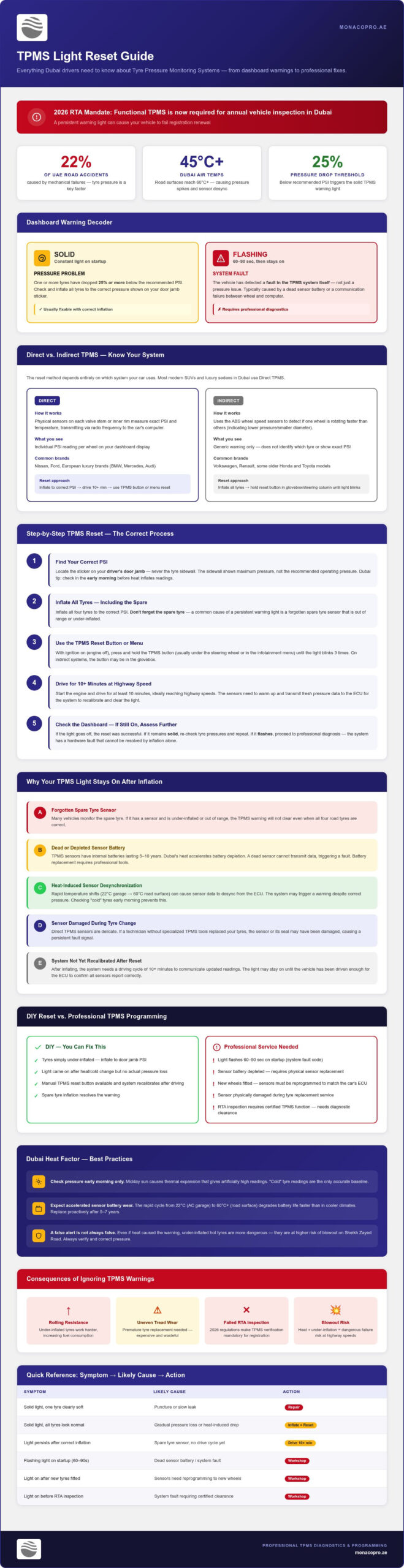
Distinguishing between the types of alerts helps you determine the appropriate course of action. A solid light usually means at least one tyre has dropped 25% or more below the recommended pressure level. If the icon flashes for approximately 60 to 90 seconds after you start the engine before staying lit, the vehicle has detected a fault in the system itself. A flashing light is a system error rather than a pressure error. This typically indicates a dead sensor battery or a communication failure between the wheel and the car’s computer that requires professional diagnostics.
The Impact of Dubai’s Climate on TPMS Sensors
The extreme temperature shifts in the UAE place immense stress on sensitive electronics. Your sensors endure rapid cycles, moving from the 22°C environment of an AC-cooled garage to road surfaces that can hit 60°C or higher during the afternoon. This intense heat can degrade sensor battery life much faster than manufacturers initially intended. To ensure accuracy and avoid a false reset tpms light trigger, we recommend checking your pressure in the early morning hours. Testing while the tyres are “cold” provides the most reliable data before the midday sun causes pressure to spike unnaturally.
Direct vs. Indirect TPMS: How Your Car Measures Pressure
Identifying whether your vehicle uses a direct or indirect system is the essential first step toward a successful outcome. Vehicle manufacturers in the UAE employ two distinct technologies to monitor tyre health, and the method you use to reset tpms light indicators depends entirely on which one is under your hood. Most modern SUVs and luxury sedans found in Dubai, including models from Nissan, Ford, and various European manufacturers, utilize the Direct system because it offers superior precision in high-temperature environments.
The distinction is vital for any driver because the reset procedure for a Nissan Patrol is fundamentally different from that of a Volkswagen or a Renault. Direct systems provide specific PSI readings for each individual wheel, while indirect systems simply notify you that a pressure loss has occurred somewhere on the vehicle. If you’re unsure which technology your car utilizes, consulting your owner’s manual or a qualified technician is the best way to avoid a failed calibration attempt.
The Mechanics of Direct TPMS Sensors
Direct TPMS relies on dedicated hardware sensors mounted on the valve stem or the inner rim of each wheel. These components measure exact internal pressure and temperature, transmitting the data via radio frequency to the vehicle’s central computer. While highly accurate, these sensors are delicate instruments. They are particularly susceptible to physical damage or seal failure during a tyre replacement Dubai service if the technician isn’t using specialized equipment. If a sensor is bumped or the battery fails, the dashboard will trigger a persistent warning that air alone cannot fix.
How Indirect TPMS Uses Your ABS
Indirect systems don’t actually measure air pressure inside the tyre. Instead, they leverage the Anti-lock Braking System (ABS) wheel speed sensors to calculate the revolution speed of each wheel. An under-inflated tyre has a slightly smaller diameter, which causes it to spin faster than a fully inflated one. The computer detects this mathematical discrepancy and triggers the alert. Because this system relies on relative speed rather than direct measurement, it’s crucial to perform a manual reset every time you add air or rotate your tyres to establish a new baseline.
This calculation method means the system can be sensitive to other mechanical factors. For instance, if your vehicle requires car vibration repair due to warped rotors or worn bearings, the inconsistent wheel speeds might trick the TPMS into thinking a tyre is low. If your dashboard remains illuminated despite having perfect pressure, it’s often a sign that the ABS data is compromised or the sensors need software recalibration. Our team at MonacoPro Auto Garage provides expert car computer diagnostics to pinpoint exactly why your system is misbehaving, ensuring your safety systems are functioning as intended.
Common Reasons Your TPMS Light Stays On After Inflation
It’s incredibly frustrating when you’ve filled every tyre to the correct PSI, yet the dashboard warning persists. This often happens because the system is detecting a variable outside the four main wheels. For many Dubai SUV owners, the ‘forgotten’ spare is the primary culprit. A sensor inside the spare wheel monitors its pressure just like the others; if it drops below the threshold, you won’t be able to reset tpms light indicators until that fifth tyre is serviced. Always check the trunk or the rear mount before assuming the system is broken.
Sensor battery life is another major factor we’re seeing in 2026. Most internal batteries are designed to last between five and ten years. As vehicles from the 2016 to 2021 era age, we’re seeing a wave of sensor failures where the battery simply can’t maintain a consistent signal. Additionally, physical damage from Dubai’s occasional deep potholes or corrosion from salt air near coastal areas can compromise the sensor’s integrity. These environmental factors lead to permanent fault lights that no amount of air can extinguish.
Environmental interference also plays a subtle but significant role. In high-frequency areas of Dubai, such as near major telecommunications hubs or dense infrastructure, radio frequency signals can be momentarily disrupted. This causes the car’s computer to lose contact with the wheel sensors, triggering a warning. While these alerts usually clear once you move away from the interference, persistent exposure can sometimes require a manual system reboot.
Sensor Desynchronization After Maintenance
When you rotate your tyres to prevent uneven wear, the car’s computer still expects each specific sensor ID to be in its original position. If the system isn’t ‘re-learned’ after the move, it may trigger a fault because the data doesn’t match the mapped location. This is particularly relevant if you’ve noticed your car pulling to one side Dubai, as wheel alignment issues and TPMS errors often go hand-in-hand during routine maintenance cycles. Visiting a trusted wheel alignment garage that uses modern 3D alignment technology can help ensure your wheels are correctly positioned and your sensors are accurately re-mapped after any rotation or adjustment. A professional diagnostic tool is usually required to re-map these positions correctly.
The Impact of Aftermarket Wheel Accessories
Aesthetic upgrades can sometimes interfere with safety systems. Heavy metal valve caps or certain high-metallic wheel finishes can shield the radio frequency signal, preventing the sensor from communicating with the car. Similarly, choosing non-OEM sensors during a DIY wheel upgrade often leads to compatibility issues. These generic sensors may not use the same protocol as your vehicle’s computer, making a successful reset tpms light procedure impossible without professional programming equipment. Always ensure that any aftermarket parts are specifically rated for your vehicle’s make and model.
Step-by-Step Guide to Resetting Your TPMS Light
Once you’ve addressed potential culprits like a low spare tyre or environmental interference, it’s time to physically recalibrate the system. Successfully attempting to reset tpms light indicators requires a precise sequence to ensure the car’s computer accepts the new data. Before you begin the electronic process, you must ensure your tyre’s physical state is perfect. Follow these steps to clear the warning effectively:
- Step 1: Verify pressure with a high-quality manual gauge while the tyres are cold. Friction from driving increases internal heat, which can lead to false readings.
- Step 2: Inflate all tyres to the exact PSI listed on the driver-side door jamb. Ensure you include the spare wheel, as a neglected fifth tyre is a common cause of persistent alerts.
- Step 3: Select the reset method that matches your vehicle’s specific year and manufacturer protocol.
- Step 4: Confirm the dashboard has cleared after a brief test drive to allow the sensors to transmit updated telemetry.
Method 1: The Driving Technique (Auto-Reset)
Many 2026 models feature an automatic recalibration mode that triggers during a standard highway run. To start this, drive your vehicle at a steady speed, typically above 80 km/h, for at least 10 minutes. Most modern vehicles require a consistent speed to allow sensors to sync with the ECU. Heavy stop-and-go Dubai traffic on congested routes like Al Khail Road often prevents the system from completing this cycle. It’s best to perform this on a clear stretch of the E11 where you can maintain a constant pace without frequent braking.
Method 2: Using the Dashboard Menu or Reset Button
If your car doesn’t support auto-resetting, you’ll need to use the onboard interface. Older models often have a physical reset button tucked under the steering column or inside the glovebox. For newer vehicles, you’ll likely navigate the “Service” or “Vehicle Settings” menu on your infotainment screen. The standard procedure follows the “Press and Hold” rule; you must hold the button or confirm the reset in the menu until the TPMS icon blinks three times. This indicates the system has successfully entered its learning phase.
Method 3: The Battery Disconnect (For Advanced Users)
When the software appears to be stuck in a fault loop, a hard reboot can sometimes clear the error. You can achieve this by safely disconnecting the positive battery cable for approximately 15 minutes. While this forces the computer to refresh its sensor map, be aware that you’ll likely lose your radio presets, clock settings, and seat memory. If your dashboard remains illuminated after these attempts, it’s time for a professional car computer diagnostic at MonacoPro Auto Garage in Umm Ramool to identify deeper electrical or sensor issues.
When to Seek Professional TPMS Programming in Dubai
If your dashboard continues to signal an error even after you’ve followed every manual step to reset tpms light indicators, you’re likely facing a hardware or software conflict that DIY methods cannot resolve. There’s a fundamental difference between a simple system reset and professional TPMS programming. While a reset tells the car to “ignore” the current alert and look again, programming involves using specialized OBD-II diagnostic tools to write new sensor IDs directly into the vehicle’s Engine Control Unit (ECU). Luxury European and American brands are particularly sensitive; they often require specific ID cloning so the car recognizes a new sensor as a legitimate component rather than an error.
At MonacoPro Auto Garage in Umm Ramool, we ensure your safety through precise calibration that goes beyond surface-level fixes. Our technicians use high-end diagnostic equipment to verify that every sensor is communicating correctly with the central computer. This prevents false alarms and ensures the system is ready for the mandatory 2026 RTA inspection requirements. When the light returns immediately after a reset, it’s a clear signal that the computer has detected a persistent fault that requires professional intervention.
Advanced Diagnostics at MonacoPro Auto Garage
Our facility utilizes professional-grade scanners that allow us to check sensor battery levels and signal strength without ever removing the tyre from the rim. This non-invasive approach lets us identify exactly which sensor is failing, saving you time and preventing unnecessary labor. We often integrate these checks into a comprehensive car repair checkup, ensuring that your safety systems are as robust as your engine performance. By diagnosing the root cause, whether it’s a weak battery or a broken internal antenna, we provide a permanent solution rather than a temporary fix.
The Importance of TPMS Sensor Programming
Properly configuring the system ensures the car’s computer recognizes the unique digital signature of each individual sensor. This level of detail is critical after installing new tyres or replacing a damaged valve stem. Without professional tpms sensor programming, your vehicle may display a persistent “Check TPMS” warning that generic DIY tools simply cannot clear. We bridge the gap between hardware installation and software synchronization, providing the same level of technical expertise you’d expect from a dealership but with the personalized service of an independent specialist. This precise mapping is the only way to guarantee your dashboard remains clear and your tyres stay accurately monitored under the intense Dubai sun.
Secure Your Safety with Professional TPMS Care
Maintaining accurate tire pressure is about more than just clearing an annoying dashboard icon; it’s a critical component of road safety and fuel efficiency in Dubai’s challenging climate. While many drivers can successfully reset tpms light indicators using the manual steps provided, persistent warnings often point to underlying sensor malfunctions or battery failures that require expert attention. Ensuring your vehicle meets the 2026 RTA inspection standards starts with a fully functional monitoring system that you can trust.
When DIY methods fall short, professional intervention provides the accuracy needed for modern luxury and economy vehicles. MonacoPro Auto Garage offers specialized TPMS programming and comprehensive wheel care from our conveniently located facility in Umm Ramool. Our workshop handles everything from tire replacement and wheel alignment to advanced computer diagnostics. Don’t let a faulty sensor compromise your peace of mind on the road.
Book Your TPMS Diagnostic at MonacoPro Auto Garage today to ensure your vehicle is performing at its best. Safe driving begins with the right data at your fingertips.
Frequently Asked Questions
Can I drive with the TPMS light on?
You can drive for a short distance to reach a service station, but you shouldn’t ignore the warning. A solid light indicates that at least one tyre is significantly under-inflated, which increases the risk of a blowout and reduces braking efficiency. Since mechanical failures contribute to 22% of road accidents in the UAE, it’s vital to pull over safely and inspect your tyres as soon as the icon appears on your dashboard.
How much air should I put in my tyres for Dubai roads?
You must follow the specific PSI levels listed on the sticker inside your driver-side door jamb or in the owner’s manual. Many drivers mistakenly believe they should lower pressure to account for Dubai’s 45°C+ summer heat, but this actually causes the tyre sidewalls to flex excessively and overheat. Stick to the manufacturer’s recommended cold pressure settings for the best balance of safety, fuel economy, and tyre longevity on local roads.
Why does my TPMS light turn on only in the morning?
This occurs because air density changes with temperature. Overnight, as the ambient temperature drops, the air inside your tyres contracts, causing the pressure to fall just below the sensor’s trigger threshold. Once you begin driving and the tyres heat up from road friction and the rising Dubai sun, the air expands and the light may turn off. This is a clear sign that your base pressure is slightly too low and needs topping up.
Will the TPMS light reset itself after I put air in?
Whether the system clears automatically depends on your vehicle’s specific technology. Many modern SUVs will auto-detect the corrected pressure after you drive at a steady speed for about 10 minutes. However, some models require you to manually reset tpms light settings through the dashboard menu or by holding a physical button. If the light remains after inflation and a short drive, your car likely needs a manual recalibration or a professional diagnostic check.
Does a TPMS light fail my RTA vehicle inspection in Dubai?
Yes, as of June 2026, a functioning Tyre Pressure Monitoring System is a mandatory requirement for passing the RTA vehicle inspection in Dubai. If the warning light is illuminated or flashing during the test, your vehicle will receive a failure notice. The inspectors verify that the system is active and communicating correctly to ensure the car meets the latest UAE safety standards before your registration can be renewed for another year.
Can I replace just one TPMS sensor or do I need all four?
You can replace a single failing sensor if the others are functioning correctly. However, since sensor batteries typically have a lifespan of 5 to 10 years, a failure in one wheel often suggests the others are nearing the end of their utility. If your vehicle is several years old, replacing all four sensors simultaneously can save you multiple trips to the garage and ensure consistent monitoring across all corners of your car during your daily commute.
What happens if I ignore a flashing TPMS light?
Ignoring a flashing light is dangerous because it indicates a system malfunction rather than just low pressure. While the light flashes, the TPMS is unable to monitor your tyres, meaning you won’t be alerted if a genuine puncture occurs. This can lead to unexpected tyre failure at highway speeds. Driving with a known fault can also potentially void your insurance coverage in the event of an accident, as the vehicle was not maintained in a roadworthy condition.
Is there a difference between winter and summer tyre pressure in the UAE?
You don’t need to change your target PSI between seasons, but you must check the pressure more frequently during seasonal transitions. In the peak of summer, road surface temperatures can hit 60°C, causing pressure to spike quickly during a drive. In the cooler winter months, you might find the pressure drops more often. Consistently maintaining the manufacturer’s recommended PSI ensures your tyres stay within the safe operating range regardless of the external environment in Umm Ramool.