
New tyres don’t automatically mean your car needs a wheel alignment. So, is wheel alignment necessary after new tyres? It depends on the vehicle’s condition and whether an inspection shows the wheels are out of alignment. To protect your new tyres from uneven wear, look at how the previous set wore and how the car handles, rather than approving an adjustment without a clear reason.
This guide explains when to check alignment after a tyre change, which signs may warrant an inspection, and what the results can tell you. It also explains how alignment differs from balancing: alignment concerns wheel angles, while balancing addresses weight distribution to help prevent vibration.
Dubai driving can include speed bumps and potholes, so it’s sensible to pay attention to changes in steering and tyre wear. Still, the next step should depend on the vehicle’s condition, not assumptions about local roads. MonacoPro Auto Garage provides tyre replacement, wheel alignment and balancing in Umm Ramool, Dubai. Each service has a distinct purpose.
Key Takeaways
- “Is wheel alignment necessary after new tyres?” Use tyre wear, steering behaviour and recent road impacts to decide whether an inspection is warranted.
- Toe, camber and caster describe different wheel and steering angles. Which angles a technician can adjust depends on your vehicle.
- Alignment and balancing address different issues. Match the service to the concern you’ve noticed, while remembering that symptoms alone don’t confirm a fault.
- Before approving adjustments, ask what the inspection found and how the recommendation relates to your vehicle maker’s specifications.
- Tyre replacement, alignment, balancing and TPMS sensor programming are separate services, each with a different purpose.
Is wheel alignment necessary after new tyres? The clear answer
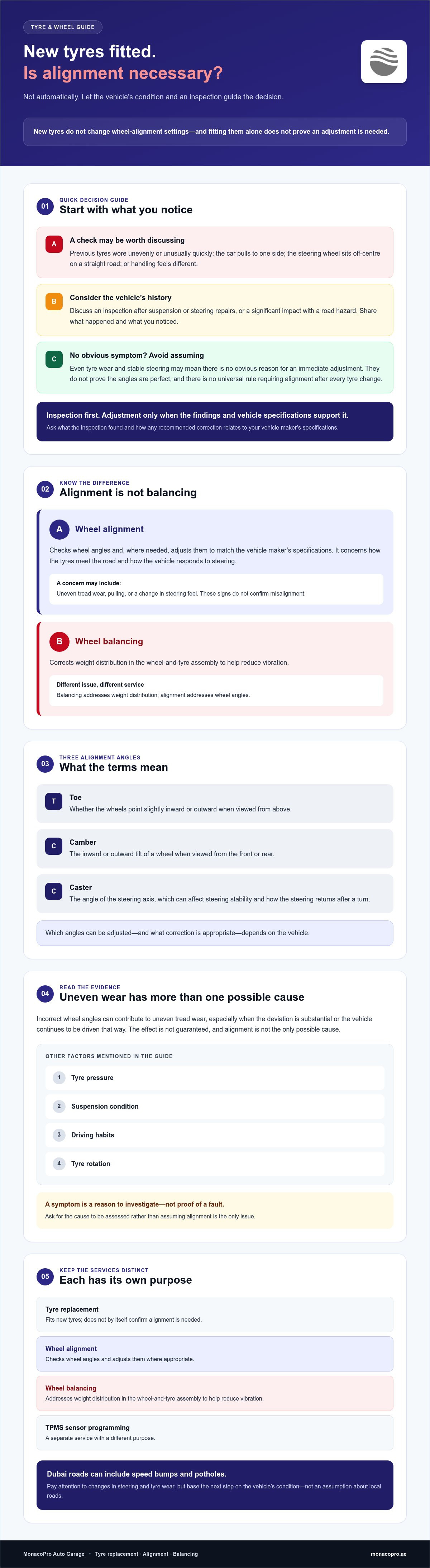
No, wheel alignment isn’t automatically required every time you fit new tyres. An inspection is worth considering if the old tyres wore unevenly, the car’s handling has changed, or the vehicle has had an impact or repair that could affect its wheel angles. The question “is wheel alignment necessary after new tyres” is best answered by assessing the vehicle, not by applying a blanket rule.
New tyres don’t correct incorrect wheel angles. An alignment check measures those angles and, where needed, adjusts them to match the vehicle maker’s specifications. Correct alignment helps the tyres meet the road as intended and supports predictable handling. The Wheel alignment reference explains core angles, including camber, caster and toe. Which angles can be adjusted, and what correction is appropriate, depends on the vehicle.
A recommendation should be based on inspection findings and the vehicle’s history. Replacing tyres alone doesn’t prove alignment is needed, and new tyres don’t rule out an existing alignment concern.
When should a driver check alignment after fitting new tyres?
Ask about an alignment inspection if your previous tyres had uneven or unusually rapid tread wear, the car pulls to one side, the steering wheel sits off-centre on a straight road, or handling feels different. These signs don’t confirm misalignment, but they give a technician a reason to investigate.
An inspection is also worth discussing after suspension or steering repairs, or a significant impact with a road hazard. Tell the technician what happened and what you noticed so the vehicle’s history can inform the assessment.
When might alignment not be needed immediately?
If the old tyres wore evenly and the car’s steering and handling felt stable, there may be no obvious symptom requiring immediate adjustment. That doesn’t prove the angles are perfect, but it helps put the decision in context. There’s no universal rule requiring an alignment adjustment after every tyre replacement.
A recommended alignment check is an inspection; an adjustment should follow only when the findings and vehicle specifications support it. Ask what the check revealed and why any proposed correction is appropriate. This keeps the decision evidence-led rather than automatic.
How wheel alignment affects new tyres, handling, and tread wear
Wheel alignment involves checking wheel angles and adjusting them, where possible, to match the vehicle maker’s specifications. Those angles affect how the tyres meet the road and how the vehicle responds to steering. If they’re outside specification, the car may feel less settled or the tread may wear unevenly. The effect depends on the amount of deviation and the vehicle’s condition.
New tyres don’t change the vehicle’s alignment settings. If the angles were already incorrect, fitting fresh tyres won’t correct them. Alignment and balancing are different: alignment concerns wheel angles, while balancing corrects weight distribution in the wheel-and-tyre assembly to help reduce vibration.
What do toe, camber, and caster mean?
Toe describes whether the wheels point slightly inward or outward when viewed from above. Camber is the inward or outward tilt of a wheel when viewed from the front or rear. Caster refers to the angle of the steering axis, which can affect steering stability and how the steering returns after a turn. Which angles can be adjusted varies by vehicle.
Can poor alignment damage a new set of tyres?
Incorrect wheel angles can contribute to uneven tread wear, particularly if the deviation is substantial or the vehicle continues to be driven that way. They may also be associated with pulling or a change in steering feel. These effects aren’t guaranteed. Alignment isn’t the only possible cause of tyre wear: pressure, suspension condition, driving habits and tyre rotation can also influence the tread pattern.
If wear appears uneven, ask for the cause to be assessed rather than assuming alignment is the only issue. An explanation of the inspection findings can help you decide whether an adjustment is appropriate. Drivers in Dubai can ask MonacoPro about an alignment check as part of that assessment.
Wheel alignment vs. balancing after new tyres: which service do you need?
Alignment and balancing address different parts of the wheel-and-tyre setup. Alignment checks and, if needed, adjusts the wheels’ angles to the vehicle’s specifications. Balancing corrects uneven weight distribution in each wheel-and-tyre assembly. Knowing the difference can help you describe what you’re experiencing, although symptoms alone can’t confirm which service is needed.
| Service | What it addresses | Signs that may warrant a check |
|---|---|---|
| Wheel alignment | Wheel angles and how they relate to the vehicle and road | Persistent pulling to one side, an off-centre steering wheel, or uneven tyre wear |
| Wheel balancing | Weight distribution of the wheel-and-tyre assembly | Vibration felt through the steering wheel or vehicle |
These signs are clues, not a diagnosis. Vibration can have several possible causes, including a tyre or suspension concern, while pulling can also have causes other than alignment. An assessment can help narrow down what’s responsible instead of treating one symptom as proof of a particular fault.
Which symptoms can point to alignment or balancing?
If the car persistently pulls or the steering wheel sits off-centre while driving straight, ask whether an alignment inspection is appropriate. If you notice vibration, balancing may be worth checking, but it isn’t the only possibility. Explain when the symptom occurs and whether it began after tyre work or an impact. Those details can help guide the investigation.
Can a car need both alignment and balancing?
Yes. The services correct separate conditions, so an inspection may find that both are relevant. Balancing wheels during tyre fitting doesn’t adjust their alignment angles, and tyre replacement doesn’t automatically include either service. Confirm what work has been performed rather than assuming one service covers the other.
If you’re comparing tyre options too, the Dubai tyre replacement guide offers related guidance. If you’re asking, “is wheel alignment necessary after new tyres,” let inspection findings, symptoms and the vehicle’s condition guide the decision rather than treating alignment as an automatic add-on.
A practical checklist for deciding on alignment in Dubai
Use a few clear observations to decide whether an alignment inspection makes sense after fitting tyres. Driving in Dubai can involve road hazards such as potholes or high curbs, but an impact doesn’t automatically mean the wheels are misaligned. The vehicle’s symptoms, tyre condition and recent maintenance history matter more than assumptions about the roads.
- Review the old tyres: Note whether the tread wore evenly or showed noticeably more wear along one edge.
- Pay attention to steering: On a suitable, level road, note any persistent drift or an off-centre steering wheel. If the vehicle pulls consistently, see this guide to a car pulling to one side.
- Recall recent work or impacts: Mention suspension or steering repairs, a hard wheel impact, and any change in steering behaviour.
- Check tyre pressures: Follow the vehicle maker’s guidance, since incorrect pressure can affect handling and wear independently of alignment.
Note when the tyres were fitted and when you first noticed a symptom. This gives a workshop useful context and helps make the recommendation evidence-led. If you haven’t noticed a clear concern, say so; an inspection should establish whether adjustment is appropriate, not assume it in advance.
What should you check before visiting a garage?
Gather the tyre fitting date, any uneven wear on the previous set, and a brief description of what the car does. Note whether the steering wheel sits off-centre or the vehicle consistently drifts, and whether the behaviour began after an impact or repair. Don’t test the car in unsafe conditions; report what you’ve already observed during normal driving.
Ask the technician to consider the manufacturer’s maintenance guidance and inspect the vehicle’s condition before recommending adjustments. An alignment reading needs to be considered in context, particularly if a component affecting wheel position is worn or damaged.
When could suspension condition affect alignment results?
Worn or damaged suspension components can affect alignment readings or prevent the settings from being adjusted correctly. If symptoms persist, or the readings can’t be brought within the vehicle maker’s specifications, ask whether relevant components need inspection before proceeding. For background on suspension concerns, read this Dubai car suspension repair guide.
For an assessment in Umm Ramool, Dubai, you can ask MonacoPro about wheel alignment and share what you’ve noticed.
What to expect from a professional alignment check after new tyres
A professional alignment assessment should answer a practical question: do the wheel angles need adjustment, and can they be set correctly for this vehicle? The technician should compare relevant measurements with the vehicle maker’s specifications and explain how the findings support any recommendation. The outcome depends on the vehicle, its condition and which angles are adjustable.
If you’re still asking, “is wheel alignment necessary after new tyres,” an inspection can provide a more useful answer than a blanket rule. Ask what the assessment includes, how the vehicle is checked against the correct specifications, and whether the technician found wear or damage that could affect the result.
What happens during an alignment assessment?
The process should begin with the vehicle’s history and condition, not an automatic adjustment. A technician may ask about steering behaviour and recent tyre changes, then check the tyres and relevant visible suspension components. Ask the workshop to explain its measurement procedure so you understand what the inspection involves.
Wheel angles can then be measured and compared with vehicle-specific specifications. If a reading is outside the appropriate range, the technician should explain whether adjustment is possible and what correction is recommended. If wear or damage could affect the readings or prevent a setting from being achieved, that should be raised before adjustments are proposed.
A clear recommendation connects the inspection findings to the work suggested. If the readings are within specification, or an angle isn’t adjustable on your vehicle, the next step may differ from a standard adjustment. Ask for the findings in plain language and clarify any separate concerns before approving additional work.
How can MonacoPro help after tyre replacement?
MonacoPro Auto Garage in Umm Ramool, Dubai, provides tyre replacement, wheel alignment and balancing, suspension service, and TPMS sensor programming. These are distinct services, so explain what has already been done and what you want checked. For example, share when the tyres were fitted, whether the previous set wore unevenly, and whether steering or handling has changed.
That information can help the team understand your concern and discuss an appropriate next step without treating every tyre change as an automatic alignment adjustment. To enquire about the available services, contact MonacoPro Auto Garage in Dubai.
Make your next tyre decision with confidence
So, is wheel alignment necessary after new tyres? Not automatically. Consider the vehicle’s condition: uneven tread wear, persistent pulling, an off-centre steering wheel or a recent impact may justify an inspection. If there are no obvious symptoms, that doesn’t prove alignment is perfect, but it does mean an adjustment should be guided by findings rather than assumed.
Remember that alignment and balancing address different issues. An alignment check assesses wheel angles against vehicle-specific specifications, while balancing corrects weight distribution in the wheel-and-tyre assembly. A technician’s assessment should also take relevant suspension condition into account before recommending adjustments.
MonacoPro Auto Garage in Umm Ramool, Dubai, provides tyre replacement, wheel alignment and balancing, suspension service and TPMS sensor programming. Share when your tyres were changed and any handling concerns to discuss the appropriate service for your vehicle. Contact MonacoPro Auto Garage in Dubai to take the next step.
Frequently Asked Questions
Is wheel alignment necessary after new tyres?
Not automatically. The answer to “is wheel alignment necessary after new tyres” depends on the vehicle’s condition, tyre wear and driving symptoms. An alignment inspection is sensible if the old tyres wore unevenly, the steering wheel sits off-centre, or the vehicle pulls to one side. A technician can compare the wheel angles with the vehicle maker’s specifications and explain whether adjustment is warranted.
Can I fit new tyres without getting a wheel alignment?
Yes. You can fit new tyres without an alignment adjustment if there’s no evidence that the wheel angles need correction. Replacing tyres doesn’t itself change those angles, but it also doesn’t fix an existing alignment issue. Consider the previous tyres’ wear, any recent suspension repairs or impacts, and how the car handles. If you have concerns, ask for an inspection rather than assuming adjustment is required.
What happens if I do not align my wheels after changing tyres?
If the wheel angles are outside the vehicle maker’s specifications, leaving them uncorrected may contribute to uneven tyre wear or affect handling. The impact depends on the degree of misalignment, vehicle condition and use, so the result can’t be predicted for every car. Tyre pressure, suspension condition and driving habits can also affect wear. If you notice a problem, have the cause assessed.
How do I know if my car needs alignment after new tyres?
Look for uneven wear on the previous tyres, persistent pulling to one side, an off-centre steering wheel while driving straight, or a change in handling. These are reasons to request an inspection, not proof of misalignment. A tyre or suspension issue may cause similar symptoms. Share when the tyres were fitted and whether the car recently had suspension work or a road impact to help guide the assessment.
Is wheel alignment the same as wheel balancing?
No. Wheel alignment checks and, when needed, adjusts wheel angles to the vehicle’s specifications. Wheel balancing corrects uneven weight distribution in the wheel-and-tyre assembly, which can help address vibration. The services solve different issues, and one doesn’t automatically include the other. Vibration may point to a balancing concern, but tyres or suspension can also be involved, so a symptom alone can’t confirm the cause.
Should I get alignment after hitting a pothole in Dubai?
Not necessarily after every pothole, but request an inspection if the impact was significant or the car’s behaviour changed afterward. Watch for pulling, an off-centre steering wheel, unusual tyre wear or altered handling. A road impact can affect a vehicle, but the impact itself doesn’t confirm misalignment. A technician can assess the wheel angles and relevant vehicle condition before recommending an adjustment.
How often should wheel alignment be checked?
As a general guide, consider an alignment check every 10,000 to 15,000 kilometres or at least once a year, while following your vehicle maker’s maintenance guidance. Some Dubai recommendations suggest checking every six months or 10,000 kilometres, particularly in view of local driving conditions. Also consider an inspection after suspension or steering work, a significant road impact, or signs such as uneven tyre wear or pulling.