
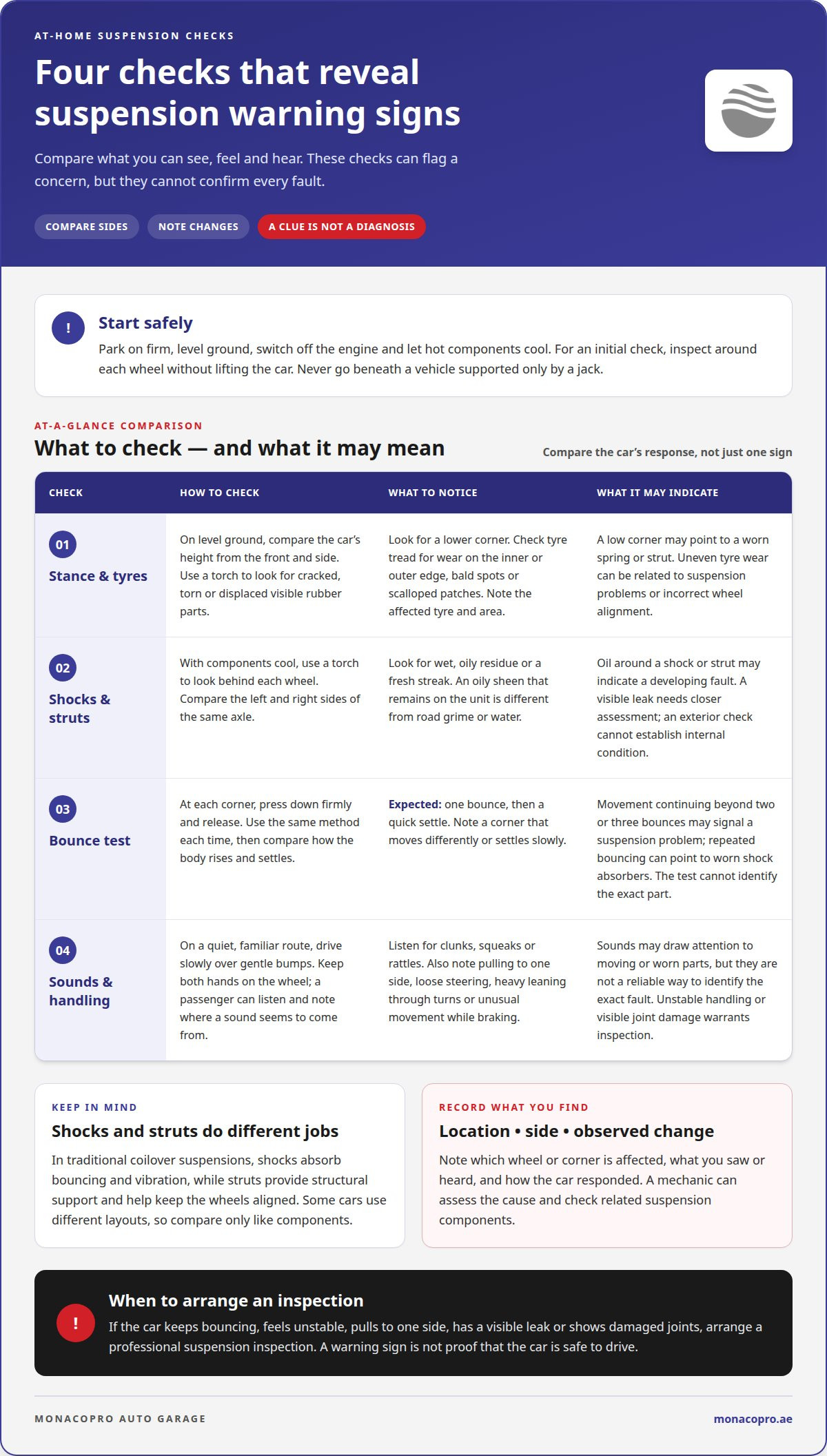
You can spot several suspension warning signs without taking the car apart. To learn how to check car suspension at home, park on level ground, look behind each wheel for fluid leaks, press down on each corner and watch how it settles, then listen for clunks, squeaks or rattles over bumps. A low corner, repeated bouncing or unusual noises may point to a problem that needs closer inspection.
If your car feels unsettled, pulls to one side or wears its tyres unevenly, it’s natural to want a quick way to assess what might be wrong. These checks can help you spot changes, but they can’t identify every worn or damaged component.
This guide covers a visual inspection, the bounce test and a listening check. It explains what each sign may mean and when to arrange a professional suspension inspection.
Key Takeaways
- Compare the car’s ride height on level ground and inspect tyre wear for clues that suspension parts or alignment may need attention.
- Look behind each wheel for fluid around the shocks or struts, which can signal a developing fault.
- Use the bounce test to notice whether a corner settles promptly or keeps moving after being pressed down.
- Pay attention to clunks, squeaks, or rattles over bumps, and learn when a professional suspension inspection is the sensible next step.
How to check the car suspension system?
Start on level ground, then check visible parts and observe how the car behaves. These steps can reveal warning signs, but they can’t confirm every fault.
Gather Inspection Tools and Safety Equipment
For a visual check, gather a torch, gloves and a tyre-pressure gauge. Park on firm, level ground, switch off the engine and let hot components cool before looking near the wheels. Use the torch to check visible rubber parts for cracks, tears or displacement. Don’t reach into moving parts or assume a quick look can reveal the condition of hidden joints.
Lift and Support the Car Safely
For an initial check, keep the car on level ground and inspect around each wheel without lifting it. If you need to look underneath, use the vehicle handbook’s lifting points and suitable support stands on firm ground. Never put any part of your body beneath a car supported only by a jack. If you lack the right equipment or aren’t confident supporting the vehicle, leave the underside inspection to a mechanic.
Check Ride Height, Sagging, and Tyre Wear
With the car parked level, compare its stance from the front and side. A lower corner may indicate a worn spring or strut. Check each tyre tread for wear along the inner or outer edge, bald spots or scalloped patches. Uneven wear can be related to suspension problems or incorrect wheel alignment, so note which tyre and area are affected.
Inspect Suspension Joints and Vehicle Stability
Use a torch to check for visibly torn bushings, damaged rubber boots or loose-looking parts around ball joints and tie rods. Don’t dismantle or force components. On a careful drive, note any pulling to one side, loose steering, heavy leaning through turns or unusual movement while braking. Arrange a mechanic’s inspection if you notice these signs, visible joint damage or unstable handling. Suspension condition matters because it helps keep tyres in contact with the road and supports vehicle control.
Checking shocks and struts for fluid leaks
- Park on flat ground, switch off the engine and let hot components cool. Use a torch to look behind each wheel at the visible shock absorber or strut. Check for wet, oily residue or a fresh streak running down the unit. Oil around a shock or strut may indicate that it is failing.
- Compare the left and right sides of the same axle. A damp surface on one unit, especially when its counterpart is dry, is worth noting. Don’t mistake road grime or water for shock fluid: look for an oily sheen or residue that remains on the component. Observe where the mark is and how far it extends before wiping anything.
- Look at the lower area behind each wheel without reaching into the suspension. Note where fluid appears, whether it has spread onto nearby parts and which side is affected. A visible leak can signal a problem, but an exterior check can’t establish the component’s internal condition. Don’t crawl beneath a vehicle supported only by a jack.
- Keep the parts’ different roles in mind. In traditional coilover suspensions, shocks absorb bouncing and vibration, while struts provide structural support and help keep the wheels aligned. Some cars use shocks and struts in different layouts, so compare only like components. A leak, unstable ride or other warning sign needs closer assessment.
- Record the wheel location and what you observed, then arrange an assessment if you find oily residue. A trained inspection can determine whether the shock or strut needs attention and check related suspension components. For a closer assessment, professional suspension inspection can help identify the source of a visible leak and its effect on the vehicle.
The suspension bounce test
The bounce test shows how each corner responds to pressure. Compare the movement rather than judging the car by a single push.
- Park on level ground, switch off the engine and make sure the car is stationary. Clear the area around the vehicle so you can press each corner safely. Don’t perform the test in traffic or while someone is moving the car. Start at one corner and use the same method at each of the others to compare their responses.
- Stand beside the bumper at the first corner, press down firmly and release. Watch how the body rises and settles. Repeat at each corner, noting whether one side moves differently. Keep your hands clear of gaps between the bodywork and tyres, and don’t position yourself beneath the vehicle.
- Look for a controlled return. A healthy suspension should bounce once and settle quickly after release. Movement that continues beyond two or three bounces may signal a suspension problem; several repeated bounces can point to worn shock absorbers. Note which corner moves most and whether the car settles unevenly or slowly.
- Compare all four corners, not just one. For example, if the front settles promptly but a rear corner keeps bouncing, record the difference. The test can flag a concern, but it can’t diagnose a specific component. Springs, shocks, struts and other parts may need further assessment to determine the cause.
- If the car keeps bouncing or feels unstable, don’t treat the test as proof that it’s safe to drive. A suspected suspension problem can make driving dangerous. Arrange a professional inspection if the car doesn’t settle as expected, particularly if you’ve also noticed changes in handling or unusual movement over bumps.
Listening for suspension noises
- Choose a quiet, familiar route with a few gentle bumps and drive slowly. Keep both hands on the steering wheel and listen for sounds from the front and rear. Don’t use a phone or ask the driver to investigate while moving. A passenger can listen and note where each noise seems to come from.
- Listen for clunks, squeaks or rattles as the tyres pass over bumps. A clunk may happen as suspension parts move, while a squeak or rattle may draw attention to worn bushings or ball joints. These sounds are clues, not a reliable way to identify the exact faulty component.
- Note when each sound occurs. For example, record whether a rattle happens only over a bump or a clunk repeats across several bumps. Notice whether the noise seems to come from one side or move with the car. A clear pattern gives a mechanic more useful information than simply saying, “It makes a noise.”
- Compare the sound on the same stretch of road at a slow, controlled speed. Don’t accelerate over a bump or deliberately hit a pothole to reproduce a noise. If ordinary road movement brings out a clunk, squeak or rattle, stop repeating the test and note the conditions instead.
- Combine the sound with other observations, such as pulling, loose steering, or repeated bouncing. A noise over bumps alongside a handling change deserves prompt attention, because worn suspension can affect vehicle control. A listening check cannot show the condition of hidden joints or bushings. Arrange a professional suspension inspection if the noise persists or the car feels unstable.
MonacoPro Auto Garage: Suspension Service
MonacoPro Auto Garage provides Suspension Service when a home check reveals persistent bouncing, fluid around a shock or strut, unusual noises or unstable handling. These signs can have different causes, so a visual check or road test alone may not identify the faulty part. Note when the symptom occurs and which corner or side seems affected, then share those details to help focus the inspection.
A professional assessment is the sensible next step if the car pulls, leans heavily or continues bouncing after pressure. Don’t rely on repeated test drives when handling feels unstable. If the tyres also show uneven wear, mention it, as suspension concerns and wheel alignment can be related.
For a closer assessment of a suspected suspension issue, contact MonacoPro Auto Garage about its Suspension Service.
Make your next suspension check count
A home inspection is a useful starting point, not a definitive assessment of your car’s condition. If you’re unsure how to check car suspension at home, focus on recording clear observations rather than trying to identify or repair a hidden fault yourself. Note when the concern appears and how the vehicle behaves, then use those details to decide what to do next.
MonacoPro Auto Garage can address suspension concerns through its Suspension Service. The garage also offers Battery Replacement, Oil Change and Car Computer Diagnostic for other vehicle maintenance needs.
Take the next step toward a clearer assessment: contact MonacoPro Auto Garage. A careful inspection can help you make an informed plan and feel more confident about getting back on the road.
Frequently Asked Questions
Why does suspension maintenance improve safety?
Suspension maintenance helps keep tyres in contact with the road and supports control when braking and turning. If worn parts affect tyre contact, handling can become less predictable and braking efficiency can suffer. Suspension condition also matters beyond ride comfort: an unnoticed fault can contribute to faster tyre wear. Treat changes in how the car responds as a safety concern, not just an inconvenience.
What are the signs of worn or damaged car suspension?
Common warning signs include an uneven stance, fluid around a shock or strut, repeated bouncing, unusual noises, pulling or uneven tyre wear. Note whether symptoms appear together or affect one corner more than the others. For example, a new clunk accompanied by a change in steering response is a clearer reason to arrange an inspection than a noise considered on its own.
How do I inspect car suspension at home step by step?
To learn how to check car suspension at home, park on level ground and compare the car’s stance. Inspect visible areas behind each wheel for residue or damaged rubber, check the tyre tread, perform the bounce test and listen for sounds during a cautious drive over familiar bumps. Record each symptom’s location and the conditions when it occurs. Never crawl beneath a car supported only by a jack.
How do I do the bounce test on car shocks and struts?
With the car stationary on level ground, press down firmly on the bumper at one corner and release it. Watch how the body returns, then repeat at the other corners for comparison. A healthy suspension should bounce once and settle quickly. Bouncing that continues beyond two or three movements can signal a problem. This basic test can’t confirm which component needs attention.
How do I check suspension components for leaks, cracks, or looseness?
Use a torch to inspect visible areas behind each wheel. Look for oily residue on shocks or struts, cracked rubber around bushings and torn boots near joints. Don’t pull, pry or dismantle parts to test for looseness; a visual check can’t reliably assess hidden movement. Note the affected area and arrange a mechanic’s inspection if you see damage or oily fluid.
Can uneven tyre wear indicate a suspension problem?
Yes. Wear concentrated along the inner or outer edge, bald patches or scalloped tread can point to a suspension issue or incorrect wheel alignment. The pattern alone can’t identify the cause. Note which tyre is affected and where the wear appears, then compare it with the other tyres. If the wear is pronounced or handling has changed, include both observations in a professional assessment.
Knowing how to check car suspension at home can help you describe a concern clearly, but visual checks can’t confirm every fault. Use your observations to guide the next step.