
A fair asking price is one you can justify against similar cars, not simply the lowest figure in a listing. Compare 10-20 vehicles with the same model year, or within 1-2 years, and treat a price 10-15% above comparable cars as a premium that needs a clear reason, such as low mileage or a full dealer history. The questions to ask when buying a used car in Dubai should establish whether the car’s condition and documented history support its price.
It’s reasonable to focus on the asking price, but service records can reveal how consistently a car has been maintained and help explain its condition. This guide covers questions to ask when buying a used car in Dubai, from comparing similar listings and checking accident and service history to arranging a pre-purchase inspection and budgeting for ownership costs. These checks help you assess value, negotiate more confidently, and anticipate likely expenses.
Key Takeaways
- Compare similar Dubai listings to judge whether an asking price is reasonable, then look for evidence that supports any premium.
- Arrange a professional pre-purchase inspection to assess mechanical condition before you commit.
- Use service records, repair details, and accident-history checks to build a clearer picture of the car’s past.
- Plan for insurance, registration, fuel, and maintenance alongside the purchase price.
Arranging a pre-purchase mechanical inspection
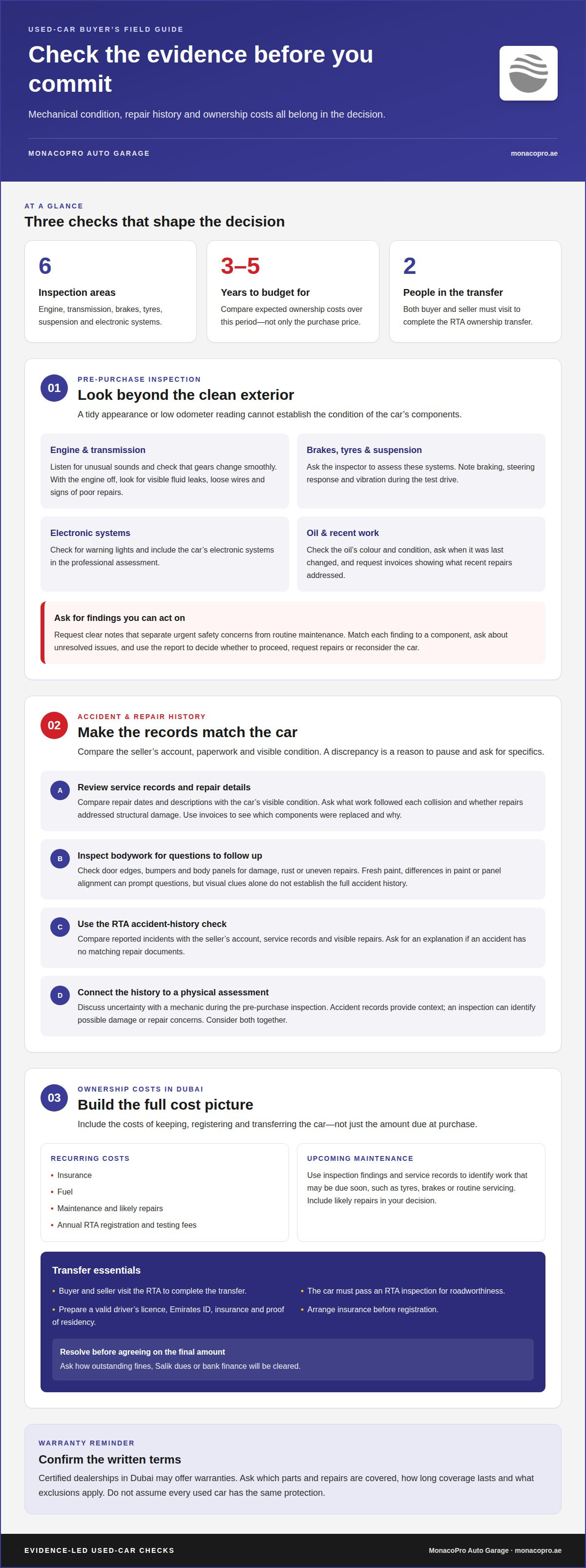
Warranty coverage depends on the seller’s written terms. Certified dealerships in Dubai may offer warranties, so ask which parts and repairs are covered, how long the warranty lasts, and what exclusions apply. Don’t assume every used car comes with the same protection.
- Arrange an independent inspection before agreeing to buy. A professional pre-purchase inspection is particularly useful for higher-value cars or vehicles with low mileage. Ask the inspector to assess the engine, transmission, brakes, tyres, suspension, and electronic systems. A tidy appearance or low odometer reading cannot establish the condition of those components.
- Ask the seller for permission to inspect and test-drive the car. On the test drive, listen for unusual sounds and check whether the transmission changes gears smoothly. Try the car on different road types when practical, and note warning lights, steering response, braking, and vibration. Compare anything unusual with the seller’s explanation.
- Check beneath the hood with the engine off. Look for visible fluid leaks, loose wires, and signs of poor repairs. Inspect the engine oil’s colour and condition, then ask when it was last changed. A dark or contaminated appearance deserves an explanation and professional assessment, rather than a quick assumption about the cause.
- Ask the inspector to connect findings to likely repairs. Request clear notes separating urgent safety concerns from routine maintenance. For example, worn tyres may need attention sooner than a minor cosmetic defect. Use the findings to decide whether to proceed, request repairs, or reconsider the car, rather than relying on a seller’s verbal assurances.
- Keep the inspection report with the car’s documents. Match each finding to a specific component and ask the seller about unresolved issues. If the report identifies transmission slipping, oil leaks, or damaged wiring, pause the purchase until you understand the implications. These documented findings help you judge condition before committing.
Checking accident and repair history
Review the car’s records alongside its visible condition. A consistent account can help explain repairs and point to questions for the seller.
Compare service records with accident history
Ask the seller for service records and details of previous accidents. Compare repair dates and descriptions with the car’s visible condition. For example, fresh paint around a door or bumper should be consistent with the stated repair history. Ask what work followed each collision and whether repairs addressed structural damage. Look for signs of a cracked or welded chassis.
Ask about recent repairs, too, as they may affect the car’s performance. An invoice can show which component was replaced and why. If the seller’s account conflicts with the paperwork or visible evidence, pause and resolve the discrepancy before negotiating.
- Check door edges, bumpers, and body panels for damage, rust, or uneven repairs. Differences in paint or panel alignment can prompt further questions, but visual clues alone don’t establish the full accident history. Note each concern and ask the seller for a specific explanation rather than accepting a general assurance.
Run RTA accident-history checks
Use the Roads and Transport Authority (RTA) accident-history check to review reported incidents associated with the car. Compare the available history with the seller’s account, service records, and visible repairs. If a reported accident has no matching repair documents, ask for an explanation before deciding.
Discuss any uncertainty with a mechanic during a pre-purchase inspection. An accident record provides context, while a physical assessment can identify possible damage or repair concerns. Consider both as parts of the same review, not substitutes for each other.
- Connect recorded repairs to how the car drives. If the inspection identifies concerns with steering, suspension, or braking, factor those findings into your decision. A suspension or brake service may address a relevant mechanical issue; distinguish that work from investigating the accident itself.
Considering ownership costs in Dubai
Compare the purchase price with the costs of keeping the car. Budget across the next 3-5 years, including registration, insurance, fuel, and maintenance.
Estimate future maintenance costs
Review inspection findings and service records to identify upcoming work. Ask which items need attention soon, such as tyres, brakes, or routine servicing. Incomplete maintenance records may warrant a closer assessment before estimating upkeep. Include likely repairs in your decision rather than treating the asking price as the full cost.
Set an ownership-cost budget
List insurance, fuel, maintenance, and annual RTA registration and testing fees alongside the purchase price. Insurance is required for registration in Dubai, so arrange it in advance. Compare the total expected costs over 3-5 years against your budget, not just the amount due when buying. This view helps you decide whether a lower-priced car remains affordable to maintain.
Review vehicle transfer requirements and fees
Plan the ownership transfer with the seller through the RTA. Both buyer and seller must visit to complete the transfer. Prepare a valid driver’s licence, Emirates ID, insurance, and proof of residency. The car must pass an RTA inspection to confirm roadworthiness during the transfer process.
Include registration and testing fees in your budget, and account for insurance before registration. Ask how outstanding fines, Salik dues, or bank finance will be cleared before the transfer. Resolve these items before agreeing on the final amount.
- Compare the sale arrangements and watch for warning signs. Certified dealerships may offer inspected cars and warranties. For a private sale, include a test drive and checks of the documents and service history. Be cautious if the seller avoids an inspection or gives inconsistent mileage or accident details. Check for outstanding finance, fines, and Salik dues before agreeing on a price.
Verifying service history
Treat the service file as a timeline, not just a stack of receipts. In Dubai, compare recorded mileage with the car’s age and current odometer reading.
- Ask the seller for service records, invoices, and maintenance details. Check each document for its date, odometer reading, workshop, and work completed. Together, these details form a timeline you can compare with the car’s current condition, rather than relying on a verbal summary.
- Put recorded odometer readings in chronological order. Each entry should make sense beside the previous one and the car’s current mileage. A gap or inconsistency calls for a clear explanation, as incomplete records make the vehicle’s maintenance pattern harder to assess.
- Compare mileage with the vehicle’s age, without treating one figure as proof. Cars in Dubai and across the UAE average around 15,000-25,000 km yearly. A five-year-old daily driver commonly shows 70,000-120,000 km, so investigate readings that differ substantially.
- Compare listed maintenance with the work described on invoices. For example, a record of brake repairs should identify the work performed and its date. Repeated entries for the same issue may point to an ongoing concern worth discussing with the seller and inspection mechanic.
- Ask about periods missing from the file and any recent repairs. Find out what prompted each repair, which parts or systems were involved, and whether follow-up work took place. Compare the answers with inspection findings. Unexplained gaps leave important questions about the car’s maintenance unanswered.
- Use the records to distinguish routine servicing from unresolved problems. A stamped service booklet can help, but detailed invoices give a clearer account of completed work. Keep copies of both, then note any maintenance the seller says is due after purchase.
- Make your decision from the records, odometer, and mechanical findings together. If notes point to braking or suspension concerns, explore brake and suspension services as you plan the next steps. A consistent file supports a clearer view of the car’s upkeep.
MonacoPro Auto Garage
MonacoPro Auto Garage can help address mechanical concerns identified while assessing a used car. After reviewing the vehicle’s records and inspection findings, use them to prioritise maintenance before deciding. A battery concern, overdue oil change, diagnostic warning, or tyre issue, for example, may need attention. The relevant service can address that specific maintenance need, but it doesn’t replace checking the seller’s documents or accident history.
Bring the findings into your ownership planning so you can distinguish immediate mechanical needs from routine upkeep. If you’re ready to discuss a maintenance concern, contact MonacoPro Auto Garage.
Make your next decision with confidence
The most useful questions to ask when buying a used car in Dubai turn uncertainty into a clear next step. Use the paperwork, inspection findings, and seller’s answers to decide what you’re comfortable taking on, rather than rushing. If the car needs attention, identify the priority and plan how to address it before the ownership transfer. Keep copies of invoices and service notes after purchase, too. A clear maintenance record helps you track completed work and make informed decisions about future upkeep.
MonacoPro Auto Garage provides battery replacement, oil changes, and car computer diagnostics to address specific maintenance needs. These services can help with relevant vehicle concerns after you’ve made your purchase decision. Base your maintenance plan on the car’s actual condition and required work, rather than treating every possible service as immediately necessary.
For support with a maintenance concern, contact MonacoPro Auto Garage. Take your next step at a pace that lets you make an informed choice and begin ownership prepared.
Frequently Asked Questions
What is a “fair” asking price?
A fair asking price is supported by comparable cars and the specific vehicle’s condition. Where possible, compare the same model variant, engine, trim, and transmission. A base model may not be a useful benchmark for a higher trim. Then consider mileage, documented maintenance, and visible condition. If the seller’s figure is higher, ask which features or records explain the difference.
What questions should I ask the seller when buying a used car in Dubai?
Ask why the car is being sold, how long the seller has owned it, and what work may be due. Clarify whether warning lights appear and whether known faults remain unresolved. Ask which documents and service invoices are available, and whether warranty terms are in writing. Specific answers help you compare the seller’s account with the records and inspection results.
How can I check a used car’s accident and service history in the UAE?
Use the RTA accident-history check alongside the seller’s service documents. Match repair dates and descriptions with invoices, then ask about any incident or repair that appears in one source but not another. Keep any difference as an open question until it’s explained. File the records with your inspection notes so your decision reflects both documented history and the car’s present condition.
How do I verify a used car’s mileage and ownership history in Dubai?
Compare odometer readings across dated service invoices and other vehicle documents. Read them in date order, then ask the seller to explain gaps or readings that don’t fit the timeline. To understand ownership history, review the available registration and transfer documents, and ask how long the seller has owned the car. Consistent paperwork gives you a clearer chronology to consider alongside the inspection.
What is the process for a vehicle inspection and test drive before buying a used car in Dubai?
Agree on access to the car, arrange a professional inspection, and take a test drive before deciding. During the drive, pay attention to steering response, braking, unusual vibration, and gear changes. Where practical, include turns, low-speed manoeuvres, and normal traffic conditions. Afterward, compare your observations with the inspection findings and ask the seller to address any differences before proceeding.
What are typical used car prices in Dubai, and how can I compare market value?
There is no single typical price for used cars across Dubai. Build a useful comparison by matching the car’s model variant, trim, engine, mileage, condition, and service documentation with similar listings. Separate differences in equipment from differences in upkeep, as both can affect the asking price. If listings vary widely, refine your comparison instead of relying on a broad market average.