
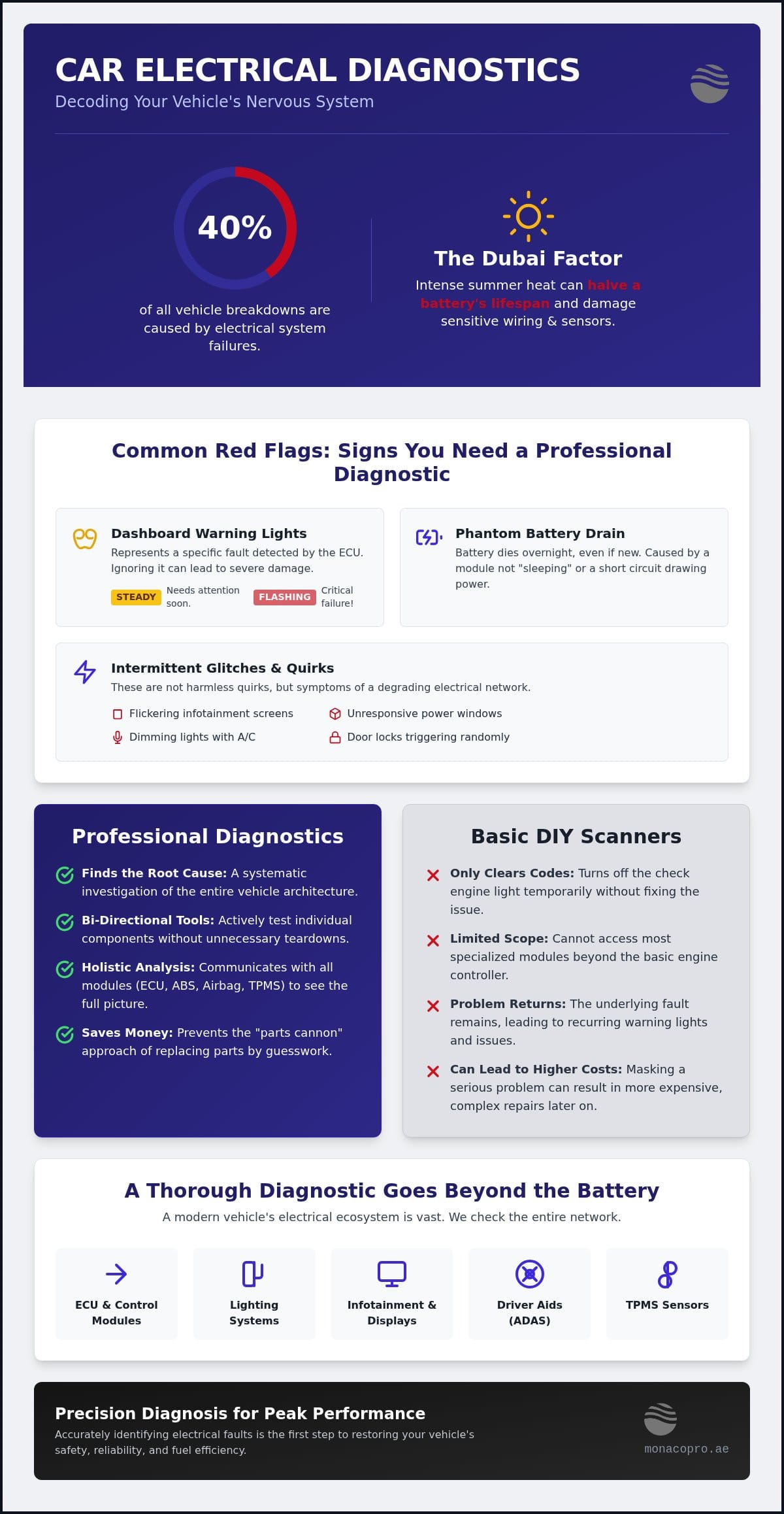
Did you know that 40% of all vehicle breakdowns are actually caused by electrical system failures? In Dubai’s intense environment, where summer heat can halve a battery’s lifespan and put immense strain on every sensor, it’s deeply frustrating when your car starts acting up. You might worry about a mechanic simply guessing at the problem or charging you for expensive parts that don’t actually need replacing. It’s a common anxiety for luxury car owners when intermittent faults seem impossible to track down.
This guide explains how a professional car electrical diagnostic moves far beyond a basic computer scan to pinpoint the exact root cause of your wiring or sensor issues. You’ll discover how specialized tools identify hidden faults that others miss, helping you avoid the “parts cannon” approach and ensuring your vehicle remains reliable. We will walk through the diagnostic process, from generating detailed fault reports to the technical precision required to keep modern electronics running perfectly in the UAE climate. By the end, you’ll understand how to restore your car’s safety and performance without the stress of trial and error repairs.
Key Takeaways
- Understand why a professional car electrical diagnostic is the only way to accurately map your vehicle’s complex network of sensors and control units.
- Identify the specific warning signs of electrical failure, such as phantom battery drains and intermittent dashboard alerts, before they lead to a total breakdown.
- Learn how extreme Dubai temperatures and humidity physically damage your car’s wiring, making preventative electronic health checks vital.
- Discover the technical advantages of bi-directional diagnostic tools that allow technicians to test individual parts without performing unnecessary teardowns.
- Find out how a systematic diagnostic workflow saves you money by preventing the “parts cannon” approach of replacing expensive components through guesswork.
What is a Car Electrical Diagnostic and Why Does Your Vehicle Need It?
Modern vehicles have evolved into sophisticated computers on wheels. A professional car electrical diagnostic is much more than a simple scan for error codes; it is a systematic investigation into your vehicle’s entire digital and physical architecture. This process examines the complex communication network, known as the CAN bus, alongside the various sensors and control modules that dictate how your car behaves. By using standardized On-Board Diagnostics (OBD) interfaces, technicians can access real-time data streams to identify exactly where a circuit is failing or a signal is dropping.
There is a critical difference between a basic warning light reset and a root-cause investigation. While a cheap hand-held tool might clear a “Check Engine” light, it doesn’t fix the underlying fault. Without a proper car electrical diagnostic, that light will inevitably return, often accompanied by more severe performance issues. In the high-performance automotive landscape of 2026, precision is the only way to maintain the safety and reliability standards expected by Dubai drivers. A thorough check ensures that every mile of wiring is delivering the correct voltage to the components that keep you safe on the road.
The “Brain” of Your Vehicle: Understanding the ECU
The Engine Control Unit (ECU) functions as the central processor that interprets data from every sensor in the car. It manages everything from fuel injection timing to emission controls. Professional-grade diagnostic platforms don’t just look at the engine; they “talk” to multiple specialized modules, including the ABS (Anti-lock Braking System), airbag controllers, and the transmission management system. This holistic approach allows an efficient expert to see how a fault in one area might be triggering a phantom symptom in another, ensuring a complete repair rather than a temporary patch.
Beyond the Battery: The Scope of Electrical Systems
While many owners associate electrical issues only with a dead battery, the modern electrical ecosystem is vast. It encompasses your vehicle’s lighting, infotainment screens, power windows, and increasingly complex Advanced Driver Assistance Systems (ADAS). At our Umm Ramool facility, we also integrate specialized TPMS sensor+ programming into our electrical checks to ensure your tyre safety systems are communicating correctly with the main computer. Maintaining this electrical health is directly linked to your vehicle’s fuel efficiency. When sensors provide inaccurate data, the ECU often overcompensates by burning more fuel, leading to higher costs at the pump and unnecessary wear on the engine.
Common Red Flags: Signs You Need a Professional Diagnostic
Recognizing the early warning signs of an electrical malfunction can prevent a minor glitch from becoming a roadside emergency. The most obvious indicator is the appearance of the “Check Engine” or “Service Vehicle” light on your dashboard. While it’s tempting to ignore these symbols if the car seems to be driving normally, they represent specific data points captured by the ECU. These alerts require a professional car electrical diagnostic to decode the underlying issue before a secondary system fails.
A particularly frustrating symptom is the “Phantom Drain.” This occurs when your battery dies overnight despite being relatively new or recently charged. It suggests that a control module is failing to enter “sleep mode” or a short circuit is drawing power while the ignition is off. You might also notice intermittent glitches, such as:
- Power windows that respond only occasionally.
- Infotainment screens that flicker or reboot during acceleration.
- Door locks that trigger without input.
- Headlights that dim when the air conditioning kicks in.
These aren’t just harmless quirks; they are symptoms of a degrading electrical network. If you ever detect a smell like burning plastic or ozone, pull over immediately. This indicates a high-resistance short or melting wire insulation, which represents an immediate hazard to the vehicle’s safety.
Dashboard Warning Lights: More Than Just a Suggestion
Ignoring a dashboard light can eventually lead to a total vehicle shutdown or “limp mode.” It’s important to distinguish between a steady light and a flashing one. A steady light usually indicates a monitored fault that needs attention soon, whereas a flashing light signals a critical failure that could cause immediate engine or electronic damage. Modern diagnostic tools translate these generic icons into specific Diagnostic Trouble Codes (DTCs), allowing technicians to pinpoint the exact sensor or circuit at fault without unnecessary disassembly.
Starting and Charging Issues
Many drivers assume a car that won’t start simply needs a new battery. However, the issue often lies with a failing alternator or a worn starter motor. Understanding how heat damages car batteries is vital in Dubai, as extreme temperatures accelerate internal corrosion. However, replacing a battery when the alternator isn’t properly charging it is an expensive mistake. A professional car electrical diagnostic tests the entire charging loop, including the integrity of ground wires, to ensure you aren’t paying for parts you don’t need. If your car is struggling to turn over, a quick car computer diagnostic can provide the clarity you need to move forward with confidence.
Professional Diagnostic Tools vs. DIY Scanners: The Real Difference
Many car owners attempt to solve electronic issues by using $50 Bluetooth dongles found online. While these tools are useful for reading basic emissions codes, they represent only a small fraction of the capability found in professional $10,000+ diagnostic platforms. A high-end car electrical diagnostic involves much more than just pulling a code from the computer. It requires bi-directional control, which allows a technician to send commands back to the vehicle. For example, we can command a fuel pump to turn on or a window motor to actuate directly from the scanner. This process isolates the component from the wiring, telling us instantly if the motor is dead or if the signal is getting lost in a frayed wire.
A fault code only tells you “where” the computer sees a problem, not “why” it exists. If a sensor reports a low voltage, the “parts cannon” approach suggests replacing the sensor immediately. However, an expert knows that the issue could be a corroded connector, a weak ground, or even a software glitch in the ECU. Professional diagnostics provide a definitive roadmap for repair, eliminating the cost of trial-and-error. To understand exactly how these professional-grade systems outperform consumer gadgets, our detailed breakdown of car diagnostic tool service options versus DIY scanners explains the critical differences in depth. This same principle applies when your vehicle exhibits physical symptoms alongside electronic ones — for instance, if you notice your car shaking when braking, a thorough diagnosis can reveal whether the cause is a faulty ABS sensor or a deeper mechanical issue rather than simply assuming warped rotors.
Accessing Manufacturer-Specific Modules
Basic scanners often miss up to 70% of the data available in luxury brands like Mercedes, BMW, or Range Rover. These vehicles use proprietary communication protocols that generic tools simply cannot translate. Our professional systems allow for deep-level access to every module, including the ability to view live data streaming. Watching sensor values in real-time while the vehicle is running is the only way to catch “intermittent” faults that don’t stay active long enough to trigger a permanent light. This level of access is also essential for specialized TPMS sensor+ programming and resets that DIY tools cannot perform.
Saving Money by Preventing “Part-Guessing”
The “Parts Cannon” trap is a common pitfall where owners replace perfectly good components based on a generic code read. This often leads to spending hundreds of dollars on hardware that doesn’t fix the problem. Investing in an hour of professional diagnostic time is a logical financial decision. It ensures that every dirham spent on parts is necessary and effective. By identifying the root cause with surgical precision, we protect your budget and restore your vehicle’s reliability in one visit.
The Dubai Factor: How Heat and Humidity Kill Car Electronics
Driving in Dubai is uniquely taxing on a vehicle’s electrical architecture. While many drivers prepare for mechanical wear, the environmental impact on circuitry is often overlooked. When summer temperatures exceed 50°C, the physical properties of wire insulation change. Over several seasons, this plastic coating becomes brittle and cracks. Once the copper core is exposed, it’s vulnerable to short circuits or signal interference. This is why a car electrical diagnostic is essential for any vehicle that has spent multiple summers in the desert.
Dubai’s high coastal humidity also plays a destructive role by accelerating oxidation on electrical connectors and fuse boxes. A tiny amount of corrosion can disrupt the sensitive low-voltage signals used by modern ECUs. Additionally, microscopic sand and dust particles can infiltrate electrical sensors and air intake modules, leading to erratic readings that trigger dashboard warning lights. These factors combined mean that battery life in the UAE is significantly shorter than in cooler climates, often requiring replacement every 18 to 24 months.
Heat-Induced Resistance and Voltage Drop
The physics of heat is a major enemy of your car’s wiring. High temperatures naturally increase electrical resistance, which means your alternator and battery must work harder to deliver the same amount of power. This stress often manifests in the air conditioning system. Many owners assume a warm AC means a gas leak, but the root cause is frequently a failed pressure sensor or a melted compressor clutch relay. A professional car electrical diagnostic identifies these voltage drops before they lead to a total system failure. Checking wiring harnesses during routine summer maintenance is a proactive way to avoid being stranded in the heat.
Protecting Luxury Interiors and Electronics
There is a direct connection between the state of your cabin and the electronics beneath the surface. When upholstery becomes heat-damaged and brittle, it no longer provides adequate insulation for the sensitive components underneath, such as seat occupancy sensors and airbag wiring. Our specialized upholstery for all cars service ensures that these electronic elements are properly protected and seated during any interior restoration. We also highly recommend high-quality tinting as a preventative measure. By blocking UV rays and reducing cabin temperatures, you significantly extend the longevity of your dashboard electronics and infotainment screens. If you suspect your vehicle is suffering from heat-related glitches, schedule your car computer diagnostic at our Umm Ramool facility today to ensure every system is operating at peak efficiency.
Precision Electrical Solutions at MonacoPro Auto Garage
At MonacoPro Auto Garage, we treat every car electrical diagnostic as a surgical investigation rather than a simple scan. Our technicians follow a methodical three-stage workflow designed to eliminate guesswork. We begin with a comprehensive digital scan to identify all active and pending fault codes across your vehicle’s network. This is followed by live data analysis, where we observe sensor behaviors in real-time under various driving conditions. Finally, we conduct physical circuit testing to verify the integrity of the wiring and connectors. This logical progression ensures we identify the root cause of a failure, preventing the common mistake of replacing functional parts.
Our “Efficient Expert” persona is built on transparency. We provide you with a clear, documented report of every fault found, explaining the technical necessity of each repair. By managing the entire diagnostic and repair journey in-house, we remove the stress of coordinating between different specialists. This one-stop solution approach saves you time and ensures that the technical quality of the work meets the high standards required for Dubai’s premium automotive market.
Comprehensive Computer Diagnostics in Umm Ramool
Located in the heart of the Umm Ramool automotive hub, our facility is equipped with professional diagnostic platforms updated for 2026 models. We provide detailed reporting on ECU health and system faults for all vehicle brands, ranging from reliable daily drivers to complex luxury exotics. This deep technical insight is why a Pre-Purchase Inspection is the most critical part of buying a used car in Dubai. Electrical “ghosts” can be hidden by clearing codes temporarily, but our diagnostic process reveals the true history of the vehicle’s electronic health, protecting you from inheriting expensive, pre-existing failures.
Integrated Care: From Electronics to Upholstery
Modern vehicle electronics are often physically integrated with the cabin’s comfort features. We handle complex electrical repairs without compromising your car’s premium interior. Whether we are accessing wiring looms behind the dashboard or sensors embedded within the seats, our technicians ensure that every trim piece is handled with care. This integration extends to our specialized TPMS sensor+ programming, which is vital for maintaining tyre longevity and road safety. Proper sensor calibration ensures your computer receives accurate pressure data, which is essential for vehicle stability in high-speed desert driving. Ready for a definitive answer? Book your professional car electrical diagnostic at MonacoPro today and restore your vehicle’s reliability with precision engineering.
Protect Your Vehicle’s Electronic Future
Modern vehicles rely on a delicate balance of software and hardware that requires specialized care, especially in the UAE’s harsh climate. We have explored how identifying red flags early and choosing professional-grade tools over basic scanners can save you significant time and money. By understanding the specific impact of Dubai’s heat on your wiring, you can take proactive steps to prevent a total electronic failure before it leaves you stranded.
At MonacoPro Auto Garage, we provide the definitive answers your vehicle needs to stay roadworthy. Our Umm Ramool facility offers specialized TPMS programming and expert computer diagnostics for all car brands, ensuring every sensor and module operates perfectly. Don’t let intermittent faults or dashboard lights create unnecessary stress. Schedule Your Expert Diagnostic at MonacoPro Auto Garage today to receive a clear, documented report and a lasting solution. We are here to help you drive with confidence and total peace of mind.
Frequently Asked Questions
How much does a car electrical diagnostic cost in Dubai?
Industry rates for basic diagnostic checks in Dubai typically start from 80 AED, while comprehensive investigations for luxury vehicles can reach 500 AED or more. These costs vary based on the complexity of the wiring and the depth of the software analysis required. Investing in a professional car electrical diagnostic prevents the high costs associated with replacing functional parts based on guesswork, which can quickly exceed several thousand dirhams.
Can a car electrical diagnostic find a battery drain?
Yes, a diagnostic is the most effective way to identify a “phantom drain” that depletes your battery overnight. Technicians use specialized meters to measure current draw while the vehicle is in sleep mode. This process isolates which specific module or circuit is staying active when it should be off. By pinpointing the exact location of the drain, you avoid the frustration of buying multiple batteries for a car that has an underlying wiring issue.
How long does a professional car computer diagnostic take?
A standard scan and fault report typically take between 30 and 45 minutes. However, a deeper car electrical diagnostic for intermittent sensor issues or complex wiring faults can require two hours or more of dedicated testing. The duration depends on whether the problem is a straightforward software error or a physical circuit failure that requires tracing wires through the chassis. Our goal is always to provide a definitive answer as efficiently as possible.
Is a “Check Engine” light always an electrical problem?
While the “Check Engine” light is triggered by an electrical signal from a sensor, the root cause can be mechanical. For example, a failing spark plug or a loose gas cap will trigger a sensor, which then sends a digital alert to the ECU. The diagnostic process determines if the sensor itself is faulty or if it is accurately reporting a mechanical failure. This distinction is vital for choosing the correct repair path and ensuring vehicle safety.
Will a diagnostic tool tell me exactly which part to replace?
A diagnostic tool provides a fault code that indicates which circuit is malfunctioning, but it doesn’t always name a single part. For instance, a code for an oxygen sensor might actually be caused by a broken wire leading to that sensor. An expert technician uses the tool’s data as a roadmap to perform physical tests. This prevents the “parts cannon” approach and ensures that only the truly defective component is replaced during the repair process.
Can heat cause my car’s sensors to give false readings?
Extreme temperatures in Dubai frequently cause sensors to deliver inaccurate data. High heat increases electrical resistance in wiring and can cause the internal components of a sensor to drift out of calibration. This often leads to “ghost” faults where a warning light appears during the hottest part of the day but disappears at night. A professional car electrical diagnostic can identify these heat-stressed components before they fail completely and leave you stranded.
Do I need a diagnostic if my car is driving fine but a light is on?
Yes, because a warning light indicates that the ECU has detected a parameter outside of its safe operating range. Even if the car feels normal, the computer may be running in a “limp mode” or overcompensating by burning more fuel. Ignoring a light can lead to secondary failures, such as a damaged catalytic converter or a total system shutdown. A quick check provides peace of mind and prevents minor issues from becoming major repairs.
Can MonacoPro program my new TPMS sensors after a diagnostic?
Absolutely. Our Umm Ramool facility is equipped with specialized equipment for TPMS sensor+ programming and calibration. After identifying a faulty tyre pressure sensor through a car electrical diagnostic, we can install and program a new unit to sync perfectly with your vehicle’s computer. This ensures your dashboard displays accurate pressure readings, which is essential for safety and tyre longevity in the challenging driving conditions found throughout the UAE.