
Uneven tyre wear can be a clue, not the whole problem. On a 4×4, pulling to one side or an off-centre steering wheel can point to alignment changes, but tyre condition and suspension wear may also play a part. If you’re considering wheel alignment for 4×4 vehicles Dubai, start with the vehicle’s specifications and the symptoms you’ve noticed, rather than a generic setting.
It’s useful to distinguish alignment from balancing and suspension service before booking. Each addresses a different concern, even though their symptoms can overlap. Looking at the vehicle’s behaviour, tyre wear and recent work together helps identify what should be inspected.
This guide explains the alignment measurements that matter, what an adjustment can address, and when tyre or suspension concerns may need attention too. MonacoPro Auto Garage in Umm Ramool, Dubai, provides wheel alignment and balancing, tyre replacement and suspension service.
Key Takeaways
- Steering changes, uneven tyre wear or a recent impact are reasons to arrange an inspection, but none proves that alignment is the only cause.
- Alignment targets should follow the vehicle manufacturer’s specifications, not a generic setting.
- Alignment, wheel balancing, tyre replacement and suspension service address different concerns.
- Before your appointment, note symptoms, impacts, tyre changes, suspension work and vehicle modifications.
- MonacoPro Auto Garage in Umm Ramool offers wheel alignment and balancing, with tyre replacement and suspension service for related needs.
When does a 4×4 need wheel alignment in Dubai?
Consider an alignment inspection if your 4×4 starts pulling to one side, the steering wheel sits off-centre while driving straight, or the tyres show uneven wear. A recent impact, such as hitting a pothole or kerb, is another reason to have the wheels assessed, especially if handling changed afterwards. These signs are prompts for an inspection, not proof that alignment is the cause.
Wheel alignment means adjusting a vehicle’s wheel angles to the manufacturer’s specified settings. Wheel alignment, also known as wheel tracking, involves adjusting the geometric angles of a vehicle’s wheels. If the angles fall outside the relevant specifications, the wheels may not track as intended. That can affect handling and contribute to uneven tyre wear over time. For wheel alignment for 4×4 vehicles Dubai, the vehicle’s specifications and your reported symptoms should guide the assessment.
What 4×4 wheel alignment symptoms should drivers notice?
Pay attention to whether the vehicle drifts or pulls on a straight road, whether the steering wheel is off-centre when travelling straight, and whether handling feels different from usual. Note when the change began and whether it happens consistently. These details help the technician assess the concern without treating a single symptom as a diagnosis.
Tyre tread can offer further clues. Wear concentrated along an inner or outer edge, or a visibly uneven pattern across the tread, may justify an inspection. Note which tyres show the wear and where it appears. Tyre pressure, tyre condition and suspension concerns can also affect wear, so the pattern alone does not establish the cause.
Do Dubai driving conditions make alignment checks more relevant?
An impact or driving over a rough surface can be a reason to check alignment, particularly if the steering or handling changes afterwards. That does not mean every rough road changes the settings. If you noticed a difference after a specific journey or impact, tell the workshop what happened and which symptoms followed.
Heat-related tyre-pressure changes are a separate issue. Pressure can vary with temperature, so follow the vehicle manufacturer’s guidance when checking it. A pressure change by itself does not diagnose an alignment problem. Keeping tyre pressure and alignment distinct helps avoid treating one as a substitute for the other. The Dubai tyre health and alignment guide offers related context on tyre care at MonacoPro Auto Garage.
Arrange an assessment if a steering change persists, tyre wear appears uneven, or handling changes after an impact. Describe what you’ve noticed and when it began. That gives the technician a useful starting point for deciding whether alignment, tyres, suspension or another concern needs attention.
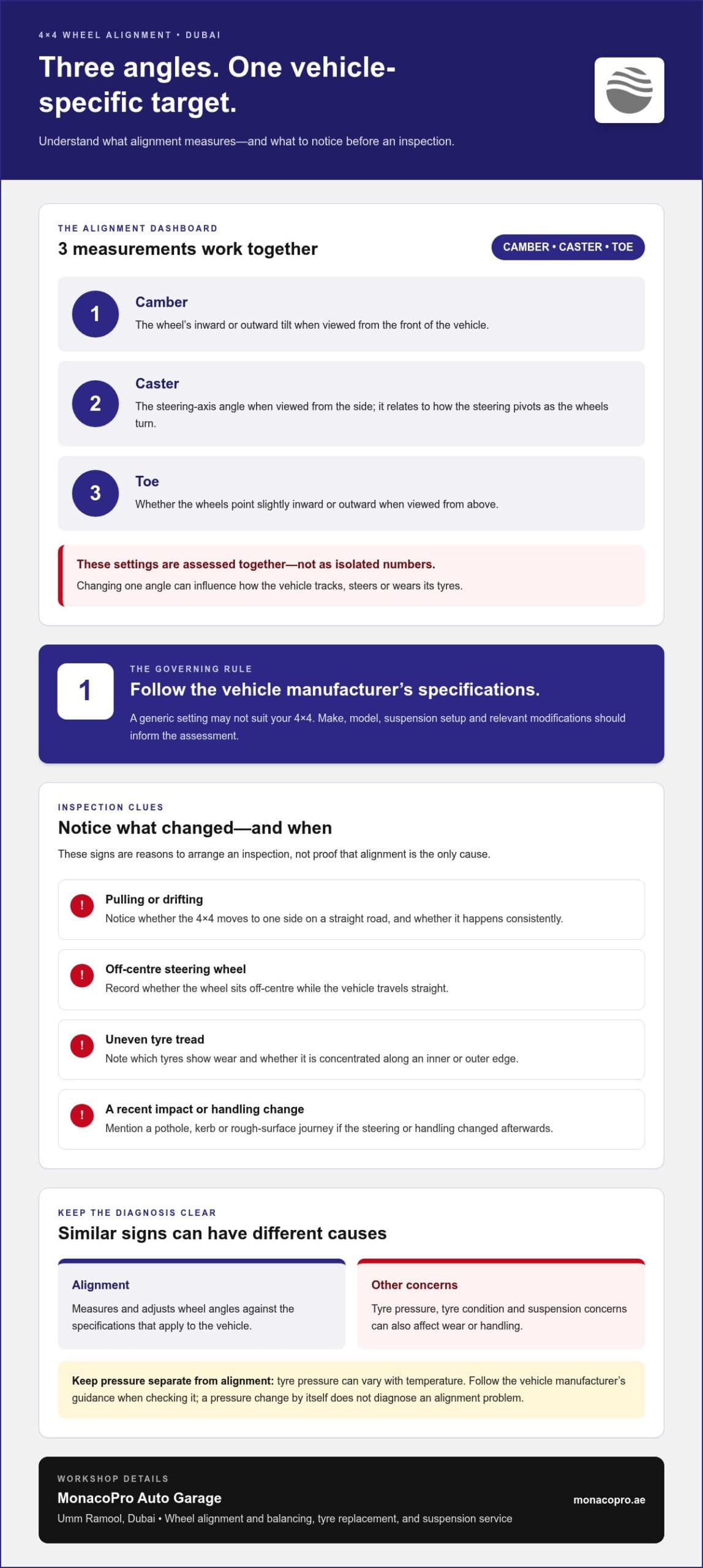
How 4×4 wheel alignment works: camber, caster, and toe
Alignment is not simply a matter of making every wheel look straight. A technician measures wheel angles, compares them with the vehicle manufacturer’s specifications and adjusts settings where the design allows. The angles work together, so changing one can affect how the wheels meet the road and how the vehicle responds in a turn. A technical overview from LUS Equip explains how caster, camber, and toe-in are interrelated in wheel alignment.
Vehicle-specific specifications matter more than generic settings because each 4×4 has its own model and suspension setup. A general target may not suit the vehicle. For wheel alignment for 4×4 vehicles Dubai, the make, model and any relevant modifications should inform the assessment.
What do camber, caster, and toe mean on a 4×4?
These terms describe different wheel angles, each viewed from a particular direction. Knowing what they refer to can make an alignment report easier to follow:
- Camber: The wheel’s inward or outward tilt when viewed from the front of the vehicle.
- Caster: The angle of the steering axis when viewed from the side. It relates to how the steering pivots as the wheels turn.
- Toe: Whether the wheels point slightly inward or outward when viewed from above.
The settings are considered together rather than as isolated numbers. An adjustment to one angle can influence how the vehicle tracks, steers or wears its tyres. The aim is to bring measurements in line with the specifications that apply to the vehicle.
Why can 4×4 specifications differ between vehicles?
Two 4x4s that look similar can have different manufacturer-defined alignment targets. The model and suspension setup matter, as can modifications or a change in ride height. Tell the technician about relevant changes so the readings can be considered in context instead of assuming the original factory setup still applies.
Four-wheel drive describes how engine power is delivered to the wheels. Four-wheel alignment describes measurement and adjustment across the vehicle’s wheels. They refer to different parts of the vehicle: having a four-wheel-drive system does not, on its own, define the alignment settings. A proper assessment considers the relevant wheels and the vehicle’s specifications.
MonacoPro Auto Garage in Umm Ramool, Dubai, provides wheel alignment and balancing for 4x4s. To learn more before your visit, explore MonacoPro’s wheel alignment service.
4X4 wheel alignment, balancing, or suspension service: what fits?
These services address different parts of a wheel or chassis concern, although their symptoms can overlap. Vibration may make wheel balancing worth assessing, while uneven tyre wear or changed handling may call for an alignment and suspension inspection. No single symptom identifies the cause by itself, so consider tyre condition and how the vehicle behaves together.
| Service | What it addresses | When it may be relevant |
|---|---|---|
| Wheel alignment | Adjusts wheel-angle settings to vehicle specifications. | Tracking changes, an off-centre steering wheel, or uneven tyre wear. |
| Wheel balancing | Corrects uneven weight distribution in a wheel-and-tyre assembly. | Vibration that warrants checking the rotating assembly. |
| Tyre replacement | Replaces tyres that are worn or damaged. | Tread or tyre condition indicates replacement is needed. |
| Suspension service | Assesses or addresses suspension concerns that can affect handling and wheel position. | Handling changes or signs of worn or damaged components. |
How is wheel alignment different from wheel balancing?
Alignment concerns the direction and angles of the wheels relative to the vehicle. Balancing concerns how evenly weight is distributed around the wheel and tyre, helping the assembly rotate smoothly. If you notice vibration, balancing may be relevant, but inspection findings should guide the next step. Alignment and balancing are separate services; completing one does not automatically make the other unnecessary.
Knowing the difference helps match the inspection to the concern rather than assuming every steering or vibration issue has the same fix. For wheel alignment for 4×4 vehicles Dubai, the vehicle’s symptoms and measurements should guide the service.
When should tyres or suspension be assessed too?
Tyre condition matters because worn or damaged tread can affect how the vehicle behaves and how wear patterns are interpreted. Suspension wear or damage may also affect handling and the wheel positions being assessed. If either is a concern, consider it as part of the service plan rather than expecting an angle adjustment alone to resolve every symptom.
MonacoPro Auto Garage offers alignment and balancing alongside tyre replacement and suspension service, so related concerns can be considered together. For more detail on suspension symptoms and repairs, see this guide to car suspension repair in Dubai.
If your 4×4 pulls to one side, do not assume alignment is the only possible cause. Tyres, suspension and other factors can contribute to similar behaviour. This guide to a car pulling to one side in Dubai explains why an inspection should consider the full set of symptoms.
How to prepare for a 4×4 alignment appointment in Dubai
A useful alignment appointment starts with a clear account of what you’ve noticed and what has changed on the vehicle. For wheel alignment for 4×4 vehicles Dubai, details such as a recent tyre change or suspension work help put the measurements in context. Use this checklist to prepare, then review the results against the specifications that apply to your 4×4.
What information should you share before alignment?
Before the appointment, note when the steering or handling change began and whether it happens consistently or only in particular conditions. For example, record whether the vehicle pulls during ordinary driving or whether the change first appeared after an impact. Share the vehicle’s model and any modifications, especially changes that may have affected ride height or suspension setup.
Have the vehicle model, symptom timeline and details of recent impacts, tyre changes, suspension work or modifications ready. This gives the technician useful context for assessing the current setup rather than relying on symptoms alone.
- Describe the symptoms. Explain what you feel through the steering or notice in the vehicle’s handling, when it began, and whether it is constant or situation-specific.
- Recall recent events. Mention impacts such as hitting a kerb or pothole, along with any tyre replacement or suspension work since the vehicle last drove normally.
- Identify modifications. Share relevant changes, including altered ride height, so the assessment can account for the vehicle’s current configuration.
What should you review after the alignment?
Take time to understand the findings. Review the measurements and adjustments, and discuss how they compare with the specifications that apply to your vehicle. The model and setup matter, particularly if the 4×4 has been modified. A clear explanation helps you understand what the alignment addressed and whether anything else may need attention.
If the original steering or handling concern remains, describe how it feels now and whether it has changed. Alignment may not explain every symptom. Depending on the inspection findings, tyre condition or suspension components may also need assessment. This helps distinguish an adjustment to the measured wheel angles from a separate issue that requires attention.
Follow recommendations suited to your vehicle rather than assuming every 4×4 needs checks on the same schedule. Your driving patterns, vehicle setup and future tyre or suspension work may all be relevant to when another assessment makes sense.
MonacoPro Auto Garage in Umm Ramool provides wheel alignment and balancing, with tyre replacement and suspension service for related needs. Book a 4×4 wheel alignment appointment with MonacoPro and bring these details to support a focused assessment.
Book 4×4 wheel alignment in Dubai with MonacoPro
Choose the next step based on the vehicle’s behaviour and inspection findings, not an assumption about the cause. Describe steering changes, uneven tyre wear or vibration, and mention recent impacts, tyre changes, suspension work and modifications. Then discuss the alignment measurements in relation to the specifications that apply to your 4×4. This helps distinguish an alignment adjustment from a related concern.
What makes MonacoPro relevant to Dubai 4×4 owners?
MonacoPro Auto Garage is located in Umm Ramool, Dubai, and provides wheel alignment and balancing. It is a local workshop option for Dubai drivers who want their 4×4’s alignment assessed alongside related wheel or suspension needs.
Tyre condition and suspension can be part of the overall picture, so MonacoPro also provides tyre replacement and suspension service. These services are not an automatic diagnosis: what fits depends on the reported symptoms and inspection findings. Keeping the discussion focused on those findings helps clarify what the alignment addresses and whether another concern also needs attention.
What is the next step for your 4×4?
Have the vehicle model and a concise description of the symptoms ready before arranging a visit. Note when you first noticed a change and whether it followed an impact, tyre change, suspension work or modification. Include any ride-height changes or other relevant adjustments. These details give the service discussion a practical starting point.
During the appointment, discuss how the measurements compare with your vehicle’s applicable specifications and what adjustments were made. If a symptom remains, explain what still feels different. Tyre or suspension assessment may be relevant depending on the findings. The aim is to discuss the 4×4 in front of you, rather than rely on a generic setting or assume one adjustment will address every concern.
Preparing these details can make a wheel alignment visit in Dubai more straightforward. Bring your observations, identify any modifications and review the results against the correct vehicle specifications.
If your 4×4 needs an alignment assessment, book a wheel alignment with MonacoPro. Share the vehicle details and symptoms when arranging your visit, then discuss the findings with the team at the Umm Ramool workshop.
Keep your 4×4 ready for the road ahead
Use an alignment inspection to respond to changes in your vehicle, rather than treating it as a one-off fix. After the inspection, notice how the 4×4 feels during your usual drives and keep track of any new steering or handling changes. That record can help you explain what has changed at a future service visit.
Choosing wheel alignment for 4×4 vehicles Dubai is easier when you treat it as a vehicle-specific assessment, not a generic adjustment. Describe what you’ve noticed, mention changes to the vehicle and use the findings to decide on a sensible next step. If tyre or suspension concerns arise, include them in the discussion where relevant.
When you’re ready to arrange an alignment, book your wheel alignment with MonacoPro. A clear account of your 4×4’s symptoms is a useful starting point for an assessment.
Frequently Asked Questions
How often should a 4×4 have its wheel alignment checked?
Follow the inspection interval in your vehicle’s owner’s manual, since there is no single schedule that suits every 4×4. Arrange an assessment sooner if steering behaviour changes, you notice unusual tyre wear or the vehicle takes a hard impact. After tyre or suspension work, an alignment check may also be appropriate. For wheel alignment for 4×4 vehicles Dubai, your driving conditions and vehicle guidance are more useful than an arbitrary mileage rule.
Can a lift kit affect wheel alignment on a 4×4?
Yes. A lift kit can change suspension geometry and affect wheel-angle readings. After a lift or another ride-height change, have the setup assessed using specifications suited to the vehicle’s current configuration. Do not assume the original settings still apply unchanged. Share details of the kit or other suspension modifications during the appointment, and discuss any limits the vehicle’s design places on adjustment.
Is four-wheel alignment the same as four-wheel drive?
No. Four-wheel drive describes a drivetrain that can send power to all four wheels; four-wheel alignment refers to measuring and adjusting wheel angles across the vehicle as applicable. The terms describe different things, so a 4WD badge does not indicate by itself what alignment service or settings a vehicle needs. The vehicle’s design and manufacturer guidance determine the relevant approach.
Can wheel alignment fix vibration in a 4×4?
Not necessarily. Vibration can have several causes, including an imbalance in a wheel-and-tyre assembly, tyre condition or another mechanical concern. Alignment may be relevant if measurements are outside the vehicle’s specifications, but vibration alone does not identify the cause. Note when it occurs, such as at a particular speed or under braking, and share that pattern during an inspection.
Should I replace tyres before or after a wheel alignment?
If your tyres are due for replacement, it is generally sensible to fit the replacement tyres before alignment, so the settings can be assessed with the tyres you’ll use. If the tyres are still serviceable, an inspection can help determine whether alignment is appropriate. Do not ignore badly worn or damaged tyres; discuss their condition first, since they can affect how the vehicle behaves and how wear patterns are interpreted.
Can I tell from tyre wear alone whether my 4×4 needs alignment?
No. Uneven wear is a useful reason to arrange an inspection, but it does not confirm an alignment problem by itself. Tyre pressure, tyre condition, driving patterns and suspension concerns can also influence tread wear. Compare tyres across the vehicle and note where wear appears, such as along one edge or in patches. Share those observations with the technician rather than relying on the tread pattern alone.
Does wheel alignment also reset the TPMS warning light?
No. Wheel alignment adjusts wheel angles, while the tyre pressure monitoring system (TPMS) relates to tyre-pressure readings and its sensors. If the warning remains on, check tyre pressures according to the vehicle guidance and have the TPMS system assessed if needed. A warning light should not be assumed to indicate an alignment issue. TPMS sensor programming is a separate service from wheel alignment.