
Coilovers aren’t automatically better than shocks and struts. The right choice depends on your car’s condition, how you use it and the suspension setup. To understand how to improve car handling and stability, look beyond a single component: balanced adjustments can make steering more predictable without sacrificing everyday comfort.
It’s natural to focus on suspension parts when a car feels unsettled, but tyres, alignment and chassis response also affect handling. This guide explains how electronic stability control and wheel alignment influence control, why weight balance matters, and what chassis braces, mounts and anti-roll bars change. It also covers how anti-roll-bar choices can shift the balance between understeer and oversteer, and why a modification that helps one car may not suit another. The aim is to help you assess handling changes before choosing what makes sense for your vehicle.
Key Takeaways
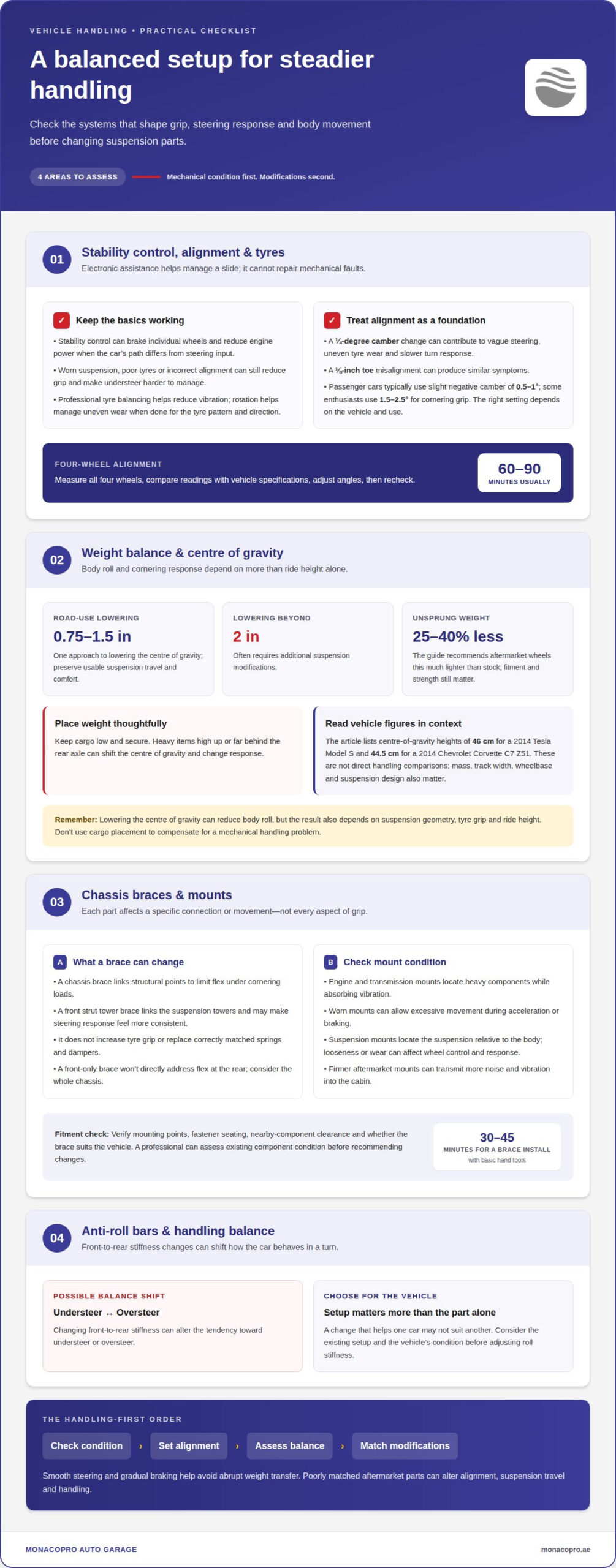
- Keep stability control functioning as intended, and treat accurate wheel alignment as a foundation for predictable steering and even tyre wear.
- Consider how added or repositioned weight affects balance and body movement before changing the suspension setup.
- Chassis braces and mounts can influence how the car responds, but their value depends on the vehicle and the condition of its existing components.
- Choose anti-roll-bar changes carefully: shifting front-to-rear stiffness can alter handling balance, including the tendency toward understeer or oversteer.
1. Electronic stability control and wheel alignment
Electronic stability control helps when a car’s path differs from the driver’s steering input. It can brake individual wheels and reduce engine power to help manage a slide. But it can’t fix worn suspension, poor tyres or incorrect alignment. These faults can reduce grip during acceleration or cornering and make understeer harder to manage. Understanding how to improve car handling and stability starts with separating electronic intervention from the vehicle’s mechanical condition.
Wheel alignment sets how the wheels meet the road and point relative to each other. A quarter-degree camber change can contribute to vague steering, uneven tyre wear and slower turn response. A toe misalignment of 1/8 inch can produce similar symptoms. Passenger cars typically have slight negative camber of 0.5 to 1 degree, while some enthusiasts use 1.5 to 2.5 degrees for cornering grip. The correct setting depends on the vehicle and its intended use.
For a professional four-wheel alignment, a technician measures all four wheels, compares readings with vehicle specifications, then adjusts alignment angles and rechecks them. The process usually takes 60 to 90 minutes. Alignment is sometimes called tracking; both terms refer to correcting wheel direction and angles so the car travels straight. Alignment pricing depends on the vehicle, adjustment needs and required components, with the amount provided after a quote request. These measured adjustments are a practical part of how to improve car handling and stability.
Professional tyre balancing corrects uneven weight distribution around a wheel, reducing vibrations that can distract the driver or affect steering feel. Rotation changes tyre positions to help manage uneven wear, in line with the vehicle’s tyre pattern and direction requirements. Together, balancing and rotation help maintain consistent contact with the road.
For turns, rain and emergency manoeuvres, smooth steering and gradual braking help avoid abrupt weight transfer; leave room to respond and reduce speed for conditions. Lowering a car beyond 2 inches often requires additional suspension modifications. Poorly matched aftermarket parts can alter alignment, travel and handling, so professionals assess the suspension and set alignment after changes.
2. Weight distribution and centre of gravity
A vehicle’s centre of gravity affects how much it leans and how weight transfers during cornering. Lowering the centre of gravity can reduce body roll, but the result also depends on suspension geometry, tyre grip and ride height. For road use, lowering by 0.75 to 1.5 inches is one approach; the setup must still preserve usable suspension travel and comfort.
Vehicle designs show how much centre-of-gravity height can vary. The 2014 Tesla Model S is listed at 46 centimetres, while the 2014 Chevrolet Corvette C7 Z51 is listed at 44.5 centimetres. These examples aren’t direct handling comparisons: mass, track width, wheelbase and suspension design also shape cornering behaviour. A wider track can influence lateral load transfer, while wheelbase affects how the vehicle responds to changes in direction.
Unsprung weight includes components that move with the wheels, such as wheel and tyre assemblies. Reducing it can help the suspension follow uneven surfaces, supporting traction and a more settled response. Lighter aftermarket wheels can reduce this weight; the guide recommends wheels weighing 25 to 40 percent less than stock. Correct fitment and strength still matter for the vehicle’s intended use.
Cargo placement affects vehicle balance. Heavy items placed high up or far behind the rear axle can shift the centre of gravity and change how the vehicle responds. A car with a front-heavy engine may behave differently from one with a balanced mid-engine layout, particularly under braking and acceleration. Keep loads low and secure, and don’t use cargo placement to compensate for a mechanical handling problem.
A roll cage adds structural components and weight, so its position can influence balance; a professional should consider the full vehicle setup. Weight reduction also needs trade-offs: removing interior materials may affect comfort, while removing essential safety equipment is not a handling solution. For changes involving wheels, professional wheel balancing can help address vibration linked to uneven wheel weight.
3. Chassis braces and mounts
A chassis brace connects structural points to limit flex when the vehicle loads up through corners. A front strut tower brace links the towers that support the suspension, helping them resist movement relative to each other. It may make steering response feel more consistent, but it won’t increase tyre grip or replace correctly matched springs and dampers.
Strut bars and braces are often used to describe similar components, although designs and fitment vary. A tower bar usually spans the engine bay, while other body braces connect points beneath the vehicle or across its structure. Each brace stiffens a particular area, so adding one without considering the rest of the chassis may bring little benefit. For example, a front-only brace won’t directly address flex at the rear.
Mount condition matters, too. Engine and transmission mounts locate heavy components while absorbing vibration. Worn mounts can allow excessive movement during acceleration or braking. Suspension mounts locate the suspension relative to the body, so wear or looseness can affect wheel control and response on uneven surfaces. A professional can assess their condition and fit before recommending replacement or a change in stiffness. Firmer aftermarket mounts can transmit more noise and vibration into the cabin, reducing comfort.
A strut tower brace can be installed with basic hand tools in 30 to 45 minutes, but fitment still requires care. The technician checks mounting points, fastener seating, clearance around nearby components and whether the brace suits the vehicle. After installation, a controlled road assessment can help identify rattles, contact or changes in steering feel. Braces don’t repair worn brakes or suspension parts, and they shouldn’t be treated as a fix for excess body roll on their own. The right change depends on the vehicle’s structure, use and existing condition.
4. Anti-roll bars and handling balance
An anti-roll bar links the suspension across an axle, resisting differences in wheel movement during cornering. A stiffer bar can reduce body roll, but it also changes how grip is shared between the front and rear tyres. The Lotus Elise example illustrates the role of suspension geometry: its roll-centre height is described as 6% of its centre-of-gravity height, with 94% of lateral force transferred through springs and dampers.
Anti-roll bars, springs and dampers each affect the vehicle’s response differently. The bar resists left-to-right suspension movement; springs support the vehicle’s weight and affect ride height, while dampers control how quickly suspension motion settles. Stiffer springs can reduce body roll but may compromise comfort on uneven surfaces. Dampers control oscillation; they don’t replace the bar’s role in balancing roll resistance.
Balance matters more than simply fitting a larger bar. On front-wheel-drive cars, a common setup uses a stiffer front bar and a weaker rear setup. Changing that relationship can introduce understeer or oversteer, which may be dangerous if unexpected. Performance sway bars are often selected 3 to 6 millimeters larger in diameter than stock, but diameter alone doesn’t determine the result. Bar shape, mounting points, suspension condition and tyre grip also affect response.
Lowering a car changes its suspension geometry and height, which can alter camber and the anti-roll bar’s effective leverage. Rubber bushes and end links also affect how directly the bar transfers force. Worn or unsuitable parts can cause noise or imprecise responses. Electronic stability control may help manage a skid, but it doesn’t make an unbalanced setup suitable for everyday driving. Fuel economy isn’t the purpose of an anti-roll bar, so it isn’t a useful measure of its handling effect.
For UAE road use, treat suspension changes as subject to applicable vehicle approval and roadworthiness requirements; a part fitting the car does not establish compliance. For a professional assessment of suspension balance, arrange a suspension assessment.
MonacoPro Auto Garage
MonacoPro Auto Garage can assess handling concerns by examining the systems that affect tyre contact, steering response and stability. If your car pulls, vibrates, feels unsettled in corners or displays a stability-control warning, an inspection can help identify whether the cause relates to alignment, tyres, suspension or an electronic fault.
Depending on the findings, service may include wheel alignment and balancing, suspension work, tyre replacement or computer diagnostics. These checks help distinguish a setup issue from a worn or faulty component, so the next step addresses the cause instead of relying on a modification alone.
To discuss a handling concern, contact MonacoPro Auto Garage in Umm Ramool, Dubai.
Make your next handling decision with confidence
A practical approach to how to improve car handling and stability starts with how you use your vehicle. Note what feels different during everyday driving, then have the cause assessed before choosing parts. A setup intended for occasional track use may not suit daily roads, where comfort, predictable responses and usable suspension travel matter.
Keep the assessment focused: describe the symptoms and any recent changes so the technician can consider the vehicle as a whole rather than treating one component in isolation. MonacoPro Auto Garage also provides computer diagnostics for electronic concerns, as well as battery replacement and oil changes for other maintenance needs.
When you’re ready to discuss a handling concern, contact MonacoPro Auto Garage. A measured assessment can help you choose a sensible path forward and drive with greater confidence.
Frequently Asked Questions
Are Coilovers Better Than Shocks And Struts?
Coilovers aren’t automatically better. They can suit drivers who need an adjustable suspension setup, while replacement shocks and struts may suit a car retaining its standard configuration. Some coilovers allow ride-height or damping adjustments, but they need careful setup to avoid an uncomfortable or poorly balanced result. For everyday driving in Dubai, consider road conditions and comfort alongside your handling goals before choosing a suspension change.
Are Polyurethane Bushings Worth It?
Polyurethane bushings can make suspension response feel more direct, but the firmer material may transmit more noise and vibration than rubber. The listed hardness range is 75 to 90 durometer for polyurethane, compared with 50 to 60 for rubber. They may suit a vehicle prioritising sharper response, while rubber can better preserve a quieter, more compliant ride. The right choice depends on use and mounting location.
How Can I Increase My Cornering Speed?
Prioritise control, not higher speeds on public roads. On a closed circuit, drivers can build confidence by looking through the corner, braking before turn-in, steering smoothly and accelerating progressively as the car straightens. Abrupt inputs can unsettle the vehicle and reduce available grip. Tyre condition, suspension response and a balanced setup matter more than a single modification.
How Do I Make My Car Stable At High Speed?
Start by addressing symptoms rather than fitting an aerodynamic part. A shaking steering wheel, a car that wanders or a new vibration can point to different issues, including wheel balance, tyre condition or suspension wear. Don’t continue at speed if the vehicle feels unstable. A professional assessment can identify whether the cause is mechanical, alignment-related or an electronic warning.
What Causes Poor Car Handling?
Poor handling can result from mismatched or worn components, damaged tyres, incorrect alignment, or a fault affecting the steering or stability systems. Symptoms can help narrow down the cause: pulling to one side differs from vibration through the steering wheel, while excessive bouncing points to another concern. Recent impacts, tyre changes or suspension work are useful details for a technician assessing your vehicle.
What Factors Effect The Handling Of A Car?
Handling reflects how the vehicle, tyres and driver work together. Tyre grip and condition, suspension geometry, steering response, braking behaviour and vehicle load all shape how it turns or changes direction. Wheelbase and track also influence its response. Road surface and weather alter available grip, while abrupt steering or braking can disturb balance. That’s why a change should be judged within the full setup.