
What if the right solution for a cracked leather seat isn’t a repair kit? In Dubai, heat and UV exposure can dry leather over time, but a fine surface crack and a split that exposes the seat’s foam need different approaches. Cracked leather seat restoration works best when the repair matches the damage, the material and how the car is used.
Before applying a DIY product, check how deep the damage appears. Fillers and colour compounds can be difficult to match, and a quick fix may not suit a worn or weakened area. Surface wear isn’t the same as a deep crack, and recognising the difference helps you choose an appropriate next step.
This guide explains common causes of cracked leather, signs that distinguish surface wear from deeper damage, and the practical limits of DIY repairs. It also outlines what to expect from professional upholstery restoration in Dubai. MonacoPro Auto Garage provides car upholstery restoration for all cars from its workshop in Umm Ramool, giving Dubai drivers a local option for professional interior care.
Key Takeaways
- Cracked leather seat restoration can improve damaged surfaces without automatically requiring full upholstery replacement. The extent and pattern of wear help guide the repair.
- Cleaning and conditioning support routine care, but they don’t repair cracked, peeling or otherwise damaged material.
- Compare DIY and professional approaches by considering the damage, the work involved and how important a consistent finish is to you.
- Before discussing restoration, note the affected seat area, crack pattern, any peeling and treatments already applied. Clear personal items from the seat.
- MonacoPro Auto Garage provides car upholstery restoration for all cars at its Umm Ramool workshop in Dubai.
What Causes Cracked Leather Seats, and What Does the Damage Mean?
Cracked leather seat restoration means repairing or improving a damaged seat surface. It doesn’t automatically mean replacing the upholstery. The right approach depends on whether the problem is limited to the finish or the seat material itself has split, peeled or worn away. Identifying that distinction helps avoid treating surface wear as though it were deeper damage.
Leather type and finish can affect how a seat wears and responds to care. The overview of leather in What is Leather? provides useful context. In practical terms, a fine line in the surface differs from a split that separates at the edges or reveals material beneath. When damage extends beyond the surface finish, the repair needs to address more than appearance.
How to recognise different levels of leather-seat damage
Look at the shape and location of the wear, but don’t rely on appearance alone to judge its depth. A narrow-looking crack may extend farther into the material than you can see. Avoid pulling at it or applying a product as a test, since that can change the damaged area.
- Fine surface lines: Thin marks with no obvious gap between the edges may indicate early surface wear.
- Separated edges: A visible gap or lifted edges can suggest a deeper split.
- Colour loss or peeling: Faded patches and flaking indicate finish damage. Peeling may expose a different layer underneath.
- Punctures or missing material: A hole or area where material is gone is more than a surface crack and needs careful assessment.
Perforated seat panels and seams need particular care. A mark near stitching may involve the seam rather than just the panel surface, while perforations can make it harder to judge the underlying condition at a glance.
Why Dubai driving conditions matter to seat care
How Does Cracked Leather Seat Restoration Work?
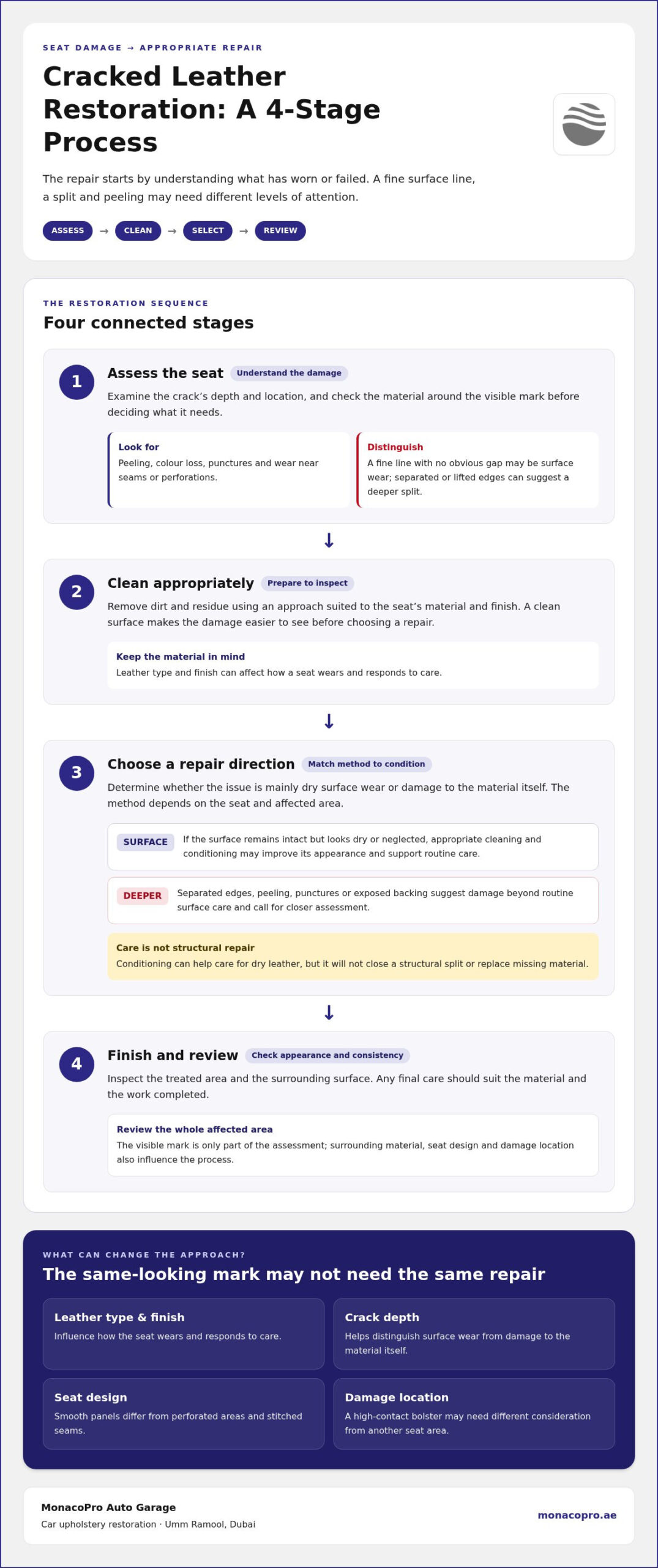
A sound repair starts with understanding what has worn or failed, rather than treating every mark as the same problem. The general sequence is to assess the damaged area, clean it appropriately, select a repair method that suits the material and damage, then finish and review the result. The steps vary because a fine surface line, a split and peeling can call for different levels of attention.
- Assess the seat: Examine the crack’s depth and location, along with any peeling, colour loss, punctures, or wear near seams and perforations. Check the material around the visible mark as well.
- Clean appropriately: Remove dirt and residue using an approach suited to the seat’s material and finish. A clean surface makes the damage easier to see before choosing a repair.
- Choose a repair direction: Determine whether the issue is mainly dry surface wear or damage to the material itself. The method depends on the seat and affected area.
- Finish and review: Inspect the treated area and surrounding surface for appearance and consistency. Any final care should suit the material and the work completed.
Leather type, crack depth, seat design and damage location all influence the process. A mark on a smooth panel presents different considerations from one on a perforated area, stitched seam or high-contact bolster. Copying a repair method from another seat can lead to an unsuitable result: visible symptoms may look similar even when the underlying damage differs.
What can be done for fine surface cracks?
Use products intended for the seat’s material and follow their directions. Applying several treatments to the same area can make it harder to judge the original condition, so don’t layer products in an attempt to disguise a crack. If a fine line catches or opens when the seat flexes, get the damage assessed rather than assuming it is only dry surface wear.
When cracks need a more involved repair
Separated edges, peeling, punctures or exposed backing suggest the damage extends beyond routine surface care. A closer assessment can distinguish a repairable surface issue from damage that may call for a more extensive upholstery solution. Colour and texture matter, while seams and perforations require attention because the repair needs to account for the seat’s construction.
Professional upholstery restoration considers the damaged area and the seat as a whole before identifying a suitable direction for the work. For cracked leather seat restoration, matching the repair approach to the actual damage is more useful than choosing a product based only on the word “crack.” MonacoPro Auto Garage provides car upholstery restoration for all cars in Umm Ramool, Dubai. Explore car upholstery restoration for professional care of a damaged seat.
DIY Repair or Professional Restoration: Which Option Fits Your Cracked Seat?
The choice depends on whether you’re caring for a surface or trying to address damaged material. Routine cleaning and conditioning can suit light wear when the seat remains intact. Deeper splits, peeling, exposed backing or prominent damage call for a more considered assessment. Use this comparison to decide whether home care is appropriate or professional upholstery restoration is worth exploring.
| Approach | Suitable damage | Likely effort | Limitations and finish |
|---|---|---|---|
| DIY cleaning and conditioning | Light dryness or surface wear with intact material | Routine care, following product directions | Won’t repair a split or replace missing material; appearance may remain uneven |
| DIY repair product | Minor surface marks, depending on the product and seat | Careful preparation and application | Colour and texture can be difficult to match; results depend on the damage and application |
| Professional upholstery restoration | Deeper, widespread or visually prominent damage | Assessment and a repair plan suited to the seat | The finish depends on the condition, material and affected area |
When careful DIY care may be reasonable
For light surface wear, start with care rather than a repair compound if the material is intact. Choose a cleaner or conditioner intended for the seat’s material and finish, then test it on a discreet area first. Follow the instructions and observe the test area before treating a visible section. Avoid abrasive pads, stiff brushes and household cleaners that may be incompatible with automotive upholstery.
Keep expectations measured. Cleaning may remove surface residue, while conditioning may improve the look of dry or neglected leather. Neither step closes a structural split or restores material that has peeled away. If the mark remains open, catches or looks more visible after care, stop rather than adding more product. Repeated applications can make the damage harder to assess.
When professional upholstery restoration is worth considering
Consider a professional assessment if the crack has separated edges, the finish is peeling, backing is exposed or several touch-ups haven’t helped. Damage across a high-visibility panel can also be difficult to blend at home. An even-looking repair depends on how the affected area relates to the surrounding seat, including its colour, texture, seams and perforations.
Professional restoration is a repair option, not an automatic decision to replace the seat. The right direction depends on the extent and location of the damage. For cracked leather seat restoration, separating repair from replacement keeps the decision focused on the seat’s actual condition. If you’re weighing those options, leather car seat upholstery options offers a broader discussion of the choices.
Leather Seat Restoration: Prep and Care in Dubai
Good preparation makes it easier to describe the seat’s condition and discuss the next step. Before arranging an assessment for cracked leather seat restoration, record what you can see without pulling at the cracks or applying another product. Clear the affected seat so the damaged area is accessible, and note any previous treatment.
- Document the location: Note which seat and area are affected, such as the outer bolster, cushion or backrest.
- Describe the pattern: Record whether the marks are fine lines, a wider split or several cracks, and estimate how much of the panel they cover.
- Note visible changes: Mention peeling, missing material, exposed backing, and any nearby seams or perforations.
- Clear and photograph: Remove personal items from the seat and take clear photos in good light from more than one angle.
- List past treatments: Write down any cleaners, conditioners, repair compounds or previous repairs used on the area.
What information helps assess a cracked seat?
Specific observations are more useful than simply describing the seat as “cracked.” Explain whether the damage is on the driver’s seat edge or centre panel, whether the edges appear separated, and whether colour loss or peeling surrounds the lines. Mention perforations, stitching and earlier touch-ups too. Photos can help show what you’re seeing when arranging an assessment, but they don’t replace an in-person inspection of the seat.
How to care for restored leather seats
MonacoPro Auto Garage provides car upholstery restoration for all cars from its workshop in Umm Ramool, Dubai. Arrange an upholstery assessment to discuss your seat’s condition with MonacoPro.
Cracked Leather Seat Restoration in Umm Ramool: What to Expect from MonacoPro
Choosing a restoration direction is easier when the visible damage has been described clearly. A fine surface mark, a peeling section and a split near a seam can raise different questions, so noting what you see gives the discussion a useful starting point. You don’t need to diagnose the damage yourself or decide in advance whether repair or replacement is appropriate.
MonacoPro Auto Garage is located in Umm Ramool, Dubai, and provides car upholstery services for all cars, including upholstery restoration. For a cracked seat, the aim is to connect what’s visible with an appropriate upholstery direction. The condition and location of the damage, along with the seat’s design, help shape that discussion without presuming a specific result.
A considered route from visible damage to service
Start by identifying the affected seat and noting where the cracks appear, whether the edges are separated, and whether there’s peeling or missing material. Include any earlier treatments, then bring the vehicle to MonacoPro’s Umm Ramool workshop so the seat can be considered in context. These details help frame restoration options around the actual condition rather than an assumption based on a photograph or product label.
The seat design matters too. A damaged area near a seam, perforation or prominent panel may need a different restoration direction from a small mark on an uninterrupted surface. An assessment provides a basis for discussing the work, not a promise of a particular finish, repair duration or guaranteed outcome. Each seat has its own condition and construction.
Explore MonacoPro’s upholstery service in Dubai
For Dubai drivers, MonacoPro’s Umm Ramool location offers a local option for car upholstery care. The garage provides upholstery services for all cars, including restoration, so a cracked seat can be considered as part of the vehicle’s interior needs. A clear description of the damage helps focus the discussion on the affected area and practical choices for the upholstery.
For cracked leather seat restoration, a clear description and an informed discussion are useful first steps. Explore MonacoPro’s upholstery service and arrange the next step for your car upholstery.
Take the Next Step with Confidence
Your seat’s condition can guide what happens next. Rather than trying another product or deciding on replacement straight away, use what you’ve observed to start a focused conversation about suitable upholstery care. This keeps the decision grounded in the seat’s actual needs.
For cracked leather seat restoration, MonacoPro Auto Garage offers car upholstery services for all cars from its workshop in Umm Ramool, Dubai. Explore the service to discuss your seat’s condition and consider an appropriate restoration direction.
Explore MonacoPro’s upholstery service in Umm Ramool and take the next step towards caring for your car’s interior.
Frequently Asked Questions
How much does cracked leather seat restoration cost in Dubai?
There isn’t one fixed cost for cracked leather seat restoration in Dubai because the work depends on the damaged area, crack severity, seat construction and restoration required. A small surface mark and extensive peeling involve different scopes. For a useful assessment, describe where the damage is and whether material is missing, and share clear photos if possible. General online figures are guidance, not a quote for your seat.
Can leatherette seats develop cracks like leather seats?
Yes, leatherette and other synthetic upholstery can crack, peel or wear too. Their surface construction differs from natural leather, so a cleaner or repair compound intended for one material may not suit another. Check the vehicle’s upholstery information or owner’s manual if you’re unsure what the seats are made from. Avoid applying a repair product until the material and damage have been assessed.
Does leather conditioner repair a cracked car seat?
No, conditioner is for routine care, not structural repair. Depending on the seat’s condition and the product, it may improve the feel or appearance of dry leather, but it won’t rebuild missing material or close a deep split. If a crack opens when someone sits down or has peeling edges, conditioner alone won’t address the damage. Use it as maintenance, following the product directions, rather than as a complete repair.
Is it safe to use a leather repair kit on a perforated seat?
Applying a repair kit over perforations can be risky unless the product is suitable and used according to its directions. Filler, dye or adhesive may cover the small openings or affect the nearby finish. Follow product instructions and avoid spreading the material across a large area. If the damage touches perforations or stitching, a close assessment can help determine how to approach the seat without assuming every kit is suitable.
Can seat covers prevent cracked leather from getting worse?
A well-fitting seat cover may reduce some direct contact and friction, but it won’t repair existing cracks or stop every cause of wear. A loose or unsuitable cover can shift, and some covers may retain heat, so follow the manufacturer’s fitting and care instructions. Check that the cover suits the seat’s design and features. Continue appropriate upholstery care, and pay attention if a crack expands or begins to peel beneath the cover.
What should I avoid using on cracked leather seats in Dubai?
Avoid harsh household cleaners, abrasive pads, untested solvents and products not intended for your seat material. These can affect the surface or make damage harder to assess. Follow the care product’s label and test it discreetly as directed before treating a visible area. Dubai’s direct sun can add to interior wear, so choose shaded parking when practical to limit exposure. Don’t rely on conditioning to repair a split or peeling section.
Can a cracked leather seat be restored without removing it from the car?
Whether restoration can be done with the seat installed depends on the damaged area, access, seat design and work needed. A mark on an exposed surface may be easier to reach than damage tucked beside trim or a seam. Seat removal isn’t automatically necessary, but it can’t be ruled out in every case. The specific seat and affected area guide the approach, so don’t plan around removal before an assessment.