
What if the tyre pressure warning isn’t caused by low pressure at all? A warning that stays on after you’ve checked the tyres can leave you unsure whether it’s safe to drive or whether a sensor needs replacing. Careful tyre pressure sensor fault diagnosis helps distinguish an actual pressure issue from a sensor, signal or system fault before parts are changed.
That distinction matters in Dubai, where heat can affect tyre pressure and a warning light alone won’t identify the cause. A steady light commonly signals that one or more tyres need attention, while a flashing light can indicate a TPMS fault, but warning behaviour varies by vehicle. Start with safe checks: measure pressure when the tyres are cold and follow the vehicle’s recommended settings. If the warning remains, a professional assessment can help pinpoint the next step.
In this guide, you’ll learn what common warning patterns can mean, which checks you can carry out yourself, and when a sensor or communication problem needs further diagnosis. We’ll also explain how car computer diagnostics and TPMS sensor programming at MonacoPro Auto Garage in Umm Ramool can support an accurate repair decision, so you can address the cause rather than guess which parts to replace.
Key Takeaways
- A TPMS alert points to a condition that needs investigation; it does not, by itself, confirm a failed sensor.
- Tyre pressure sensor fault diagnosis works best as a sequence: verify tyre condition, review vehicle-specific fault information, then narrow down the cause.
- Low pressure, a sensor problem, signal disruption and a setup requirement can produce overlapping clues, so one symptom may not identify the fault.
- Use reliable vehicle guidance when checking pressure, and consider how Dubai’s changing temperatures may affect readings.
- At MonacoPro Auto Garage in Umm Ramool, car computer diagnostics and TPMS sensor programming support a repair decision based on the fault found.
Tyre pressure sensor fault diagnosis: what the warning actually means
Your tyre pressure monitoring system (TPMS) checks tyre pressure and alerts you when it detects a condition that may need attention. Depending on the vehicle, it may use sensors inside the wheels or estimate pressure changes through other vehicle systems. The Tire-pressure monitoring system (TPMS) overview explains these approaches and the system’s purpose.
A tyre pressure warning signals a condition to investigate; it does not, by itself, prove that a TPMS sensor has failed. A low-pressure alert and a system-fault message point to different possibilities. The first may mean a tyre is below its recommended pressure. The second may indicate that the monitoring system cannot read or report pressure as expected. Dashboard symbols and wording vary between vehicles, so don’t diagnose the cause from the icon alone.
This distinction helps prevent an unnecessary part replacement. If the tyre is underinflated, its pressure needs attention; if the system has a fault, adding air may not clear the warning. Reliable tyre pressure sensor fault diagnosis considers both the tyre’s actual condition and the information the vehicle reports, rather than treating every alert as proof of a failed sensor.
What information does the TPMS warning provide?
The dashboard may show a warning symbol, a text message or pressure readings. Some vehicles identify the affected tyre; others display only a general alert. A steady light or a flashing symbol can have different meanings across makes and models, so check the owner’s manual for the exact warning behaviour and any instructions that apply to your vehicle.
Note what the display shows and when it appears, such as after starting the car or while driving. Also record whether the warning stays on or changes. These details help a technician compare the warning with the tyre condition and the vehicle’s system information.
Why can the warning appear when a tyre looks normal?
A tyre can look properly inflated and still be below the vehicle’s recommended pressure. Visual checks cannot measure pressure accurately, so use a reliable gauge and the vehicle’s recommended settings. A TPMS sensor or another part of the system may also trigger an alert even when the tyres appear normal.
If the warning persists after you’ve checked and corrected the pressure, further assessment can help distinguish a pressure issue from a sensor or system fault. This is the focus of TPMS malfunction diagnosis, where the warning is treated as a clue, not a verdict.
How professionals diagnose a tyre pressure sensor fault
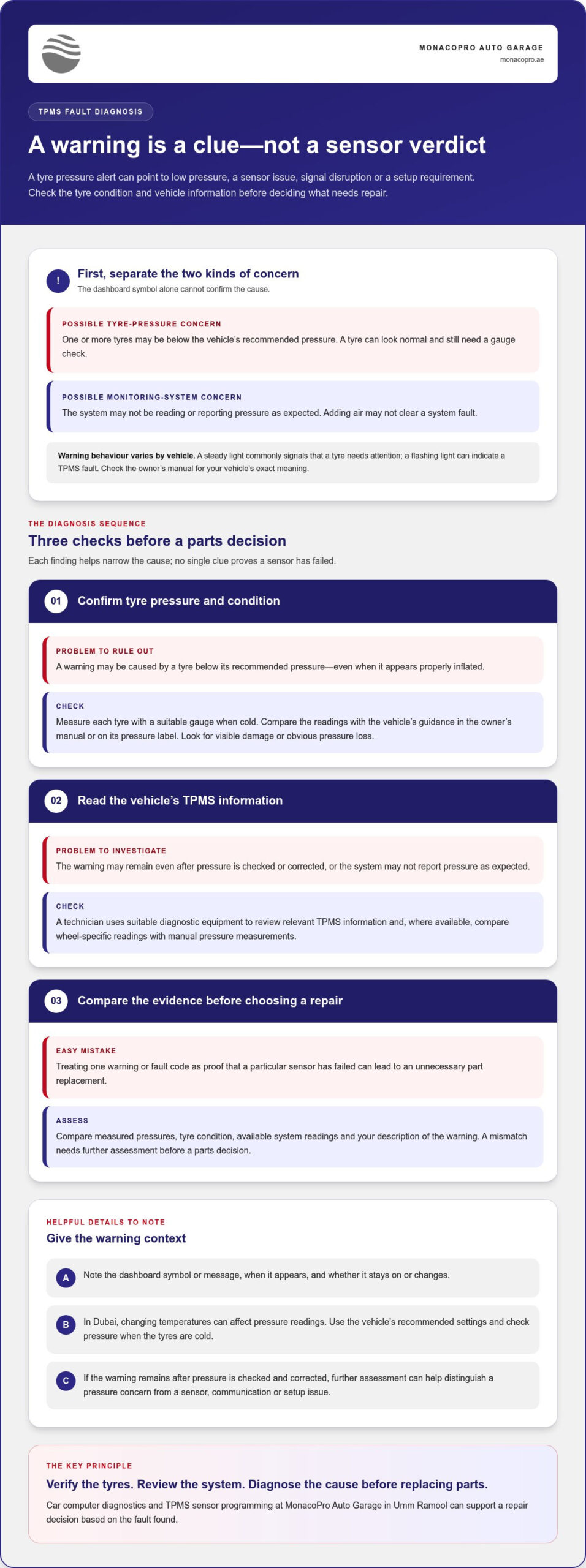
Accurate tyre pressure sensor fault diagnosis follows a sequence rather than jumping straight to replacement. A technician first establishes whether the tyres are correctly inflated, then reviews vehicle-specific TPMS fault information and assesses which cause best fits the evidence. Comparing these findings with your account of the warning helps distinguish a pressure concern from a sensor, communication or setup issue.
The exact checks depend on the vehicle’s TPMS design and the manufacturer’s procedure. A direct system may provide pressure information from wheel sensors, while another system may monitor pressure indirectly. The Federal regulations on TPMS describe requirements for vehicles covered by that US standard; they are not a substitute for the relevant vehicle-specific procedure in Dubai.
- Confirm tyre pressure and condition. Measure each tyre and compare the results with the vehicle’s recommended cold-pressure guidance. Check for visible damage or an obvious pressure loss.
- Read the vehicle’s fault information. Use suitable diagnostic equipment to identify relevant TPMS information and, where available, compare wheel-specific readings.
- Assess the likely cause. Compare system information with measured pressures, tyre condition and the warning you reported before deciding what action is appropriate.
A fault code should guide diagnosis, not replace it. It points the technician towards an area to investigate, but it doesn’t automatically prove that a particular sensor has failed. If a reading doesn’t match the physical pressure, for example, further assessment is needed before making a parts decision.
Start with the tyres and the vehicle’s recommended pressures
Find the correct pressure guidance in the owner’s manual or on the vehicle’s pressure label, which may be placed on the driver’s door area or another location specified by the manufacturer. Use a suitable pressure gauge rather than judging inflation by appearance. If a tyre measures below the recommendation, address that condition first, then follow the vehicle’s instructions to see whether the warning remains.
This first check gives technicians a reliable baseline. Without it, a pressure alert and a system fault can be harder to distinguish because the dashboard warning alone doesn’t describe the tyre’s measured condition.
Use fault information to narrow down the cause
After checking the tyres, a technician can review TPMS information available for the specific vehicle. Wheel-specific readings, when supported, can be compared with manual pressure measurements and your description of the warning: which message appeared, when it started and whether it changes. A mismatch can point to further checks, but it doesn’t prove that one component has failed.
A sensor issue, interrupted communication and a vehicle-specific setup requirement can call for different next steps. That’s why technicians interpret the information in context and follow the relevant manufacturer procedure before recommending a repair. At MonacoPro Auto Garage in Umm Ramool, car computer diagnostics and TPMS sensor programming support a diagnosis-led repair decision when system assessment or setup is needed.
Sensor failure or another TPMS issue? Compare the likely causes
A dashboard alert can point towards several different problems, and the same symptom may mean different things on different vehicles. Use the clues below as a starting point, not a verdict. Sound tyre pressure sensor fault diagnosis compares the warning with measured pressure and vehicle-specific system information before recommending a repair.
Possible cause
Clues
What clues cannot prove
Diagnostic follow-up
Low tyre pressure
A measured pressure is below the vehicle’s recommendation; the display may identify a wheel.
A warning alone doesn’t reveal how low the tyre is or why pressure dropped.
Measure all tyres against manufacturer guidance; investigate repeated pressure loss separately.
Sensor fault
The system may not report expected information for a wheel, or a fault message may appear.
A missing or unusual reading doesn’t prove the sensor itself is the cause.
Check TPMS fault information and assess the sensor in the context of the vehicle.
Communication issue
The vehicle may intermittently or consistently fail to receive expected sensor information.
An interrupted reading doesn’t distinguish a sensor problem from a wider system issue.
Compare available system data and follow vehicle-specific diagnostic procedures.
Setup requirement
A warning may follow tyre or sensor work, or the system may need to recognise a change.
Timing alone doesn’t confirm that setup is the only cause.
Check the required relearning or programming procedure for that vehicle.
Low tyre pressure versus a sensor fault
Compare actual pressure with the value recommended by the vehicle manufacturer, using a suitable gauge rather than appearance. If a tyre is underinflated, address that condition first and then observe the dashboard according to the owner’s manual. If pressure is correct but the warning remains, continue diagnosis instead of assuming the sensor has failed. Correct pressure narrows the possibilities; it doesn’t identify the fault by itself.
Keep repeated pressure loss separate from a TPMS warning. If the same tyre needs air again, the tyre or valve may need inspection to establish why it’s losing pressure. A system reset or sensor replacement won’t correct an underlying tyre condition.
Sensor, signal, or setup issue?
A sensor fault is one possible explanation when the system can’t report expected information, but communication problems or a required relearning step can produce similar clues. Recent tyre or sensor work is useful context, not proof. The correct next check depends on the vehicle’s TPMS design and procedure.
What Dubai drivers should do when a TPMS fault appears
A TPMS warning is a reason to check the tyres and the vehicle’s instructions, not something to ignore or interpret from the dashboard alone. In Dubai, heat and changing conditions can affect measured tyre pressure, so compare readings with the manufacturer’s guidance and consider when and how the measurement was taken. If the alert remains unclear, professional tyre pressure sensor fault diagnosis can distinguish a pressure concern from a system issue.
Use this calm first-response checklist:
- Reduce risk. If the car’s handling changes or a tyre looks damaged or unusually low, pull over somewhere safe and inspect it.
- Check each tyre. Look for visible damage and use a suitable pressure gauge rather than relying on appearance or the TPMS display alone.
- Follow vehicle guidance. Find recommended pressures and warning descriptions in the owner’s manual or on the vehicle’s pressure label.
- Arrange an assessment if needed. Suspected pressure loss, visible damage or a warning that persists after pressure checks warrants prompt professional attention.
Tyre condition matters alongside sensor function. For broader guidance on choosing and caring for tyres in local conditions, consult the Dubai tyre shop guide.
When should you stop and inspect the tyre?
What should you note before a garage diagnosis?
A few details can make the assessment more focused. Record the exact warning or symbol, when it first appeared, and whether it returned after you checked pressure. Note any recent tyre replacement, wheel work or other service that may be relevant. Have the vehicle’s manual available, or note its recommended pressures and warning descriptions, since TPMS procedures and displays differ between models.
These observations help a technician compare your experience with the measured tyre condition and vehicle-specific fault information. If a warning persists or a sensor setup issue is suspected, TPMS diagnosis and programming in Umm Ramool can help identify the appropriate next step.
Professional tyre pressure sensor fault diagnosis in Umm Ramool
A persistent TPMS warning doesn’t automatically mean a sensor needs replacing. At MonacoPro Auto Garage in Umm Ramool, Dubai, professional tyre pressure sensor fault diagnosis brings together the tyre’s measured condition, your description of the warning and the vehicle’s available TPMS fault information. Considering these clues together helps identify a sensible repair direction instead of relying on guesswork.
The findings may point to a pressure concern, a sensor-related issue or a setup requirement. Each calls for a different response. If a tyre needs attention, tyre-related work may be relevant; if the system needs sensor setup, programming may be the appropriate next step. Tyre replacement, alignment or balancing belongs in the plan only when the diagnosed condition makes it relevant.
What to expect from a clear diagnostic process
A useful assessment starts with what you’ve noticed: the warning symbol or message, when it appeared, and whether it returned after pressure checks. The technician can compare those symptoms with measured tyre pressure and vehicle-specific fault information. This context matters because one dashboard alert can’t, by itself, establish whether the source is the tyre, a sensor or another part of the TPMS.
Car computer diagnostics can help review available vehicle fault information, while pressure checks establish whether the tyres match the vehicle’s recommended guidance. The relevant checks and warning behaviour depend on the vehicle’s TPMS design and manufacturer procedure. A clear diagnosis considers the evidence available for your vehicle rather than applying one assumption to every model.
The purpose is to narrow down the issue before deciding on a repair. A pressure concern and a sensor or setup concern may produce a warning but require different actions. Assessment helps explain which finding best fits the evidence and whether further checks are needed before replacing a part. The repair recommendation should follow the findings from your vehicle, not the warning symbol alone.
From diagnosis to the right next step
If the findings point to a sensor-related issue, the next step may involve TPMS sensor programming or another relevant repair. Programming can be important when a replacement sensor or vehicle-specific setup requires it, but it isn’t a universal fix for every warning. The diagnosis should connect the identified fault to the proposed action, so you understand why that step is recommended.
MonacoPro Auto Garage provides TPMS sensor programming and car computer diagnostics in Umm Ramool. The technician can explain the assessment and proposed next step in relation to the fault found. This measured approach helps avoid replacing a sensor simply because a warning appeared, while ensuring a genuine pressure or setup concern is not overlooked.
If your TPMS alert persists or its cause is unclear, book TPMS diagnosis with MonacoPro Auto Garage in Umm Ramool and take the next step with a clearer understanding of the issue.
Make your next TPMS decision with confidence
An unexplained TPMS alert can make every journey feel uncertain, but you don’t have to decide what to replace based on a dashboard symbol alone. The useful next step is to turn the warning into a clear repair decision, supported by the vehicle’s condition and diagnostic findings. That makes tyre pressure sensor fault diagnosis a practical way to protect your time as well as your tyres.
Once the cause is identified, keep the result as a reference point. If a warning returns, knowing what was checked and what action was taken can help the next assessment start with useful context instead of repeating assumptions. This measured approach leaves room for the right repair, whether the issue relates to pressure, a sensor or system setup.
At MonacoPro Auto Garage in Umm Ramool, TPMS sensor programming and car computer diagnostics support professional assessment. If the warning remains on or you want a diagnosis before replacing parts, arrange professional TPMS diagnosis in Dubai. Take the next step with clarity and move forward with greater confidence.
Frequently Asked Questions
Can I drive with a tyre pressure sensor fault warning?
It depends on whether the warning reflects a tyre problem or a TPMS system fault. Check the tyres and consult your vehicle’s manual; a sensor fault can mean the system may not reliably alert you to pressure changes. If a tyre looks damaged or low, or the car handles differently, stop somewhere safe and seek professional help. Don’t rely on the warning light alone to judge whether continuing is safe.
Can a TPMS warning appear when all tyres have the correct pressure?
Yes. A warning may remain even after pressure is corrected, or appear when a sensor or another part of the monitoring system isn’t reporting as expected. Confirm your readings with a suitable gauge and compare them with the vehicle’s specified pressures. If the readings are correct but the alert stays on, note whether it changes after restarting the car, then arrange diagnosis rather than repeatedly adding air.
Does a new tyre pressure sensor need programming?
It may. Some vehicles require a new sensor to be programmed, paired or otherwise recognised by the TPMS before it reports correctly. The required procedure depends on the vehicle and replacement sensor, so don’t assume installation alone completes the job. If a warning appears after sensor replacement, have the system setup assessed. MonacoPro Auto Garage provides TPMS sensor programming in Dubai when the vehicle’s procedure calls for it.
Can tyre rotation or tyre replacement trigger a TPMS warning?
It can, depending on the vehicle’s design and what happened during the work. After a rotation, a system that identifies individual wheels may need to update which reading corresponds to each position. During tyre replacement, a sensor may also be disturbed or damaged, or the system may require a relearning procedure. A warning after wheel work is useful diagnostic context, but timing alone doesn’t identify the cause.
Does Dubai heat affect tyre pressure readings?
Yes. Tyre pressure changes as the air inside the tyre warms, so a reading taken after driving may differ from one taken before a journey. For a useful comparison, follow your vehicle manual’s instructions about checking pressure, including whether tyres should be cold. Avoid reducing pressure just because a warm tyre reads higher than expected; use the manufacturer’s guidance to decide what adjustment, if any, is appropriate.
How do I know whether the fault is the sensor or the tyre?
Compare a gauge measurement with the vehicle’s recommended pressure, then consider whether the tyre loses pressure again or shows visible damage. A repeat loss suggests the tyre or valve needs attention, while correct readings don’t automatically prove a sensor failure. The warning pattern and vehicle fault information help complete tyre pressure sensor fault diagnosis. A technician can assess both the tyre condition and TPMS data before recommending a repair.
Will a TPMS warning clear on its own?
Sometimes a warning may go out after the underlying pressure issue is corrected, but the timing and reset behaviour depend on the vehicle. Some systems require a specific reset or relearning process described in the manual. A fault caused by a sensor or communication problem is unlikely to be solved simply by waiting. If the warning persists or returns, arrange an assessment instead of assuming the system has reset.