
Imagine you’re cruising down the E11 at 120 km/h, and the moment you relax your grip, your steering wheel starts a slow, persistent crawl toward the barrier. It’s an unsettling experience that turns a routine commute into a high-stress workout. Constant steering correction is more than a minor annoyance; it’s a safety risk that often signals deeper mechanical issues. If your car pulling to one side Dubai has become a daily struggle, you’re likely concerned about losing control at high speeds or the mounting cost of replacing unevenly worn tyres.
You deserve a vehicle that tracks straight and responds with precision. This guide explores the mechanical and environmental reasons your car drifts, from 3D wheel alignment discrepancies to the impact of extreme heat on suspension components. By understanding these root causes, you can restore your car’s handling and avoid the expense of unnecessary part replacements. We’ll walk through a professional diagnostic approach to ensure your vehicle returns to the road with the stability and safety you expect from a premium driving experience. Discover how to identify the culprits behind steering drift and what it takes to achieve a safe, straight-tracking ride once again.
Key Takeaways
- Identify the difference between constant steering pull and random wandering to provide your technician with accurate diagnostic data.
- Learn how Dubai’s intense summer heat and the physical design of local highways can mimic mechanical steering issues.
- Uncover hidden causes for your car pulling to one side Dubai, including tyre conicity and suspension component fatigue, that often go beyond simple wheel alignment.
- Master a safe, step-by-step “hands-off” test to evaluate your vehicle’s tracking before visiting a service center.
- Understand the value of 3D computerized alignment and comprehensive diagnostics in extending tyre life and ensuring high-speed stability.
Why Your Car is Pulling to One Side: Understanding the Drifting Sensation
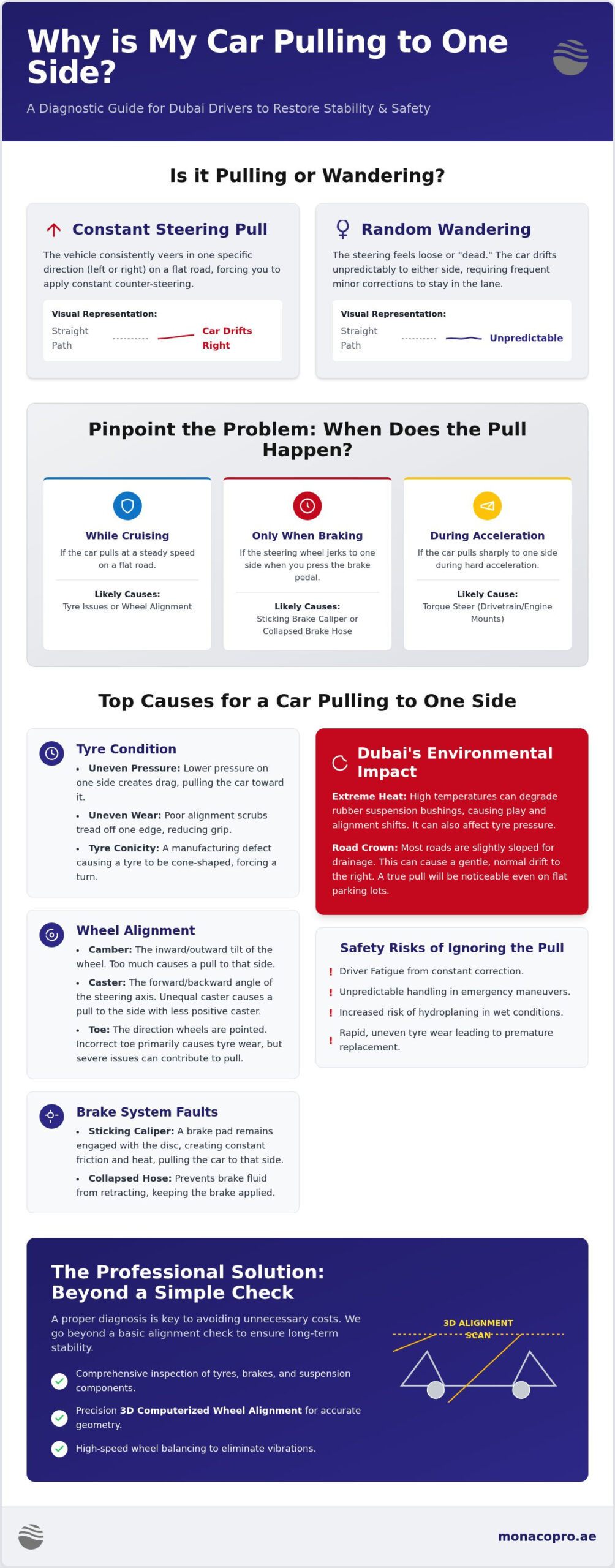
When you’re driving on a level road, your vehicle should maintain a straight trajectory with minimal input. Steering pull occurs when the car consistently veers from this path, requiring you to apply counter-pressure to the steering wheel just to stay in your lane. It’s a distinct, directional force. This differs from “wandering,” where the car feels loose and drifts randomly to either side. While wandering often suggests worn steering linkages or a loose steering box, a consistent car pulling to one side Dubai usually indicates a specific mechanical bias in one of three critical systems: your tyres, your wheel alignment, or your braking assembly.
Experiencing this sensation isn’t just a minor inconvenience for your forearms. It serves as a primary safety warning. A vehicle that doesn’t track straight is inherently unstable, especially during sudden maneuvers. To resolve the issue, we look at how these systems interact. Tyres provide the friction, alignment dictates the geometry, and brakes provide the stopping force. If any of these are out of sync, the harmony of your vehicle’s handling is lost.
The Difference Between Alignment Pull and Braking Pull
Identifying when the pull happens is the first step in a professional diagnostic workflow. If your car drifts while you’re cruising at a steady speed, the culprit is typically found in the wheel alignment or the tyres themselves. However, if the steering wheel jerks to one side only when you apply the brakes, you’re likely dealing with a hydraulic or mechanical fault in the braking system, such as a seized caliper or a collapsed brake hose. Understanding the full scope of these brake faults is covered in our guide to disc and brake service, which explains how calipers, rotors, and hoses interact to affect your vehicle’s directional stability. Torque steer is a separate phenomenon where the car pulls specifically during hard acceleration, often due to unequal driveshaft lengths or engine mounting issues.
Safety Risks of Ignoring a Drifting Vehicle
Fighting the steering wheel for an hour-long commute creates significant driver fatigue, which slows your reaction times. Beyond physical exhaustion, a drifting vehicle is unpredictable during emergency maneuvers. If you need to swerve suddenly, a car that already wants to pull right will resist a left-hand turn, potentially leading to a loss of control. In wet conditions, improper alignment or uneven tread increases the risk of hydroplaning, as the tyres can’t effectively channel water away.
Neglect also hits your wallet. A persistent pull causes rapid, uneven tread wear, often scrubbing the rubber off one edge of the tyre within weeks. This leads to the premature need for tyre replacement Dubai, an expense that’s easily avoided with timely intervention and precision 3D alignment.
Common Mechanical Culprits: Beyond Simple Wheel Alignment
While many drivers assume a wheel alignment is the universal fix, a car pulling to one side Dubai often involves more complex mechanical factors. A perfectly aligned vehicle can still drift if the underlying chassis components are compromised. As an Efficient Expert, we look beyond the computer screen to examine how the entire vehicle interacts with the road. Sometimes, the issue is “dynamic” failure, where parts only misbehave while the vehicle is in motion. A holistic check of the chassis is vital to ensure every component works in harmony.
Tyre Condition: Pressure, Wear, and Conicity
Uneven tyre pressure is the simplest culprit. A tyre with lower pressure has a larger contact patch, creating more rolling resistance. This drag pulls the car toward the deflated side. Beyond pressure, “tyre conicity” is a frequent but overlooked issue. This manufacturing or wear defect causes a tyre to take a cone-like shape, naturally veering the vehicle. You can diagnose this by swapping the two front tyres; if the pull switches directions, the tyre is the problem. Monitoring these variations is easier with a functional sensor system, which you can learn about in our guide to TPMS malfunction diagnosis.
Brake System Issues: Sticking Calipers and Drag
Brake drag is another hidden cause of steering drift. If a brake caliper piston sticks or the slide pins seize, the brake pad remains in contact with the disc. This constant friction creates a persistent pull toward the affected side. You might notice excessive heat radiating from one wheel or a distinct burning smell after a highway run. A thorough disc and brake service can identify worn or unevenly contaminated brake pads that lead to inconsistent stopping force, further complicating your steering stability during daily commutes.
Suspension and Steering Component Wear
Suspension geometry is rarely static. While your car might look aligned while parked, worn ball joints, tie rods, or control arm bushings allow the wheels to shift under the stress of driving. This “play” in the system ruins your tracking. In Dubai, frequent encounters with high speed bumps or aggressive kerb strikes can bend a control arm, subtly altering the wheelbase. Worn bushings can cause a car pulling to one side Dubai even if the initial alignment readings appear green on the machine. Professional car suspension repair in Dubai is essential to restore “memory steer” and ensure your vehicle returns to center after a turn.
If your steering remains stubborn despite basic checks, a professional chassis diagnostic can pinpoint the exact component causing the drag.
The Impact of Dubai’s Environment on Steering and Suspension
Mechanical wear isn’t the only factor causing a car pulling to one side Dubai. Our local climate and infrastructure introduce variables that don’t exist in cooler regions. For example, many drivers don’t realize that Dubai’s highways are designed with a “road crown.” This subtle slope allows rainwater to drain toward the hard shoulder. On a perfectly flat road, your car stays straight. On a crowned highway, gravity naturally tugs the vehicle toward the right. If the pull vanishes when you move to the center or left lanes, the road geometry is likely mimicking a mechanical fault.
High-speed commuting on the E11 or E311 also places immense stress on wheel balance. At speeds of 120 km/h, a weight imbalance of just a few grams becomes a violent centrifugal force. This stress can cause steering components to vibrate, leading to premature wear that eventually manifests as a persistent drift. If you notice your steering wheel shuddering alongside the pull, our guide on car vibration repair in Dubai explains how these symptoms are often interconnected and how professional diagnostics can address both issues simultaneously. Additionally, sand ingress acts as an abrasive agent, which can contribute to your car pulling to one side Dubai by damaging steering rack seals. Fine desert dust can penetrate these seals, drying out internal lubricants and causing the steering to feel heavy or biased toward one side.
Extreme Heat and Tyre Pressure Fluctuations
The UAE summer heat significantly affects tyre rubber elasticity. When tarmac temperatures exceed 50°C, the rubber becomes softer and more prone to structural damage. A growing trend in 2026 is the use of nitrogen inflation. Unlike compressed air, nitrogen is less susceptible to pressure swings caused by heat, helping maintain a consistent footprint on the road. It’s vital to check your tyre pressure when they’re “cold.” Driving even a short distance in Umm Ramool heats the air inside the tyres, leading to inaccurate readings. Heat can also cause “flat spotting” if a vehicle sits on hot pavement for too long, creating an uneven rolling surface that pulls the car off course. If your dashboard warning light stays on after inflating your tyres, our tpms sensor programming guide explains how to resolve persistent pressure alerts that a simple top-up won’t fix.
Sand Ingress and Suspension Bushing Degradation
Fine particulate sand is a silent enemy of your suspension system. This dust works its way into rubber boots and bushings, acting like sandpaper every time the suspension compresses. Over time, this abrasive action dries out grease and tears the rubber. You might hear a “squeaking” or “groaning” sound when driving over speed bumps before you ever feel a pull. This degradation changes the suspension’s resting position, altering your wheel alignment mid-drive. We recommend regular underbody cleaning to remove these deposits. The same abrasive desert sand that damages your suspension also infiltrates your vehicle’s cabin, making car interior restoration in Dubai an equally important part of comprehensive vehicle care in the UAE. This practice is a core part of specialised auto care, ensuring that abrasive sand doesn’t compromise your vehicle’s precision handling or safety.
How to Diagnose Steering Pull: A Driver’s Checklist
Before you book a professional inspection, gathering specific data about your vehicle’s behavior can significantly speed up the diagnostic process. A car pulling to one side Dubai often leaves physical clues that you can identify from the driver’s seat or with a quick walk-around. Start by conducting a “hands-off” test in a safe, controlled environment, such as a vacant parking lot or a quiet, flat side road. While driving at a low, steady speed, briefly relax your grip on the steering wheel. If the car immediately veers toward the shoulder, the issue is aggressive. If it takes several seconds to drift, the misalignment may be subtle but still requires attention.
You can also use your senses to narrow down the cause. Visually inspect your front tyres for “feathering,” where the tread blocks feel sharp when rubbed in one direction and smooth in the other. This usually points to a toe-in or toe-out alignment issue. “Cupping,” which looks like small scoops or scalloped dips in the rubber, suggests worn suspension components that are no longer dampening road force. Finally, use the “smell test.” If you detect a sharp, acrid, or “burnt” odor coming from a specific wheel after a drive, you’ve likely found a sticking brake caliper. To get an expert opinion on these symptoms, you can book a precision diagnostic session at our Umm Ramool facility.
Simple DIY Checks Before Visiting the Garage
- Verify tyre pressures: Use a reliable gauge to check your pressures against the manufacturer placard found in your driver’s side door jamb. Even a 5 PSI difference can cause a noticeable pull.
- Inspect for mismatched tyres: Ensure the tyres on the same axle are the same brand and tread pattern. Mismatched rubber has different grip levels and rolling resistances.
- Check for visible leaks: Look behind the wheels for oily residue on the shock absorbers or torn rubber boots on the CV joints. Damaged boots allow sand to enter and destroy steering components.
Interpreting Steering Wheel Feedback
The steering wheel itself acts as a primary diagnostic tool. If the wheel is physically off-centre while you are driving straight, your alignment geometry is definitely compromised. Does the car pull only during acceleration? This points to torque steer or worn control arm bushings. If the pull occurs only when you lift off the throttle, it’s often a sign of shifting suspension components. It’s also vital to distinguish a pull from a vibration. If the steering wheel shakes but doesn’t pull, your wheels likely need balancing rather than a full alignment; our detailed guide on car vibration repair can help you identify whether shaking or pulling is your primary concern. Identifying these nuances helps our team resolve your car pulling to one side Dubai with maximum efficiency.
Precision Wheel Alignment and Balancing: The Professional Fix
Resolving a persistent car pulling to one side Dubai requires more than just adjusting a few bolts. At MonacoPro, we adopt the “Efficient Expert” philosophy, which starts with a comprehensive diagnostic of your entire chassis before any adjustments are made. We’ve seen many cases where a simple alignment was performed elsewhere, only for the pull to return because a worn bushing or sticking caliper was ignored. By examining the vehicle as a complete system, we ensure the fix is permanent and your driving experience is restored to its original factory precision. This methodical approach saves you from the cycle of unnecessary part replacements and recurring garage visits.
Investing in a professional alignment is also an investment in your vehicle’s longevity. Correct geometry reduces rolling resistance, which directly improves fuel efficiency and prevents the rapid tread wear discussed in previous sections. When your car tracks straight, you’re not just improving safety; you’re protecting the significant investment you’ve made in your premium tyres and suspension components. Precision is the only way to counteract the unique stresses of Dubai’s high-speed highways and intense climate.
Modern 3D Alignment Technology vs. Traditional Methods
Guesswork has no place in high-performance maintenance. Our technicians utilize advanced 3D sensors to capture sub-millimetre deviations in Camber, Caster, and Toe angles, comparing them against a massive database of factory-original specifications. This is particularly vital for luxury and performance cars where even a tiny variance can ruin the handling profile. We also prioritize “thrust angle” alignment. This ensures that the rear wheels are perfectly parallel to the vehicle’s center line, a step that’s often missed but essential for vehicles that have experienced minor accidents or heavy kerb strikes. Without a correct thrust angle, your car may “crab” down the road, causing a persistent car pulling to one side Dubai even if the front wheels appear straight.
The Importance of TPMS and Wheel Balancing
It’s important to distinguish between alignment and balancing. While alignment deals with the angles of the wheels, wheel balancing addresses the distribution of weight within the tyre and rim assembly. Imbalanced wheels create centrifugal vibrations that, over time, can shake suspension components loose and knock your car out of alignment. Maintaining the correct “footprint” on the road also relies on accurate inflation data. Specialized tpms sensor programming ensures your vehicle’s computer receives real-time, accurate pressure readings, allowing you to catch the pressure drops that cause steering drift before they damage your tyres. If you’re ready to experience a safe, straight-tracking vehicle, book a precision wheel alignment at MonacoPro Auto Garage today and restore your car’s handling to its peak potential.
Reclaim Your Confidence on the Road
Navigating the high-speed highways of the UAE requires a vehicle that responds with absolute accuracy. A persistent car pulling to one side Dubai is rarely just a matter of adjusting a single bolt. It’s a complex symptom of environmental stress and mechanical wear. Whether the root cause lies in heat-induced tyre pressure fluctuations, abrasive sand ingress in your suspension, or a sticking brake caliper, identifying the problem early prevents high-speed instability and costly tyre damage.
Our expert technicians in Umm Ramool utilize precision 3D wheel alignment technology and comprehensive suspension and brake diagnostics to look beyond the surface. We don’t just treat the drift; we solve the mechanical bias at its source. Restore your car’s precision handling at MonacoPro Auto Garage today to ensure every journey is smooth, safe, and efficient. You can drive with the peace of mind that comes from professional, hospitality-focused automotive care. We look forward to getting your vehicle back on the straight and narrow.
Frequently Asked Questions
Is it safe to drive a car that pulls to one side?
It isn’t safe to ignore a vehicle that drifts because it significantly reduces your ability to perform emergency maneuvers. When your car pulling to one side Dubai requires constant steering correction, you’re fighting the vehicle’s natural physics. This leads to rapid driver exhaustion and unpredictable handling on high-speed roads. Over time, the uneven stress can cause a sudden tyre failure or suspension collapse, putting you and other motorists at risk.
Can a bad wheel bearing cause a car to pull?
A failing wheel bearing can certainly cause a noticeable pull if it creates enough internal friction or “play” in the wheel hub. As the bearing degrades, it generates heat and resistance, slowing down that specific wheel and tugging the car toward that side. You might also hear a rhythmic humming or growling sound that changes with your speed. If the bearing is loose, it alters the wheel’s camber angle, ruining your alignment.
How much does wheel alignment cost in Dubai?
The cost of a professional wheel alignment in the UAE depends on your vehicle’s complexity and the type of equipment used, such as 3D computerized systems. High-performance or luxury cars often require more precise adjustments to match manufacturer specifications, which can influence the service price. While we don’t quote fixed industry rates here, investing in a precision alignment is always more cost-effective than the premature replacement of a set of premium tyres.
Why does my car pull to the side only when I hit the brakes?
Pulling specifically during braking suggests a mechanical or hydraulic fault within the brake system itself. This typically happens when a caliper piston sticks or a brake hose collapses, causing one wheel to bite harder than the others. It can also result from unevenly worn brake pads or a contaminated rotor. Since this issue only appears under load, a technician will focus on the braking hardware rather than just adjusting the wheel angles.
How often should I get my wheels aligned in the UAE?
We recommend checking your wheel alignment every 10,000 to 15,000 kilometers as part of your routine maintenance schedule. However, the harsh environmental conditions in Dubai, including high temperatures and frequent encounters with speed bumps, can knock your car out of spec sooner. If you notice your car pulling to one side Dubai after a minor kerb strike or if you’ve recently replaced suspension components, an immediate professional check is essential.
Can hitting a pothole in Dubai ruin my alignment instantly?
A single impact with a deep pothole or a sharp kerb can instantly ruin your vehicle’s alignment. The force of the strike can bend a tie rod, damage a control arm, or simply knock the adjustment cams out of position. Even if the damage isn’t visible to the naked eye, a shift of just a few millimeters in your suspension geometry will cause immediate steering drift and rapid, uneven tyre wear that compromises your safety.
Does tyre pressure really affect steering pull that much?
Tyre pressure has a massive impact on your car’s tracking because it changes the tyre’s rolling resistance and effective diameter. If one front tyre is significantly lower than the other, it creates more drag and pulls the vehicle toward the soft side. This is often the first thing we check during a diagnostic. Maintaining balanced pressures across each axle is the easiest way to prevent unnecessary steering correction and ensure a stable ride.
Will new tyres fix my car pulling to one side?
New tyres will only fix a pull if the original problem was caused by a manufacturing defect like conicity or uneven wear patterns. However, if the underlying cause is a suspension fault or misaligned geometry, your new tyres will quickly develop the same wear issues. It’s standard professional practice to perform a 3D wheel alignment whenever you install new rubber to protect your investment and ensure the car tracks perfectly from the first kilometer.