
You’ve just invested in a fresh set of rubber and pulled out of the workshop, only to see that familiar, glowing orange horseshoe illuminate your dashboard. It’s an instant source of anxiety. You start to wonder if there’s a hidden puncture, or worse, if the technician accidentally damaged a delicate sensor during the installation. It’s incredibly frustrating to leave a service feeling less confident in your car’s safety than when you arrived.
We understand that a persistent warning light is more than just an annoyance; it’s a distraction that compromises your peace of mind. The good news is that learning how to fix TPMS light after tyre change issues is often simpler than you think. This guide explains why your car’s computer and new tyres sometimes fail to communicate and provides the exact steps needed to restore that connection. We’ll walk you through manual reset procedures and help you identify when a professional recalibration or sensor replacement is required. From understanding system “handshakes” to ensuring your vehicle is truly road-ready for the UAE heat, you’ll find everything you need for a clear dashboard and a safe, error-free drive.
Key Takeaways
- Understand why a tyre change often disrupts the “handshake” between your car’s computer and sensors, triggering a false warning light.
- Learn how to fix TPMS light after tyre change issues using simple dashboard initialization steps and accurate cold-pressure adjustments.
- Differentiate between a standard “relearn” procedure and professional sensor programming to determine if your vehicle needs specialized diagnostic tools.
- Identify when a warning light indicates a physically damaged sensor or a depleted battery that requires a high-quality replacement for continued safety.
- Discover how expert recalibration at a professional Dubai workshop ensures your system remains precise and reliable under harsh driving conditions.
Understanding Why the TPMS Light Activates After a Tyre Change
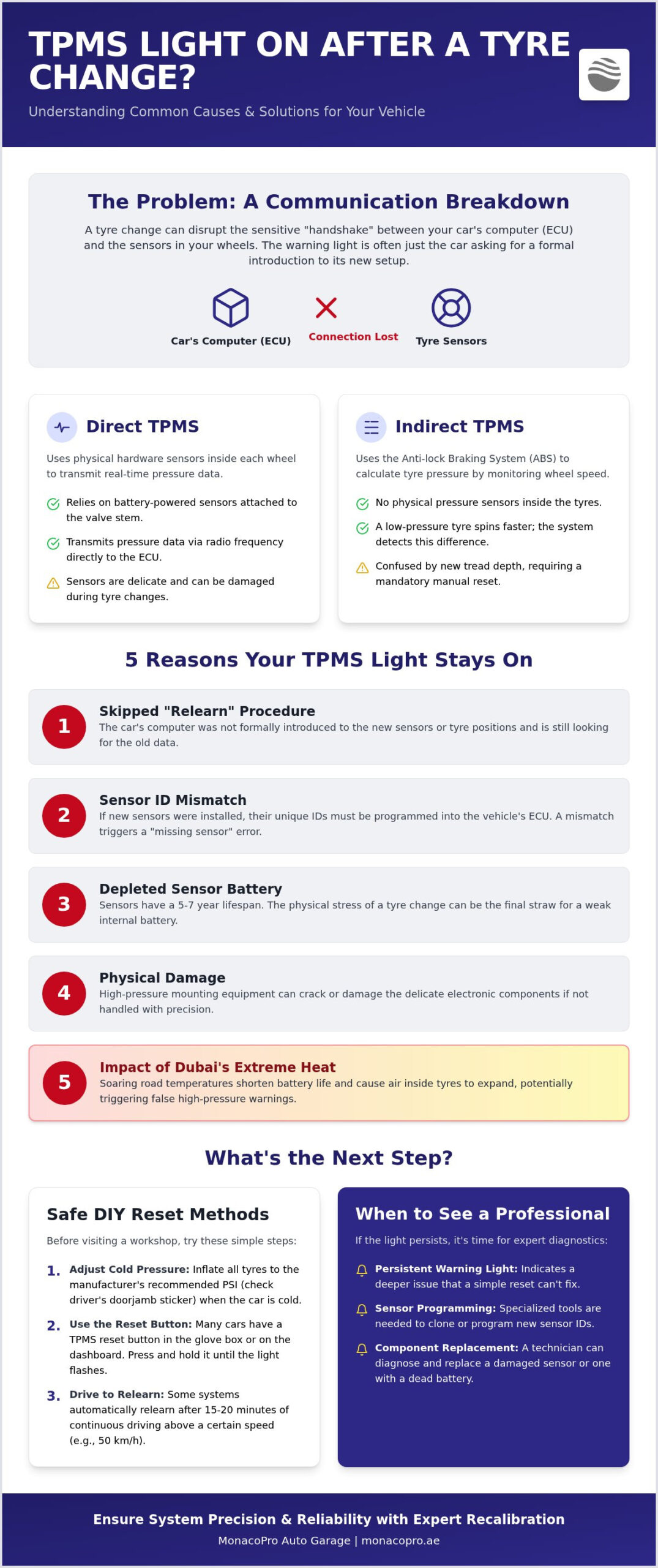
Your Tyre Pressure Monitoring System (TPMS) is a silent guardian that works in real-time to ensure your vehicle remains stable and efficient. In the UAE, where road temperatures can soar, maintaining the correct pressure is vital for preventing blowouts and ensuring optimal fuel economy. However, this sensitive system is often disrupted during a standard tyre replacement. When you attempt to fix TPMS light after tyre change complications, you’re usually addressing a communication breakdown between your car’s central computer and its wheels.
The act of removing an old tyre and mounting a new one is a physical process that can easily disturb a sensor’s calibration. Even if the technician is extremely careful, the car’s Engine Control Unit (ECU) may struggle to recognize the new components. This isn’t always a sign of a fault; it’s often just the car asking for a formal “handshake” to confirm that the new setup is safe and intentional.
Direct TPMS: The Physical Sensor Connection
Most modern vehicles use a Direct TPMS. This system relies on physical hardware sensors located inside each wheel, typically attached to the base of the valve stem. These sensors use small lithium batteries to transmit radio frequencies directly to your car’s computer. During a tyre change, these sensors are exposed. If they are moved to a different position on the car without being “relearned,” or if the new tyre’s structure slightly alters the signal strength, the dashboard light will stay on. Because these sensors are delicate, even a minor bump from a tyre lever can cause them to send an error code.
Indirect TPMS: The ABS-Based Calculation
Some manufacturers opt for an Indirect TPMS, which doesn’t use physical pressure sensors at all. Instead, it uses the Anti-lock Braking System (ABS) to monitor how fast each wheel is spinning. A tyre with low pressure has a smaller diameter and spins faster than its counterparts. When you install new tyres, the tread depth is significantly different from your old, worn set. This change in diameter confuses the ABS sensors, leading the computer to “guess” that there’s a pressure issue. For these systems, a manual reset is mandatory to tell the car that the new wheel speed is the new “normal.”
A common hurdle when trying to fix TPMS light after tyre change services is “system shock.” Your ECU is programmed with specific safety parameters. A sudden shift in tyre brand, tread pattern, or even the slight weight difference of a new tyre can cause the computer to hold onto a warning light until a professional diagnostic tool confirms the system is healthy. Understanding whether your car uses physical sensors or software-based calculations is the first step toward a clear dashboard.
5 Reasons Your Tyre Pressure Light Stays On (Even with Proper PSI)
Seeing a warning light after you’ve confirmed your tyres are perfectly inflated is confusing. If you’re trying to fix TPMS light after tyre change issues, it helps to look beyond the air pump. Often, the car’s computer simply hasn’t been told that the service is complete. Here are the five most common culprits for a persistent light.
- Skipped Relearn Procedure: Many technicians focus on the physical tyre swap but forget the digital “relearn.” Without this handshake, the car continues to look for the old tyre’s data profile.
- Sensor ID Mismatch: If new sensors were installed, they must be “cloned” or matched to your vehicle’s ECU. If the IDs don’t match, the system assumes a sensor is missing.
- Battery Exhaustion: Most sensors last 5 to 7 years. The physical vibration and stress of a tyre change can be the final straw for a weak internal battery.
- Environmental Interference: Dubai’s unique climate plays a massive role in how these electronics behave on the road.
- Physical Damage: High-pressure mounting equipment can be unforgiving to delicate electronic components if not handled with precision.
The Impact of Dubai Heat on TPMS Sensors
Extreme temperatures in the UAE significantly shorten the lifespan of the lithium batteries inside your sensors. High heat increases internal resistance, which can lead to signal dropouts just when you need them most. Additionally, thermal expansion causes air pressure to rise as you drive. Road temperatures reaching 50 degrees Celsius can cause false TPMS triggers as the air inside expands beyond the sensor’s calibrated safety threshold. This fluctuation is why a morning reading might look fine while a midday drive triggers an alert.
Mechanical Damage During Mounting
The “Bead Breaker” on a tyre machine is a powerful tool designed to separate rubber from metal. If a technician isn’t precise, this tool can easily nick or snap the sensor housing located behind the valve stem. A physically broken sensor usually results in a flashing light that eventually stays solid, whereas a software error typically stays solid from the start. Choosing a workshop that uses modern, touchless mounting equipment is the best way to avoid these costly accidents. If your light won’t turn off, a professional car computer diagnostic can quickly identify which wheel is sending the error signal and determine if a sensor needs replacement.
How to Fix the TPMS Light: Safe DIY Reset Methods
Before you return to the workshop, you can often resolve a persistent warning yourself. The first and most critical step is to confirm your tyre pressure is actually correct. Always check your tyres when they’re “cold,” meaning the car has been parked for at least three hours. Use the pressure values listed on the sticker inside your driver-side door jamb. Never use the “Max PSI” printed on the tyre sidewall, as this is a limit for the rubber itself, not a recommendation for your specific vehicle’s handling and safety.
Once you’ve matched the pressures to the manufacturer’s specifications, you can attempt to fix TPMS light after tyre change errors using your car’s internal software. For older vehicles, look for a physical reset button. These are often tucked away in the glove box or located just under the steering column. If your car has one, turn the ignition to the “On” position without starting the engine, then press and hold the button until the TPMS light flashes three times. If your car is a more modern model, you’ll likely need to use the digital interface.
A word of caution for owners of luxury European vehicles: ignore any advice suggesting you disconnect the battery to “force” a system reset. In brands like Audi, BMW, and Mercedes-Benz, pulling the battery can erase critical ECU adaptations and steering angle sensor data. This often leads to a cascade of dashboard errors that require expensive professional intervention to correct.
The ’20-Minute Drive’ Technique
Most modern vehicles require a specific driving cycle to recalibrate their sensors. After setting the correct pressure, drive your car at a consistent speed of at least 80 km/h for 15 to 20 minutes. This allows the ECU to collect enough data points from the sensors to confirm the pressure is stable. Be aware that Dubai’s heavy stop-and-go traffic on roads like Hessa Street can interrupt this process. If the light blinks for 60 to 90 seconds before staying solid, the system is likely detecting a hardware fault rather than a simple pressure mismatch.
Dashboard Menu Navigation
On vehicles with digital displays, navigate through the “Settings” or “Service” menu to find the tyre pressure section. You’ll typically see options to “Initialize,” “Store,” or “Reset.” European cars often use systems like iDrive or MMI, where you must select “Store Pressures” after a manual check. Japanese and American models usually have a simpler “Reset” command in the instrument cluster. Once you select the reset option, you must hold the ‘Set’ or ‘OK’ button until the light flashes thrice to confirm the car has accepted the new baseline.
When DIY Fails: The Difference Between Relearn and Programming
If your manual reset attempts haven’t cleared the dashboard, you’re likely facing a situation where the vehicle requires a technical “relearn” or “programming.” These processes go much deeper than a simple menu selection. While a reset tells the car to look at the current pressure as the new baseline, a relearn teaches the car’s computer the unique digital ID of each sensor and its exact location on the chassis. If you can’t fix TPMS light after tyre change complications at home, it’s often because the ECU has locked the system to prevent unauthorized or accidental changes.
A Stationary Relearn is a common requirement for many American and Japanese models. This involves a specific sequence of inputs, such as cycling the ignition or toggling the light switch, which puts the car into a “discovery mode.” The vehicle usually acknowledges each sensor with a horn chirp or a light flash. However, an OBDII Relearn is the most reliable professional method. It involves plugging a diagnostic tool into the car’s data port to manually write the sensor IDs into the system’s memory. This bypasses the need for complex driving cycles and ensures the computer recognizes the new hardware immediately.
For owners of high-end brands like Porsche, Bentley, or Audi, the requirements are even more stringent. These vehicles often use encrypted communication protocols. If you’ve installed “Universal” sensors, they must be flashed with specific software that matches your VIN before the car will even acknowledge their existence. Without this precise programming, the ECU will treat the new sensor as a foreign object and keep the warning light active as a safety precaution.
The Role of Professional TPMS Tools
Professional workshops use advanced tools from brands like Autel or Bartec to communicate with your wheels. These devices can read a sensor’s internal data, including battery life and temperature, directly through the tyre sidewall. One of the most effective strategies we use is “cloning.” By copying the unique ID from your old, failing sensor onto a new programmable unit, we can trick the car into thinking the original parts are still in place. This prevents ECU confusion and is the fastest way to get your dashboard clear. If your system is being stubborn, our specialized TPMS sensor+ programming service can sync your vehicle’s electronics with surgical precision.
Stationary vs. Active Relearn Procedures
The “handshake” protocol varies significantly between manufacturers. Certain BMW and Mercedes-Benz models utilize an Active Relearn, which only triggers once the car is in motion at a specific speed for a set duration. Other vehicles require the car to remain completely still in a dedicated learning mode. If the technician doesn’t follow these specific manufacturer protocols, the system will eventually time out, leaving you with the same warning light you started with. Understanding these nuances is what separates a standard tyre swap from a professional, road-ready service.
Professional TPMS & Tyre Services at MonacoPro Auto Garage
When DIY resets fail, you need a partner who understands the digital architecture of your vehicle. At MonacoPro Auto Garage, we specialize in providing the technical solutions necessary to fix TPMS light after tyre change issues that standard workshops often overlook. Our facility in Umm Ramool is equipped with advanced diagnostic tools capable of communicating with every major car brand. We don’t just clear the light; we verify the health of your entire system.
Our technicians perform a deep diagnostic check to determine if your dashboard warning is a simple calibration error or a sign of a failing sensor battery. Since lithium batteries inside TPMS units typically last 5 to 7 years, the stress of a fresh tyre installation can often reveal a weak signal that was previously hidden. We provide comprehensive TPMS sensor+ programming, ensuring that every new component is perfectly synced with your ECU before you leave the shop.
Every tyre service we perform comes with our ‘Road-Ready’ guarantee. This means we don’t just mount the rubber and hand you the keys. We perform a full system reset and physical verification of pressures to ensure your car is safe for the high-speed Dubai motorways. Precision is our standard, especially when handling the delicate sensors found in high-performance and luxury vehicles.
Why Visit Our Umm Ramool Workshop?
Located centrally in Dubai, our workshop is a hub for quick service auto repairing and precision maintenance. We understand that luxury car owners require a higher level of care. Our team has extensive experience with the complex TPMS protocols used by European and American manufacturers. To maximize your visit, you can combine your sensor recalibration with a professional wheel alignment or a routine oil change. This holistic approach ensures your vehicle handles perfectly and stays efficient in the UAE heat.
Booking Your Service at MonacoPro
We believe in a transparent service process. Before we replace any parts, we explain the diagnostic results to you clearly, showing you exactly why the light was triggered. Our goal is to provide a frictionless experience with fast turnaround times, getting you back on the road safely and without delay. Book your TPMS diagnostic and tyre service at MonacoPro today to experience professional care that prioritizes your safety and peace of mind.
Drive with Total Peace of Mind
A persistent warning light shouldn’t shadow the excitement of a new set of tyres. While many dashboard alerts can be cleared with a simple driving cycle or a menu reset, others require a more technical approach. It’s vital to remember that your TPMS is a critical safety feature, especially when navigating the high-speed motorways and extreme temperatures of the UAE. If manual attempts fail, the issue often lies in a technical “handshake” error or a sensor battery that has finally reached its limit.
Understanding how to fix TPMS light after tyre change complications is about more than just clearing a dashboard icon; it’s about ensuring your car’s safety systems are functioning exactly as intended. Whether your vehicle requires a stationary relearn or specialized encrypted programming, professional intervention provides the accuracy that DIY methods sometimes lack. Our full-service garage in Umm Ramool utilizes advanced computer diagnostics for all brands to identify the root cause instantly.
Don’t let a dashboard error compromise your safety. Schedule your professional TPMS programming at MonacoPro Auto Garage today for expert TPMS sensor+ programming and total vehicle verification. We’re here to ensure your car is road-ready and reliable for every journey.
Frequently Asked Questions
Is it safe to drive with the TPMS light on after a tyre change?
It is only safe if you have physically confirmed that the tyre pressure is correct using a reliable manual gauge. If the pressure matches your door jamb sticker, the light is likely a calibration error. However, driving without verification is risky because you won’t be alerted to a real puncture. It’s best to have the system reset promptly to ensure your safety monitors are active.
Can cold weather in the desert morning trigger my tyre light?
Yes, desert mornings can definitely trigger your warning light. Air contracts when it’s cold, which leads to a drop in tyre pressure. In the UAE, a significant temperature drop between night and day can result in a 1 to 2 PSI decrease. This is often enough to trip the sensor before the tyres warm up during your drive. Always check pressures when the tyres are cold for accuracy.
Do I need to replace TPMS sensors every time I get new tyres?
You don’t need to replace sensors with every tyre change. Most TPMS units are designed to last between five and seven years because the internal lithium batteries are sealed. You only need a replacement if the battery is exhausted or if the sensor was physically damaged during the mounting process. We recommend a diagnostic check during every tyre service to verify the health of each sensor.
How much does it cost to reprogram a TPMS sensor in Dubai?
The cost for reprogramming depends on your vehicle’s make and the complexity of the digital handshake required. While a basic manual reset is a standard procedure, a technical OBDII relearn or universal sensor programming involves specialized diagnostic equipment. Prices in Dubai vary across workshops based on the technology used. Investing in a professional calibration ensures your safety systems are road-ready and accurate for local driving conditions.
Why does my tyre light flash for a minute and then stay on?
A flashing light that eventually turns solid indicates a system malfunction rather than a simple low-pressure warning. This usually happens when the car’s computer loses contact with one or more sensors. It’s a common sign that a sensor battery has died or a component was damaged during a recent service. If you see this pattern, simple inflation won’t solve the problem; you’ll need a professional tool to identify the failing unit.
Can a local petrol station reset my TPMS light?
Most local petrol stations can provide air, but they generally cannot fix TPMS light after tyre change issues. Resetting a modern system often requires plugging into the car’s OBDII port or using a radio-frequency tool to trigger the sensors. For a reliable and permanent fix, a specialized garage with the correct diagnostic software is necessary to ensure the ECU accepts the new data and stops the warning light.
What happens if I ignore a faulty TPMS sensor?
Ignoring a faulty sensor leaves you vulnerable to undetected punctures and sudden blowouts. Without a functioning TPMS, you lose the real-time data needed to maintain optimal fuel efficiency and tyre longevity. Over time, even slightly underinflated tyres lead to uneven wear and increased braking distances. Maintaining this safety feature is a small step that prevents much larger, more expensive repairs and ensures your vehicle remains safe on the road.
Can MonacoPro program sensors for imported or modified cars?
Yes, MonacoPro specializes in programming sensors for all vehicle types, including US and European imports. Modified cars with aftermarket wheels often require universal sensors that must be flashed with specific software to communicate with the original ECU. Our technicians use advanced tools to ensure that even non-standard setups receive a perfect digital handshake. This ensures a safe, error-free drive regardless of your vehicle’s origin or modifications.