
In the 50°C intensity of a Dubai summer, your vehicle is more than just a mode of transport; it’s a precision machine that must withstand the planet’s harshest driving conditions. While many motorists dread the annual RTA visit as a stressful bureaucratic hurdle, a professional car safety inspection is actually your most effective tool for preventing heat-induced mechanical failure. It’s completely natural to feel anxious about failing the test or facing the hassle of a re-test, especially when the standard light vehicle inspection fee is AED 150 and your time is at a premium.
We’ve designed this guide to help you master the vehicle inspection process in the UAE with total confidence. You’ll learn exactly how to pass the RTA requirements on your first attempt and understand why advanced diagnostics are essential for your peace of mind. We will explore the differences between basic registration tests and comprehensive garage inspections, detail the 2026 regulations for new and used cars, and provide a clear roadmap for identifying repair needs before you ever head to the testing center. Whether you’re preparing for a registration renewal or evaluating a second-hand purchase, this guide ensures you stay safe and compliant on Dubai’s roads.
Key Takeaways
- Navigate the mandatory RTA vehicle test requirements with ease and secure your annual registration renewal without the stress of a re-test.
- Understand the critical systems evaluated during a professional car safety inspection, including how computer diagnostics identify electronic faults before they become costly repairs.
- Distinguish between basic regulatory tests and comprehensive pre-purchase inspections to make informed decisions when buying or selling a used vehicle in Dubai.
- Master a practical preparation checklist to fix common minor failures at home and ensure your car is ready for the road’s extreme heat.
- Use expert technical insights to maintain your vehicle’s safety and performance through precision wheel alignment and specialized sensor programming.
Understanding the Car Safety Inspection Landscape in Dubai
In the UAE, a car safety inspection is more than a bureaucratic hurdle; it’s a critical safety net. The landscape is defined by two distinct needs: meeting the legal standards set by the government and ensuring your vehicle can survive the world’s most demanding driving conditions. While global vehicle inspection regulations provide a foundation for road safety, Dubai’s specific requirements are tailored to manage high-speed traffic and extreme environmental stress. Understanding how these layers work together is the first step toward stress-free car ownership.
The distinction between a legal compliance test and a preventative audit is significant. One keeps you on the right side of the law, while the other keeps you on the road. In a city where a breakdown during the summer can quickly become a safety emergency, relying solely on the bare minimum isn’t enough. A truly safe vehicle requires a strategy that balances the RTA’s mandatory checks with proactive mechanical care.
The Legal Requirement: RTA Passing Tests
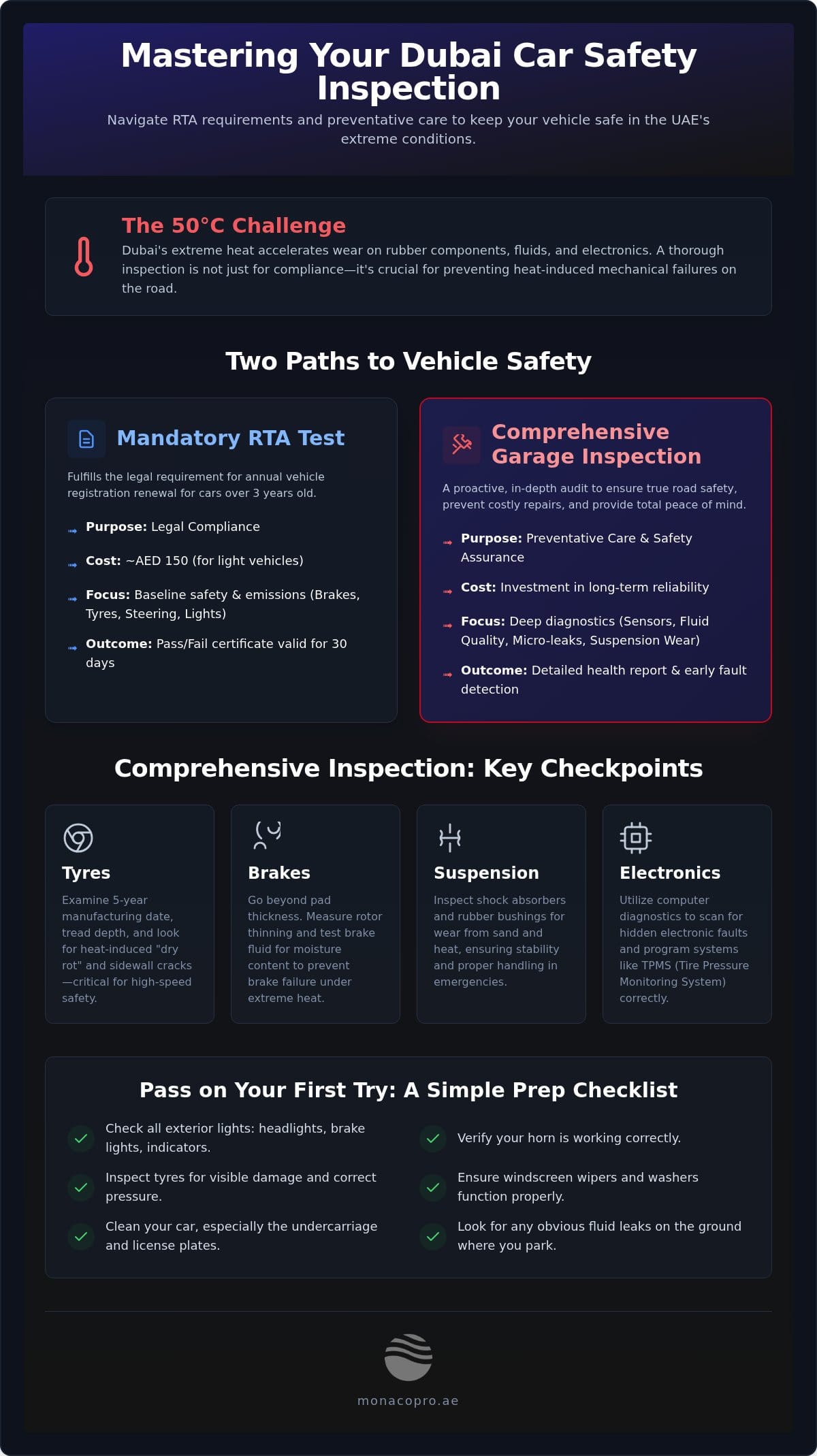
The Roads and Transport Authority (RTA) mandates that all vehicles older than three years must undergo an annual technical test. This car safety inspection is the gateway to your registration renewal. The RTA’s role is to ensure that every vehicle on the road meets a specific baseline of safety and environmental standards. For light vehicles, this test typically costs AED 150 and results in an inspection certificate valid for 30 days. You can access these services at authorized centers such as Tasjeel, Shamil, or Wasel. These facilities focus on critical safety points including brake performance, steering integrity, and tyre condition. If your car passes, you’re clear to renew your registration. If it fails, you have 31 days to complete repairs and return for a re-test.
The Preventative Approach: Why Voluntary Inspections Matter
While the RTA test is thorough, it doesn’t always account for the hidden wear caused by Dubai’s 50°C heat. Intense thermal cycles cause rubber bushings, belts, and hoses to become brittle and crack. Fluids like engine oil and coolant degrade rapidly under these conditions, losing their protective properties. A voluntary garage inspection goes deeper than the official test. It identifies micro-leaks, electronic sensor errors, and minor suspension play that wouldn’t necessarily trigger an RTA failure but could lead to a major breakdown. By choosing a preventative audit, you’re investing in a professional workflow that catches faults early. This proactive stance doesn’t just provide peace of mind; it’s a cost-saving measure that prevents minor issues from escalating into expensive mechanical failures.
The Comprehensive Car Safety Inspection Checklist
A modern vehicle is a sophisticated ecosystem where mechanical hardware and digital software must work in perfect harmony. Relying on a simple visual check is no longer sufficient for Dubai’s high-speed motorways. A professional car safety inspection utilizes a methodical workflow to interrogate every system, ensuring that hidden vulnerabilities are identified before they compromise your safety on the road. This technical audit moves beyond the surface to evaluate the structural and electronic integrity of your vehicle.
Core Mechanical Components: Brakes, Tyres, and Suspension
Your tyres are the only contact point between your car and the scorching asphalt. In the UAE, RTA regulations generally dictate that tyres must be replaced every five years, regardless of tread depth. During a car safety inspection, we examine the manufacturing date stamps and look for “dry rot” or heat-induced sidewall cracks. Brakes undergo a similarly rigorous evaluation; we don’t just check pad thickness. Technicians measure rotor thinning and use specialized tools to check the moisture content of your brake fluid, which is hygroscopic and can boil under the extreme heat of heavy braking.
The suspension system also takes a beating from sand ingress and constant encounters with speed bumps. We evaluate the integrity of shock absorbers and rubber bushings. If these components are worn, your vehicle’s stability is compromised, leading to increased braking distances and poor handling during emergency maneuvers.
Electronic Systems and TPMS Programming
Modern safety relies heavily on electronic oversight. The Tire Pressure Monitoring System (TPMS) is your first line of defense against high-speed blowouts caused by under-inflation. A critical part of our inspection involves specialized TPMS sensor programming to ensure your dashboard alerts are accurate and responsive. We also perform expert computer diagnostics to scan for “soft codes” in the engine and transmission. These are fault codes that haven’t yet triggered a dashboard warning light but indicate an underlying issue that could lead to a mechanical failure or an RTA test rejection.
Visibility and Exterior Safety
Visibility is often overlooked until a dust storm hits. We ensure your headlight alignment is precise; misaligned beams can blind oncoming drivers or leave you with “dark zones” on the road. Wiper blades are checked for heat-warping, and washer reservoirs are filled with appropriate solvents to cut through oily road film. Finally, we inspect mirrors and glass for any chips or cracks. Even a small stone chip in your line of sight can be grounds for failing an official registration test, so identifying these repair needs early is essential for a seamless passing experience.
Comparing Inspection Types: RTA vs. Pre-Purchase vs. Preventative
Choosing the right type of car safety inspection depends entirely on your current objective. While the RTA technical test ensures legal compliance for your annual registration renewal, it doesn’t provide a deep dive into the long-term mechanical health of your vehicle. For those buying a used car or planning a demanding drive, a more granular approach is required. High-performance and luxury vehicles, in particular, benefit from garage-based audits that utilize specialized diagnostics to monitor complex subsystems that basic testing centers might overlook. Understanding these distinctions helps you manage expectations and ensures you’re investing in the right level of care.
The depth of an inspection changes based on your goal. A legal test is a “pass or fail” baseline. A buying inspection is a risk-mitigation tool. A maintenance audit is a roadmap for longevity. By selecting the appropriate framework, you ensure that your vehicle remains both compliant with UAE law and resilient against the mechanical stress of desert driving.
The Pre-Purchase Inspection (PPI): A Buyer’s Best Friend
Buying a used car in Dubai’s vibrant secondary market can be a gamble without a professional PPI. This specific car safety inspection is designed to protect your investment by uncovering hidden issues that a standard service history might omit. Technicians perform a detailed structural audit to check for previous accident damage or chassis repairs that could compromise the vehicle’s integrity. We go beyond the surface, verifying the actual condition of the engine and gearbox through stress tests and digital scanning. For a complete understanding of what this process involves and how it protects your investment, our essential guide to pre purchase car inspection in Dubai covers every critical step in detail. This ensures you aren’t stuck with a “lemon” that requires immediate, expensive repairs after the sale is finalized. It’s about buying with your head, not just your heart.
Preventative Maintenance Inspections
Preventative checks are your primary defense against the UAE’s environmental extremes. Scheduling a “Summer Readiness” check is vital before the peak heat arrives, as this is when cooling systems and batteries are most likely to fail. These inspections focus on the health of your radiator, coolant quality, and battery cranking power. If you’re planning a long road trip to Salalah or Jebel Jais, a pre-trip audit ensures your vehicle can handle the steep climbs and sustained high speeds without incident. By using these inspections to plan future maintenance, you can manage your budget effectively and avoid the stress of an emergency breakdown on a busy highway. It’s a proactive strategy that keeps you in control of your vehicle’s performance.
How to Prepare Your Vehicle for a Safety Inspection
Passing your car safety inspection on the first attempt is largely a matter of attention to detail. Many failures occur due to small, preventable issues that take minutes to identify but hours to resolve if you’re forced into a re-test cycle. By taking a methodical approach to preparation, you eliminate the uncertainty and ensure a seamless experience at the testing center. A well-prepared car doesn’t just pass the test; it demonstrates to the inspector that the vehicle is maintained to a high standard.
The 10-Minute DIY Pre-Check
You don’t need to be a mechanic to perform a basic sweep of your vehicle’s safety features. Start by testing every exterior light. This includes high and low beams, indicators, brake lights, and the often-forgotten license plate light. Next, turn on the ignition and observe your dashboard; if warning lights like the ABS, SRS, or Check Engine light remain illuminated, you should address these before heading to the RTA center. Finally, open your boot to confirm that your spare tyre is properly inflated and that your fire extinguisher and jack are present and accessible. These small items are mandatory for roadworthiness in the UAE.
Handling Minor Repairs Before the Test
Small fixes can save you from the AED 35 re-test fee and the hassle of a second appointment. Replace your wiper blades if they’re cracked or leave streaks, as clear visibility is essential during sudden dust storms. You should also top up essential fluids like coolant, brake fluid, and screen wash to ensure all systems are operating at peak efficiency. Pay close attention to your number plates; they must be clean, securely fastened, and free from any damage or fading. If your plates are obscured, the inspector won’t be able to complete the digital logging required for your registration renewal.
Cleanliness is another critical factor that many motorists overlook. A layer of thick desert grime in the engine bay or on the chassis can hide leaks or structural cracks, which may lead an inspector to be more cautious during their evaluation. A professional engine bay wash makes it easier for the technician to verify your chassis number and inspect for fluid leaks. When you arrive at the center, ensure you have your Emirates ID and original vehicle registration card (Mulkiya) ready. If you want to ensure your vehicle is in peak condition before your official appointment, book a professional pre-check with our expert team today. This proactive step helps you identify and resolve hidden issues, ensuring your official test is a mere formality.
Professional Car Safety Inspections at MonacoPro Auto Garage
Located in the heart of Umm Ramool, MonacoPro Auto Garage offers a sophisticated alternative to basic, high-volume service centers. Our approach to a car safety inspection is built on the “Efficient Expert” methodology, where technical precision meets high-level hospitality. We understand that your time is valuable; therefore, we’ve refined our workflow to be methodical and highly organized. By combining deep mechanical knowledge with a customer-centric focus, we remove the stress usually associated with vehicle maintenance in the UAE. It’s a professional partnership designed to provide you with total peace of mind on the road.
Our facility isn’t just a workshop; it’s a center of technical excellence where we’ve thought of every detail so you don’t have to. From the moment you arrive, you’ll notice a composed and welcoming atmosphere that reflects our high standards of service. We manage the entire experience with a focus on logistical excellence, ensuring that your vehicle’s safety is handled with the accuracy it deserves.
Expert Diagnostics and TPMS Specialization
Modern vehicles are essentially rolling computers, requiring more than just a visual sweep. We utilize advanced computer diagnostics to look “inside” your vehicle’s brain, identifying electronic irregularities before they manifest as mechanical failures. This digital oversight is paired with our specialized TPMS sensor+ programming. On Dubai’s high-speed motorways, accurate tyre pressure data is your primary defense against heat-related blowouts. When we find an issue, we don’t just hand you a list of technical jargon. Our technicians provide detailed reporting in plain English, explaining the “why” behind every finding. This transparency ensures you understand the practical benefits of every technical process we perform.
A One-Stop Solution in Umm Ramool
We’ve designed our facility to be a comprehensive solution for Dubai motorists. If a car safety inspection reveals a need for repair, our team is equipped to handle the resolution immediately. We maintain a strict commitment to quality, utilizing high-caliber parts for all disc and brake services, suspension repairs, and tyre replacements. This seamless transition from diagnosis to repair ensures your vehicle returns to the road in peak condition without the need for multiple garage visits. Our professional environment in Umm Ramool provides easy access for residents across the city, offering a dependable partner for everything from routine oil changes to complex electronic troubleshooting. We don’t just fix problems; we manage your vehicle’s longevity with a focus on precision and reliability.
Securing Your Vehicle’s Future on Dubai’s Roads
Mastering the car safety inspection process is about more than just securing a new registration sticker. It’s about ensuring your vehicle remains a reliable asset in a climate that tests mechanical limits every single day. By distinguishing between basic legal requirements and comprehensive preventative audits, you’ve taken the first step toward long-term automotive health. Whether you’re performing a 10-minute DIY check or preparing for a rigorous RTA test, a proactive approach always pays off in safety and savings.
At MonacoPro Auto Garage, we’re ready to be your partner in this journey. Our specialists in TPMS sensor programming and computer diagnostics provide the technical precision your modern vehicle demands. Located in the heart of Umm Ramool, we offer expert pre purchase car inspection services for used car buyers and detailed safety audits for seasoned owners. Don’t leave your safety to chance. Book Your Comprehensive Car Safety Inspection at MonacoPro Auto Garage today and experience the peace of mind that comes from professional care. We look forward to seeing you at our premium service centre soon.
Frequently Asked Questions
What is the difference between an RTA test and a garage safety inspection?
An RTA test is a mandatory legal requirement focused on meeting minimum roadworthiness standards for registration renewal. In contrast, a professional garage check is a comprehensive mechanical audit that looks at long-term vehicle health. While the RTA ensures you’re compliant with UAE law, a garage-based car safety inspection identifies hidden electronic faults and mechanical wear that could lead to future breakdowns, providing a much higher level of detail for your peace of mind.
How long does a professional car safety inspection take?
A thorough car safety inspection typically takes between 45 and 60 minutes to complete. This timeframe allows our technicians to follow a methodical workflow, including computer diagnostics and a physical audit of the suspension and braking systems. We prioritize accuracy and completeness over speed, ensuring that every critical component is interrogated. Once the technical process is finished, we provide a sequential breakdown of the findings so you can plan any necessary repairs efficiently.
Will my car fail the inspection if the TPMS light is on?
Yes, a dashboard warning light for the Tire Pressure Monitoring System (TPMS) can lead to a technical failure during an official test. The system is a vital safety feature designed to prevent high-speed blowouts on Dubai’s highways. If the light is illuminated, it often indicates a faulty sensor or a programming error. We specialize in TPMS sensor programming to resolve these alerts, ensuring your vehicle remains safe and compliant with current safety regulations.
What are the most common reasons cars fail safety inspections in Dubai?
The most frequent reasons for failing a car safety inspection in Dubai include tyres that are over five years old or show heat-induced cracking. Other common issues involve burnt-out exterior bulbs, excessive window tinting beyond the legal limit, and fluid leaks in the engine bay. Brake pad wear and worn suspension bushings also rank high on the list. Addressing these minor repairs before your official RTA appointment is the most effective way to ensure a first-time pass.
Do I need a safety inspection if I am buying a car from a private seller?
Investing in a pre-purchase inspection is essential when buying from a private seller to avoid inheriting hidden mechanical problems. Unlike a basic registration test, this audit investigates the engine’s internal condition and gearbox health. It provides a clear understanding of immediate repair needs and verifies if the vehicle has suffered previous accident damage. This professional oversight gives you the leverage needed for a fair negotiation and ensures your new investment is genuinely roadworthy.
Is a chassis check included in a standard car safety inspection?
Structural integrity is a core component of any standard car safety inspection we perform. Technicians examine the chassis for signs of previous repairs, welding, or corrosion that could compromise the vehicle’s safety in a collision. In Dubai’s used car market, verifying that the frame hasn’t been compromised is critical for both safety and resale value. We use specialized equipment to ensure the chassis is straight and meets the original manufacturer’s specifications for roadworthiness.
How often should I have a preventative safety inspection performed?
We recommend a preventative car safety inspection every six months or before the peak summer heat arrives in the UAE. High temperatures accelerate the degradation of rubber components, batteries, and cooling systems. Scheduling a check-up twice a year ensures that minor faults are caught before they escalate into major mechanical failures. This proactive strategy is particularly important if you frequently drive long distances or use your vehicle for high-performance desert driving.