
Programming a TPMS sensor is only part of the job. TPMS programming for American cars configures a compatible sensor for the vehicle, while a separate relearn step teaches the vehicle to recognise it. After sensor replacement, a relearn may be part of the process. Most vehicles require a TPMS scan tool, although some models use a driving procedure.
Need a sensor programmed or relearned on your car? See Monaco Pro’s TPMS programming and sensor service in Dubai for pricing and booking.
Programming and relearning are easy to confuse, especially after replacing a sensor. Knowing the difference helps explain why a warning light may stay on even after programming. This guide explains how universal and cloneable aftermarket sensors are programmed, how vehicle relearn works, and what can affect the process on American cars in the UAE.
You’ll also learn how TPMS diagnostics and maintenance checks can help identify sensor issues and support proper system operation. The aim is to clarify each step, so you know what the service involves and what information is useful when arranging it.
Key Takeaways
- Separate sensor programming from vehicle relearn so you understand why installation may involve two distinct steps.
- Learn how universal and cloneable aftermarket sensors are prepared for a vehicle before they’re relearned.
- See how TPMS diagnostics can help identify system issues and guide maintenance decisions.
- Understand the roles of programming and diagnostic tools, and how the vehicle’s relearn method affects the process.
Difference between TPMS sensor programming and vehicle relearn
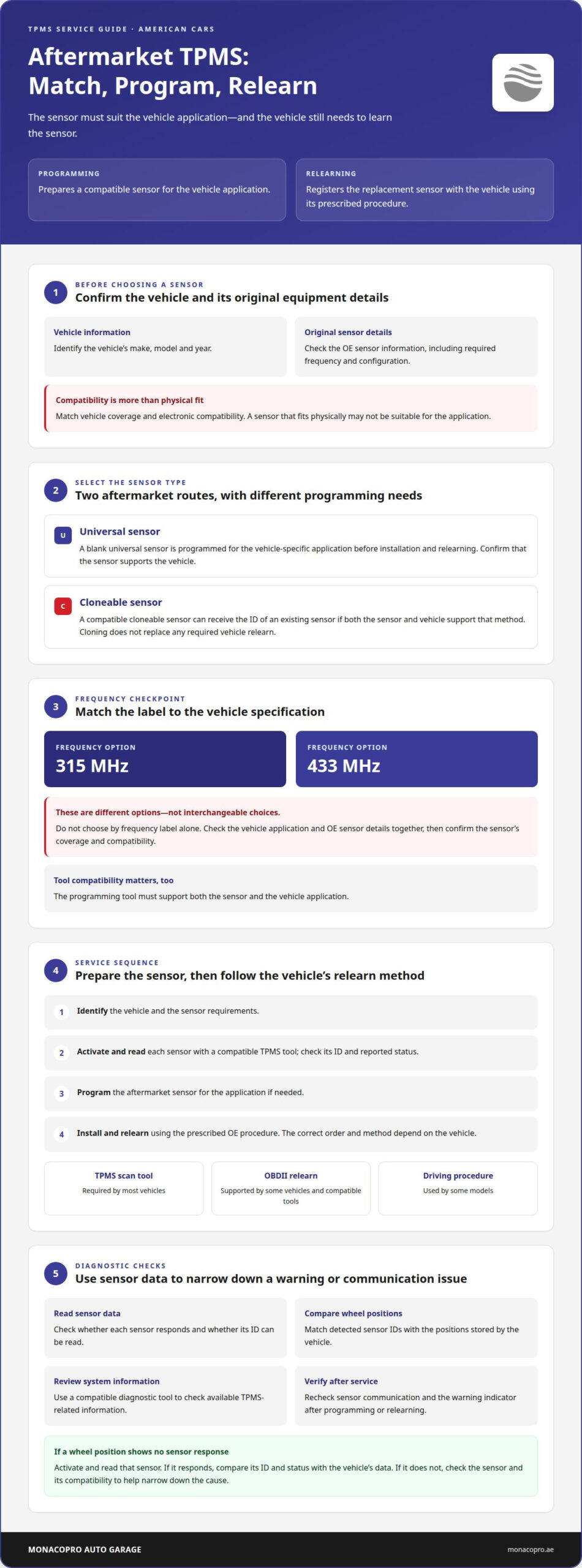
Programming prepares a sensor for its vehicle application; relearning registers the replacement sensor with the vehicle. Cloning copies an existing sensor ID to a compatible sensor, which can avoid introducing a new ID, but it doesn’t replace any required vehicle relearn.
Sensor Activation and Reading
Activation prompts a TPMS sensor to transmit information, such as its ID and reported status, so a compatible scan tool can read it. A technician can compare the readings with the vehicle’s sensor positions and check whether a sensor responds before starting the relearn. With TPMS programming for American cars, sensor compatibility and accurate identification are essential before the vehicle learns the sensor.
Replacement Sensor Relearn Methods
Every replacement TPMS sensor must be relearned to the vehicle using its prescribed OE procedure, whether it’s original equipment or aftermarket. Relearning requires a TPMS scan tool except on some models that use a driving procedure. Some vehicles support OBDII relearn functionality, which lets a compatible tool register sensor IDs through the vehicle’s diagnostic connection. The correct method depends on the vehicle’s procedure, not simply on whether the sensor has been programmed.
Disabling or bypassing TPMS isn’t the same as relearning. A reliable yes-or-no answer on legality in the United States depends on the rules that apply to the vehicle and its use. Technically, bypassing can leave the system unable to provide its intended warning. Incorrect programming can also prevent the vehicle from identifying a sensor correctly, so a warning may not reflect the sensor’s status.
Vehicle-Specific Programming Steps
For a specific make and model, the sequence is to identify the vehicle, activate and read each sensor, program an aftermarket sensor for the application if needed, then follow the prescribed relearn procedure. That final step may use a TPMS scan tool, OBDII functionality, or a driving procedure on some models. The vehicle’s OE process determines the order and method; don’t assume one procedure works across all American cars.
US dealership and tyre-shop charges depend on the work involved, including sensor type, programming, replacement, and relearn method. These factors shape the quote, so one price cannot represent every make, model, and service combination.
Programming aftermarket universal and cloneable sensors
Some aftermarket TPMS sensors need programming for the vehicle application before installation and relearning. The right choice depends on vehicle coverage, sensor compatibility, and whether the sensor is blank or can copy an existing ID.
Vehicle Coverage and OE Compatibility
Start with the vehicle’s make, model, year, and original equipment sensor details. A universal sensor must support the vehicle application, while a cloneable sensor must be compatible with the original sensor’s ID and configuration. Coverage information helps distinguish a sensor that can be programmed for the vehicle from one that merely fits physically. For TPMS programming for American cars, both physical fit and electronic compatibility matter.
Pay attention to quality and warranty details, too. Review the sensor’s stated compatibility, warranty coverage, and any conditions attached to that coverage. This clarifies what the product is designed to support without assuming all aftermarket sensors have identical terms or performance.
Sensor Frequency Options
Sensor frequency is one compatibility detail to match against the vehicle’s original equipment information. The labels 315 MHz and 433 MHz identify different frequency options; they are not interchangeable choices simply because a sensor can be programmed. A correct application requires the sensor’s frequency and vehicle coverage to align with the required specification.
Don’t choose a sensor by frequency label alone. Check the vehicle application and OE sensor details together, then select a compatible sensor before programming. This reduces the risk of preparing a sensor the vehicle cannot recognise.
A blank universal sensor is programmed for the vehicle-specific application before installation and relearning. A cloneable sensor instead receives the ID of an existing sensor, if both the sensor and vehicle support that method. In either case, the programming tool must support the sensor and application. After installation, the programmed sensor still needs the required vehicle relearn.
MonacoPro Auto Garage provides TPMS sensor programming for drivers who need help matching and programming a replacement sensor. The process begins with identifying the vehicle and sensor requirements, then preparing the compatible sensor for installation.
TPMS service diagnostics and maintenance functions
A TPMS diagnostic checks whether the sensors and vehicle system communicate as expected. A technician can activate the sensors, read their transmitted data, and compare sensor IDs with the vehicle’s recorded positions. This helps distinguish a sensor issue from an incomplete relearn or a vehicle-side communication problem.
For example, if no sensor response appears for one wheel position, activate that sensor and read it with a compatible TPMS tool. If it responds, compare its ID and status with the vehicle’s data. If it doesn’t, checking the sensor and its compatibility can help narrow down the cause before replacing parts.
- Read sensor data: Check whether each sensor responds and whether its ID can be read.
- Compare wheel positions: Match the detected sensor IDs with the positions stored by the vehicle.
- Review system information: Use a compatible diagnostic tool to identify TPMS-related information available from the vehicle.
- Verify after service: Recheck sensor communication and the warning indicator after programming or relearning.
Common programming problems include choosing the wrong vehicle application, using an incompatible sensor, failing to activate a sensor, or leaving the relearn incomplete. Verify that the vehicle and sensor match, activate and read the sensor, then follow the vehicle’s prescribed relearn procedure.
Maintenance checks can help distinguish a TPMS warning from a tyre condition that needs attention. Compare displayed readings with the vehicle’s recommended pressures, inspect the tyres, and note which wheel position triggers the warning. Adjusting pressure won’t resolve a sensor that can’t communicate, so diagnostics should consider both tyre pressure and sensor response.
After tyre or sensor service, a final scan provides a useful check: confirm that the sensors respond and the vehicle recognises their IDs. If the warning remains, review the relearn status and available TPMS information in the vehicle’s diagnostic system rather than assuming the new sensor is defective.
What tools are needed to program TPMS sensors on American cars?
The tools needed depend on whether the job involves sensor activation, programming, diagnosis, or vehicle relearn. For an American car, match each tool to the vehicle procedure and sensor type, then verify communication after the work.
- TPMS activation and diagnostic tool: Wakes a sensor and reads its transmitted information, including the sensor ID. It helps identify an unresponsive sensor and compare detected IDs with the vehicle’s recorded data.
- Sensor programming tool: Prepares a compatible aftermarket sensor for the vehicle application. For a blank universal sensor, select the correct application before installation; a tool must support both that sensor and the vehicle.
- OBDII-capable TPMS tool: Supports relearn procedures that use the vehicle’s diagnostic connection. Whether this method applies depends on the prescribed procedure for the specific make and model.
- Vehicle-specific relearn instructions: Identify the correct sequence, including whether relearn uses a scan tool or a driving procedure. A tool can’t replace the vehicle’s required process.
- Tyre pressure gauge: Measures tyre pressure during a system check. This helps distinguish a pressure concern from a sensor communication issue.
Use the tools in sequence. First identify the vehicle and replacement sensor. Next, activate and read the sensor. If it’s aftermarket and requires programming, configure it for the vehicle application. Then use the applicable relearn method and scan again to check sensor communication. A scan tool may support both activation and relearn, but these are separate steps.
If a sensor doesn’t respond, check its compatibility and activation before considering the vehicle relearn complete. If the ID reads correctly but the vehicle doesn’t recognise it, review the vehicle-specific relearn procedure. Some models use a driving procedure instead of tool-based relearning; others require a TPMS scan tool.
For help with sensor preparation and the correct programming sequence, arrange TPMS sensor programming for your vehicle.
MonacoPro Auto Garage: Battery Replacement
MonacoPro Auto Garage in Dubai can help when TPMS checks reveal a separate vehicle concern. A tyre pressure warning alone doesn’t show that the battery needs replacement, but slow or difficult starting can make battery service relevant. If a TPMS warning remains after sensor work, a Car Computer Diagnostic can help assess vehicle system information.
Turn to MonacoPro Auto Garage for Battery Replacement, a diagnostic assessment, or Tyre Replacement as part of your vehicle maintenance. Separating a tyre or sensor concern from a starting or diagnostic issue helps focus attention on the appropriate service.
Contact MonacoPro Auto Garage or visit monacopro.ae to discuss your vehicle’s service needs.
Make Your Next TPMS Service Count
Use your next service visit to give the technician a clear starting point. Note when the warning appeared, whether a sensor or tyre was recently replaced, and whether the light changes after driving. These details can help focus the diagnostic process on the right issue instead of treating every warning as a programming fault.
For TPMS programming for American cars, arrange service that accounts for the vehicle’s sensor setup and relearn process. MonacoPro Auto Garage also offers Oil Change service in Dubai, so you can plan routine maintenance alongside a TPMS visit where useful.
Contact MonacoPro Auto Garage for TPMS service and discuss the symptoms or recent work on your vehicle. A clear starting point helps you move toward the right service with confidence.
Frequently Asked Questions
What does TPMS programming mean for American cars?
TPMS programming configures a compatible replacement sensor for a vehicle application. For example, after replacing a wheel sensor, programming prepares the new sensor to communicate as intended. The key is to distinguish sensor setup from updating the vehicle’s stored sensor information. A technician identifies the vehicle and replacement sensor, then uses a compatible tool and the applicable procedure.
Which American car makes and models require TPMS sensor programming or relearning?
The required procedure depends on the exact vehicle, not just its manufacturer. A Ford, Chevrolet, or Jeep may use different procedures across models or model years, so the brand alone doesn’t identify the correct method. Provide the vehicle’s make, model, and year, along with details of the replacement sensor. This helps determine whether programming, relearning, or both are needed.
Can aftermarket TPMS sensors be programmed for American vehicles?
Yes, aftermarket sensors can be programmed when they support the vehicle application. Some universal sensors need application programming before installation, while cloneable sensors can use an existing sensor ID when the sensor and vehicle support cloning. For example, a replacement selected after a sensor failure still needs to match the vehicle’s requirements. The appropriate vehicle relearn procedure remains a separate consideration.
What TPMS frequencies and sensor types do US-market cars use?
US-market TPMS applications may use 315 MHz or 433 MHz sensors; the vehicle’s original equipment specification determines the correct frequency. Sensor options include original equipment replacements and aftermarket universal or cloneable sensors. Don’t select by frequency or sensor type alone. Match the replacement to the specific vehicle application, since a sensor that can be programmed still must be compatible with the vehicle.