
What if the clean, fresh-smelling car you’re considering has flood damage hidden beneath its carpets or behind the dashboard? A spotless cabin and a reassuring explanation from the seller don’t prove a car’s history. To avoid buying a flood damaged car in UAE, look beyond appearances and assess the vehicle using its records, physical clues, and a professional inspection.
Water exposure can affect electrical systems and mechanical components even after an interior has been cleaned. Some problems may not be obvious during a short viewing. History checks provide useful context, but they may not include every incident, so don’t rely on them alone.
This 2026 buyer’s guide explains how to check the cabin and exterior, review available records, assess seller explanations, and decide when a professional pre-purchase inspection is worthwhile. In Dubai, MonacoPro Auto Garage offers a free 17-point vehicle inspection as a no-obligation baseline health check. It is not a flood-specific test or a guarantee that hidden water exposure will be found. Use a step-by-step approach to decide whether to proceed, pause, or walk away.
Key Takeaways
- Check concealed and low areas, including seat rails, carpet edges, boot wells, and the spare-wheel compartment, for moisture, residue, or unusual corrosion.
- Compare the seller’s account with ownership, maintenance, and repair records. Check that dates and vehicle identifiers are consistent.
- Use history checks as one source of information, then weigh gaps or inconsistencies against the car’s condition and inspection findings.
- Follow a written checklist covering documents, visible condition, and normal functions before paying or signing.
- A professional pre-purchase inspection can add an assessment of the vehicle’s current health to your own checks.
Why flood damage matters when buying a used car in the UAE
Flood damage refers to water exposure that reaches parts of a vehicle’s interior, electrical systems, or mechanical components. The depth and duration of exposure, and the areas affected, can vary. A car may have been cleaned or repaired after water entered it, so a viewing may not reveal the full history.
A fresh-smelling cabin, clean carpets, or recently replaced upholstery can make a car look well cared for, but appearance alone doesn’t establish its history. Cleaning may remove visible dirt without addressing moisture or corrosion in concealed areas. An unusual smell or mark deserves attention, but can have causes unrelated to flooding. Treat clues as reasons to investigate, not as a diagnosis.
To avoid buying a flood damaged car in UAE, separate what you observe from what you conclude. No single stain, musty odour, patch of corrosion, or electrical fault proves flood exposure. The absence of those signs doesn’t rule it out either. Compare your observations with the vehicle’s records and the seller’s account, then seek a professional assessment if concerns remain.
“Concealed water exposure can leave problems behind that only become apparent after the car changes hands.”
What water exposure can affect inside a car
Water or dampness may leave residue, discolouration, or corrosion in low areas and spaces that are easy to overlook. Check carpet edges, beneath seats, around seat rails, under lower trim, and in the boot well or spare-wheel compartment. Compare nearby surfaces, such as a clean section beside a water mark. A repair, spill, or cleaning process could also explain what you find.
Cabin clues can guide closer checks, but they cannot establish flood history on their own. Note where each concern appears and whether it fits the rest of the interior. Several clues in different areas that point to the same possibility deserve more attention than one isolated mark.
Why flood-related faults may not appear immediately
Moisture can contribute to corrosion at electrical connectors or other components, which may interfere with a connection. The condition of each vehicle varies, so water exposure doesn’t mean a fault will necessarily develop. A problem may also be intermittent rather than obvious during a brief viewing, making an inspection beyond a quick test drive useful.
A warning light that stays on can signal an active issue, but it doesn’t identify flood exposure as the cause. Likewise, no warning light during the viewing doesn’t prove the car was never exposed to water. Consider warning lights alongside diagnostic results, physical observations, and available records rather than treating any one check as conclusive.
How to spot possible flood damage in a car before you buy
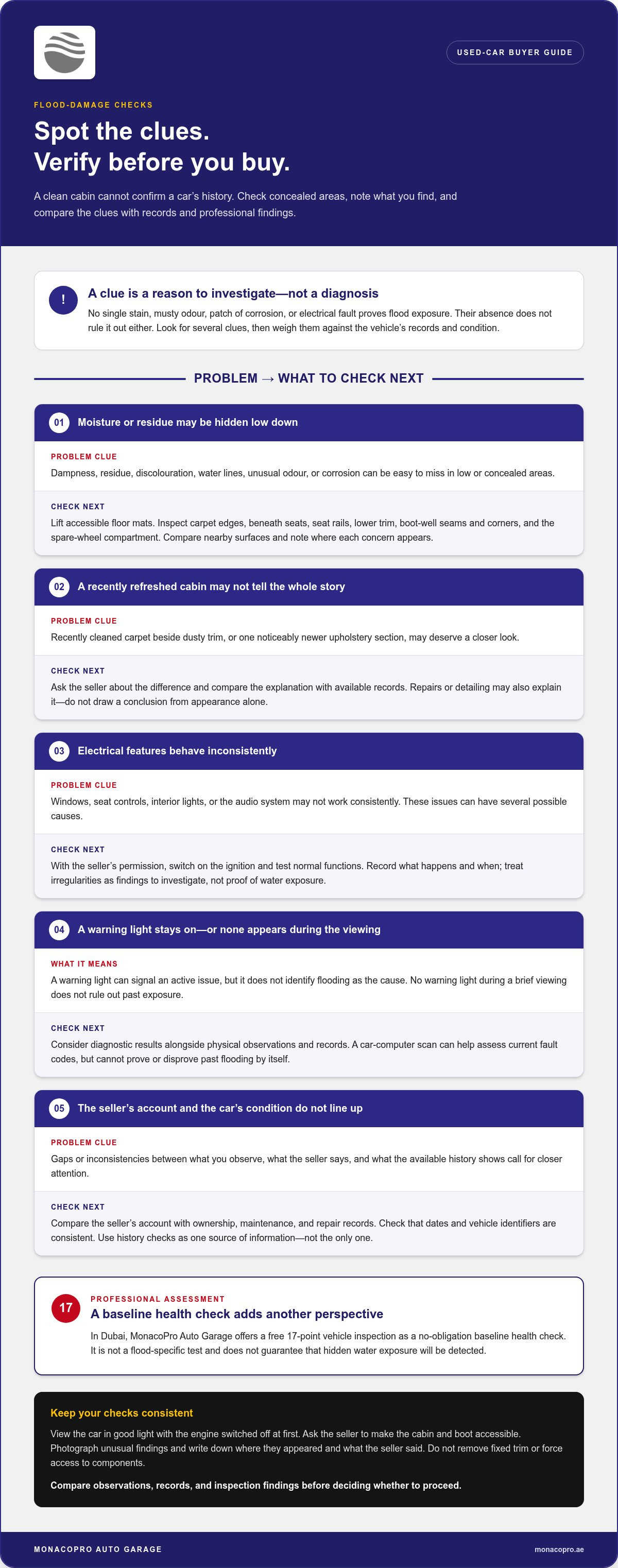
Use a deliberate, consistent process rather than relying on a quick glance. View the car in good light, with the engine switched off at first, and ask the seller to make the cabin and boot accessible. Photograph anything unusual so you can compare areas later or discuss specific observations during an inspection. Don’t remove fixed trim or force access to components.
Cabin and boot clues worth checking
Start low, where water or residue may collect. Lift accessible floor mats and inspect the carpet edges, seat rails, and lower trim. Look in the boot well and spare-wheel compartment, including seams and corners. Note dampness, residue, water lines, or a musty odour, but don’t treat any one clue as proof. Age, use, and maintenance can also affect the interior’s condition.
Compare what you find with the rest of the cabin. Recently cleaned carpet beside dusty trim underneath, or one noticeably newer section of upholstery, may be worth asking about. There may be ordinary explanations, such as repairs or detailing. Record the difference and compare the seller’s explanation with available documents instead of drawing a conclusion from appearance alone.
Electrical and mechanical warning signs
With the seller’s permission, switch on the ignition and observe the dashboard’s usual warning-light check. Note lights that remain on and features that work inconsistently, such as windows, seat controls, interior lights, or the audio system. Malfunctions have several possible causes, so record what happens and when rather than assuming water exposure is responsible.
A car computer diagnostic can help assess current fault codes and warning-light concerns, but a scan alone can’t prove or disprove past flooding. If you find electrical irregularities, include professional diagnostics in your assessment and weigh the findings alongside your visual observations.
Use this quick checklist: inspect for moisture and residue in the cabin, look for corrosion in low or concealed areas, and test electrical features. Treat each clue as a prompt for further checks, not proof.
To avoid buying a flood damaged car in UAE, write down each concern, where you found it, and what the seller said about it. Compare your notes with the vehicle’s documents and a professional assessment. This makes it easier to identify which differences appear cosmetic and which need closer attention before you commit.
If your walk-around raises questions, a pre-purchase vehicle inspection can add a professional assessment to your own checks. MonacoPro Auto Garage’s free 17-point inspection is a no-obligation baseline vehicle-health check, not a flood-specific test or a guarantee that hidden water exposure will be detected.
How to verify a used car’s history and assess seller explanations
Use the seller’s account as a starting point, then compare it with documents and the car’s condition. Ask about water exposure, interior replacements, repairs, and electrical work. The aim is to gather details that can be checked, such as dates, invoices, and the parts involved, rather than to settle the car’s history in conversation.
Questions that clarify the car’s history
Ask whether the car has ever been exposed to standing or floodwater, whether carpets or trim have been replaced, and whether electrical repairs have been carried out. Request available service records, repair invoices, and ownership documents. Compare their dates and descriptions with the vehicle in front of you. If an answer is unclear or a record is missing, note the gap and follow up rather than treating a confident explanation as evidence.
Use a comparison like this to organise what you learn:
| Seller statement | Available documentary evidence | Physical observation | Unresolved concern |
|---|---|---|---|
| “The interior is original.” | Service records don’t mention upholstery work. | One carpet section looks newer than surrounding trim. | When was it replaced, and why? |
| “The electrical issue was repaired.” | An invoice describes a repair, but gives limited detail. | A feature still works inconsistently. | Was the fault resolved, and is further diagnosis needed? |
Using vehicle records without over-relying on them
Compare the chassis or VIN on the vehicle with the identifiers on the seller’s documents and any history results. Check whether ownership and maintenance dates follow a plausible sequence and whether invoices refer to the same vehicle. Official UAE options for checking recorded accident information may include services from the Ministry of Interior or Emirates Vehicle Gate. Confirm each service’s current access and record coverage before relying on it.
Record searches can provide useful context, but their scope depends on what information was reported and made available. An accident record isn’t necessarily a flood report, and no result doesn’t establish that the car was never exposed to water. Treat a clean search as one input, not a substitute for examining the vehicle or arranging a professional assessment.
Keep a short list of statements you couldn’t match to documents and observations that still need an explanation. If the seller’s account, records, and vehicle condition don’t align, pause before paying or signing. Combining these checks is a practical way to avoid buying a flood damaged car in UAE without treating any one document or conversation as conclusive.
A practical UAE buyer checklist before paying or signing
A structured inspection helps you base your decision on evidence rather than a rushed viewing. Choose a well-lit place, allow enough time, and keep notes or photographs of anything that needs an explanation. You don’t need to dismantle the vehicle. Check the documents, visible condition, normal functions, and professional assessment in order.
Follow a consistent inspection sequence
Start by matching the vehicle’s identifying details with the documents provided, then review available ownership, maintenance, and repair records. Next, check the cabin and boot, followed by visible components and ordinary vehicle functions. Note discrepancies without removing fixed trim or attempting invasive checks. Before making a final decision, arrange a professional pre-purchase inspection and share your observations.
- Review the documents. Compare the vehicle identifier on the car with the paperwork. Note gaps in ownership, service, or repair history, and list unanswered questions.
- Inspect the vehicle in good light. Check the cabin, lower trim, boot, and accessible storage areas. Look for inconsistent condition or signs that need an explanation, and photograph relevant details.
- Check normal functions. Observe the dashboard during its usual warning-light check and test accessible features such as windows, lights, and air conditioning. Record faults instead of trying to repair or investigate them yourself.
- Arrange a professional assessment. Share your notes and specific concerns. A computer diagnostic can help assess current faults, but it can’t establish a complete history of water exposure on its own.
When to proceed, pause, or walk away
Proceed only when the available evidence is coherent and you understand what remains uncertain. A minor discrepancy may have a straightforward explanation, but it should make sense alongside the records and the car’s condition. If the seller’s account conflicts with documents, visible clues, or diagnostic observations, pause and resolve the mismatch before committing.
- Proceed when records and observations broadly align and any remaining uncertainty is acceptable to you.
- Pause when documentation is incomplete, explanations change, or a concern needs professional assessment.
- Walk away if important questions remain unanswered or you’re not comfortable with the risk before paying or signing.
Don’t drive the car if it has a safety-critical fault or warning. Arrange a professional assessment instead. Following these steps can help you avoid buying a flood damaged car in UAE and make a considered choice, whether that means proceeding, negotiating, or declining the purchase.
For a professional assessment before you commit, arrange a professional pre-purchase inspection with MonacoPro Auto Garage in Dubai.
Get a professional pre-purchase inspection in Dubai
Your own checks help you notice inconsistencies. A professional pre-purchase inspection adds an assessment of the vehicle’s current condition before you commit. It can help put concerns such as an active warning light, uneven tyre condition, or a fluid issue into context. Share your observations so they can be considered as part of the assessment.
MonacoPro Auto Garage in Umm Ramool offers a free 17-point vehicle inspection with no obligation. It is a baseline vehicle-health check, not a flood-specific test, flood-history certificate, or guarantee that every sign of past water exposure will be identified. Use the inspection alongside the seller’s documentation, your observations, and careful consideration of any unresolved concerns.
What MonacoPro’s inspection can contribute
The 17-point check covers vehicle-health items including engine oil, gearbox oil, differential oil, coolant level, brake pads and discs, brake fluid, the battery and charging system, tyres and air pressure, wheel alignment, suspension and shock absorbers, steering and tie rods, belts and hoses, spark plugs and fuel injectors, exterior lights, AC performance, warning lights and computer scan, and wipers and washer fluid. These checks help assess listed aspects of the vehicle’s current condition. A computer scan provides diagnostic information, but it can’t, on its own, confirm or rule out past flood exposure.
MonacoPro provides a digital vehicle-health report before work begins. Review the findings to understand what the inspection identified and to inform your purchase decision. Any repair decision is separate from the assessment. Consider the report alongside the car’s records, the seller’s explanations, and your own priorities before deciding whether to proceed.
For buyers looking to avoid buying a flood damaged car in UAE, this distinction matters. A clear result on the listed health checks isn’t proof that water never reached the vehicle. If you’ve noticed residue, inconsistent interior condition, or an electrical concern, share those specific observations so they can be considered in assessing the car’s condition.
Arrange the next step in Umm Ramool, Dubai
Before finalising the transaction, arrange a pre-purchase inspection at MonacoPro Auto Garage, 13th-st Umm Ramool, Dubai. Bring your notes and any available service or repair documents, and identify the questions you want the assessment to address. This gives the inspection a practical focus and helps you weigh its findings against information from your own checks.
Take time to review the vehicle-health report and consider any findings you don’t understand. Decide whether the available evidence gives you enough confidence to proceed. If concerns remain unresolved, pause the purchase until you’re comfortable with your next step. A careful assessment supports an informed decision, but no single check should be treated as a guarantee.
To take this step before signing or paying, book a pre-purchase inspection with MonacoPro.
Make your next car purchase with confidence
A used-car purchase deserves a considered decision, not a rushed one. Weigh what the evidence tells you, what remains uncertain, and whether you’re comfortable accepting that uncertainty. If an important question still has no satisfactory answer, waiting or walking away can be the right decision.
Taking time before you commit is a practical way to avoid buying a flood damaged car in UAE. Treat an inspection as part of your decision-making, not as a formality after you’ve decided to buy. A professional assessment can add useful perspective before you make that commitment.
MonacoPro Auto Garage offers pre-purchase inspections and computer diagnostics, along with a free 17-point vehicle inspection with no obligation. The inspection is a vehicle-health check, not a guarantee against hidden flood damage. To take a considered next step, arrange a professional pre-purchase inspection with MonacoPro. Careful checks and clear information can help you make a decision at your own pace.
Frequently Asked Questions
Can a car look clean after flood damage?
Yes. Cleaning or replacing interior materials can make a car look presentable even if water reached less visible areas. A clean surface doesn’t show what may be behind trim, beneath carpeting, or inside electrical connections. Check whether the condition appears consistent across the cabin and boot, and compare it with repair records. A tidy interior may be reassuring, but it doesn’t establish the car’s history.
Does a vehicle-history check show whether a car was flooded in the UAE?
Not necessarily. A history check may show recorded incidents, but it may not provide a complete record of flood exposure for every vehicle in the UAE. Available information depends on the source and what was recorded. Check the vehicle identifiers carefully and use the results as one part of your research. If a search returns no relevant record, treat that as an absence of information, not confirmation that the car was never exposed to water.
What are the first signs of possible flood damage in a used car?
Check whether the cabin’s condition is consistent, including the carpets, trim, and seat areas. Dampness, residue, unusual corrosion in low areas, or unexplained electrical problems may need closer attention. One clue alone can have other explanations. Note where you find each concern and whether other observations support it, then seek a professional assessment before deciding what it means.
Should I buy a car if the seller says it was only exposed to a little water?
Don’t decide based on that description alone. Ask what happened, which areas were affected, and whether cleaning or repairs followed. Request available invoices or service records, then compare their details with the car’s present condition. “A little water” can mean different things and doesn’t tell you whether components were affected. If the account or evidence leaves important questions unanswered, pause the purchase until you’re comfortable with the findings.
Can a computer diagnostic scan prove a car was flood-damaged?
No. A scan can identify current diagnostic information, such as fault codes, but it isn’t a record of every event in a vehicle’s past. A car may have no active warning at the time of the scan, while a code may have causes unrelated to water. Use diagnostics to understand present concerns, then consider the results alongside the physical condition, available records, and a professional pre-purchase assessment.
What should I do if I find possible flood damage before buying?
Pause before paying or signing. Photograph the areas of concern, write down what the seller said, and request relevant repair or maintenance documents. Arrange a professional assessment and use its findings to decide whether the concern is understood and acceptable. If significant questions remain unresolved, walking away is a reasonable choice. These steps can help you avoid buying a flood damaged car in UAE based on appearance or reassurance alone.