
Dashboard warning lights explained in practical terms can help you decide whether to stop, keep driving cautiously, or arrange a check. An unfamiliar symbol is a prompt to investigate, not a diagnosis by itself. Some lights signal a possible fault, while others simply show that a vehicle feature is active.
This guide explains how to identify the system a symbol may relate to and judge its urgency. You’ll learn how to distinguish common warning lights from information indicators, what red and amber lights generally signal, and what steps to take when a warning appears.
We’ll also cover situations that call for a safe stop, including a flashing check engine light, and when to seek prompt professional advice. If a warning stays on or returns after an apparent fix, a car computer diagnostic can help investigate the underlying fault rather than relying on the symbol alone.
Key Takeaways
- Get dashboard warning lights explained in plain language, then check the symbol, colour, flashing pattern, and any changes in how the car behaves.
- Use common engine, brake, battery, and tyre-pressure symbols to identify the system that may need attention, not to assume a specific part has failed.
- If the vehicle seems unsafe or the manual advises stopping, find a safe place rather than continuing to drive.
- When a warning persists or returns, diagnostic testing combined with inspection can help investigate the issue more fully.
- For a diagnostic check in Dubai, MonacoPro Auto Garage is located in Umm Ramool; TPMS sensor programming is also available for tyre-pressure monitoring needs.
Dashboard warning lights explained: what the colours and symbols tell you
An illuminated dashboard symbol can be unsettling, but it doesn’t confirm that a particular part has failed. Dashboard warning lights are vehicle alerts: some indicate that a system is active, while others report a detected issue or a maintenance prompt. The symbol is a useful clue, not a complete diagnosis.
These indicators are often called tell-tales. The Tell-tale (automotive) overview explains their role in communicating vehicle status and faults. A light may appear briefly during startup as the vehicle checks its systems, then go out. If it stays on or returns while driving, note the symbol and check the owner’s manual for the meaning specific to your vehicle.
Colour offers a first guide, but it doesn’t replace the manual or your observations of how the car behaves. Manufacturers can use different symbols and instructions, and the same colour may appear on both alerts and ordinary status indicators. Treat the light as a prompt to assess the situation, not proof of a specific mechanical cause.
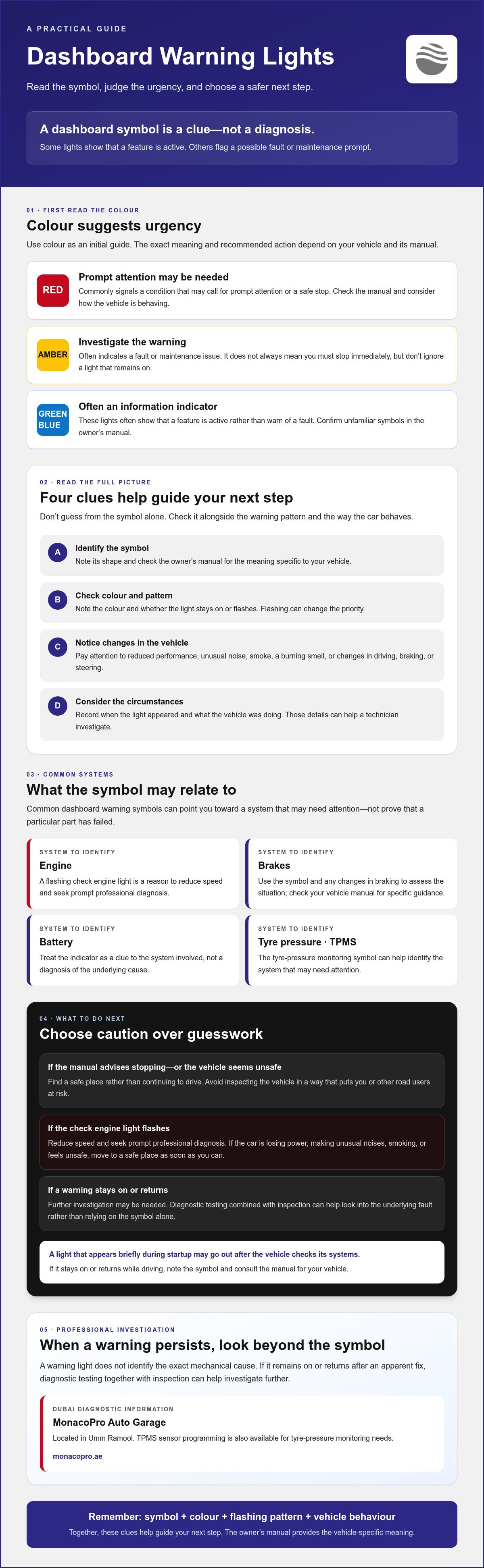
Quick guide: colour suggests urgency, flashing can change the priority, and accompanying symptoms help determine your next step.
What do red, amber, green, and blue dashboard lights mean?
Red commonly signals a condition that may need prompt attention or a safe stop. Check the manual and consider how the vehicle is behaving. Amber or yellow often indicates a fault or maintenance issue that needs investigation, though it doesn’t always mean you must stop immediately. Don’t ignore a light that remains on.
Green and blue lights are often informational, showing that a feature is active rather than warning of a fault. For example, a coloured indicator may tell you that a lighting or driving feature is switched on. Confirm unfamiliar symbols in the manual, as the exact meaning depends on the vehicle.
Why can the same dashboard symbol mean different things?
Symbol design and meaning can differ by manufacturer, model, and vehicle equipment. A similar-looking icon may refer to a different system, or a message on the display may change how you should respond. A generic online symbol chart can help narrow down what you’re seeing, but it shouldn’t replace model-specific guidance.
Consult the owner’s manual for the exact explanation and recommended action. Note whether the light is steady or flashing, and whether you notice reduced performance, unusual noise, or smoke. A symbol alone can’t identify the underlying mechanical cause. If a warning persists or returns, it may need further investigation.
How to interpret a dashboard warning light: colour, flashing, and symptoms
When a new light appears, assess it rather than guessing at the cause. Identify the symbol, note its colour, then check whether it’s steady or flashing. The owner’s manual can clarify what that indicator means for your vehicle and what action the manufacturer recommends. For a general reference to the colour system, see National Highways’ guide to dashboard warning light color meanings.
Next, pay attention to the car. Is it driving, braking, or steering differently? Listen for unusual noise and look for smoke, a burning smell, or reduced performance. A warning accompanied by a noticeable change in how the vehicle behaves calls for more caution than an unfamiliar symbol appearing while the car seems normal. Don’t inspect the vehicle in a way that puts you or other road users at risk.
Key takeaway: assess the warning together with the vehicle’s behaviour, not the symbol alone. This practical approach to dashboard warning lights explained helps you decide whether to consult the manual, stop safely, or seek advice promptly.
Does a flashing dashboard warning light mean stop driving?
Not always. Flashing can indicate a condition that needs more urgent attention, but its meaning depends on the warning and the vehicle. Check the manual for the specific instruction. If the car is losing power, making unusual noises, smoking, or otherwise feels unsafe, move to a safe place as soon as you can and avoid continuing until you’ve understood the risk. A flashing check engine light is a reason to reduce speed and seek prompt professional diagnosis.
What should you check when a new warning appears?
Make a brief record while the details are fresh. This information can help a technician understand the circumstances in which the warning appeared.
- Identify the indicator: note its shape, colour, and whether it stays on or flashes.
- Recall the circumstances: record when it appeared and what the vehicle was doing, such as starting, accelerating, or braking.
- Describe any symptoms: include changes in performance, unusual sounds, smoke, or other alerts.
- Check the manual: follow model-specific guidance and don’t clear or ignore the warning before you understand it.
If the light persists or returns, a car computer diagnostic can help investigate it alongside the symptoms you’ve recorded. Drivers in Dubai can learn more about car computer diagnostic services from MonacoPro Auto Garage in Umm Ramool.
Common dashboard warning lights: engine, brakes, battery, and TPMS
Use this reference to narrow down which vehicle system a symbol may relate to, not to diagnose a failed part. In this guide to dashboard warning lights explained, the owner’s manual remains the best source for your vehicle’s exact symbol and recommended response. Urgency depends on the manual’s instructions, whether the light is steady or flashing, and how the vehicle behaves.
Check engine and battery lights
Check engine: An engine-shaped icon can signal that the vehicle has detected an issue requiring diagnosis. It doesn’t identify one specific fault by itself. If it stays on, returns, or appears with reduced performance or unusual sounds, seek professional advice. A flashing light warrants prompt attention, so follow the manual’s guidance and don’t ignore it.
Battery symbol: This light may relate to the vehicle’s charging system. The icon alone can’t confirm which part or condition is responsible. If it remains illuminated or the car behaves differently, check the manual and arrange professional advice. For further context, Top Gear’s overview of common dashboard symbols covers several familiar indicators, including battery and brake lights.
Brake and oil pressure warnings
Brake warning: A brake-related symbol may indicate a system alert that needs careful attention. Check the manual for its specific meaning. If braking feels different or the warning appears alongside another concerning symptom, find a safe place to stop and seek advice rather than assuming the brakes are operating normally. For broader maintenance context, see this complete guide to car repair in Dubai.
Oil pressure warning: Treat this alert cautiously. Consult the manual immediately for the recommended action, and don’t continue driving if it advises stopping. The symbol signals a condition that needs attention, but it doesn’t establish the underlying cause.
Tyre-pressure monitoring system (TPMS)
TPMS warning: This may relate to tyre pressure or the monitoring system itself, rather than confirming a particular tyre fault. When it’s safe, check the tyres and follow the vehicle manual’s instructions. If the warning persists after you’ve addressed the pressure, further investigation may be needed. Read MonacoPro’s TPMS malfunction diagnosis guide for more on possible monitoring-system issues.
For any of these alerts, don’t judge urgency from the symbol alone. Match it with the manual, the light’s behaviour, and any changes in the vehicle. Seek a professional diagnostic check if the warning remains unexplained or returns.
What to Do When a Dashboard Warning Light Appears
A warning light calls for a measured response. First, notice whether the car still feels normal. Then check the symbol and instructions in the owner’s manual. If the vehicle seems unsafe, or the manual advises stopping, don’t continue driving just to reach your destination.
Resetting a dashboard light isn’t the same as resolving the issue. If a warning disappears and then returns, or remains on after an apparent fix, arrange a professional diagnostic check. A technician can investigate the alert alongside the vehicle’s symptoms, rather than treating the symbol as a confirmed diagnosis.
When should you stop safely instead of continuing?
Prioritize safety if you notice a loss of normal control, a change in braking or steering, smoke, or another serious symptom. Avoid sudden manoeuvres. Where it’s safe to do so, move out of traffic and stop in a suitable location, then follow the vehicle manual’s instructions. If the situation poses immediate danger, contact the appropriate emergency service. This guidance doesn’t replace manufacturer instructions or emergency assistance.
If the car appears to be operating normally, that alone doesn’t prove it’s safe to ignore the warning. Check the manual for the specific light, and seek professional advice if you’re unsure whether to continue. A careful decision is better than relying on a general symbol chart.
What information should you give a technician?
Clear observations can help a technician investigate the alert. Before details fade, note:
- The symbol and colour: describe its appearance or take a photo when the vehicle is safely parked.
- Its behaviour: say whether it stayed on, flashed, went away, or returned.
- When it appeared: mention what the car was doing, such as starting, braking, or accelerating.
- Any symptoms: report changes in noise, handling, braking, or performance, as well as smoke or other warnings.
- Relevant recent work: mention repairs or battery work if they happened and may relate to the timing of the alert.
These details help build a clearer picture, but they don’t replace testing. If the warning remains unexplained, MonacoPro Auto Garage in Umm Ramool, Dubai, offers car computer diagnostics to help investigate it. Arrange a car computer diagnostic check if you need professional help assessing a persistent warning.
Professional dashboard warning light diagnostics in Dubai
A warning symbol points to a system that needs attention, but it doesn’t explain the full cause. A car computer diagnostic check can help investigate relevant fault information recorded by the vehicle. It’s one part of the assessment, not an instant answer or a guarantee that every warning can be resolved through a scan alone.
What can a car computer diagnostic check help investigate?
Diagnostic equipment can retrieve information that helps a technician narrow down what to investigate. The results need context: a code may relate to a system or condition without identifying a specific failed component. A technician may compare scan findings with the warning’s timing, the symptoms you’ve noticed, and vehicle-specific information. Further inspection may be needed to understand what’s happening.
This is why dashboard warning lights explained through a symbol chart or scan result should be treated as guidance, not a final diagnosis. If a warning returns after an apparent fix, for example, the technician can consider both the available vehicle information and what has changed since the alert first appeared. The next steps depend on the findings.
When should Dubai drivers book a diagnostic check?
Consider professional advice if a warning remains illuminated, comes back after disappearing, or appears alongside unusual sounds or changes in how the vehicle performs. Follow the owner’s manual, especially if it advises stopping. A diagnostic check is not a substitute for dealing with an unsafe vehicle, and a scan should not be used simply to clear a warning without understanding why it appeared.
Before the assessment, share what you observed: the symbol, whether it flashed or stayed on, when it appeared, and any related symptoms. Mention recent repairs or battery work if relevant. These details can help the technician interpret the scan in context rather than viewing the result in isolation.
MonacoPro Auto Garage in Umm Ramool, Dubai, provides car computer diagnostic services for drivers seeking help investigating a persistent or unexplained warning. The process may involve reviewing scan information alongside symptoms and inspection, with findings guiding any further discussion. No single result should be assumed before the vehicle has been assessed.
If a warning light remains unexplained, contact MonacoPro Auto Garage to discuss whether a car computer diagnostic check may be a suitable next step. If the vehicle feels unsafe or the manual advises stopping, prioritize safety and follow the vehicle’s guidance before arranging an assessment.
Take the Next Step With Confidence
Understanding dashboard warning lights explained starts with treating each symbol as a prompt to assess, not a diagnosis. Check the light’s colour and behaviour, consult your owner’s manual, and pay attention to changes in how the vehicle runs. If it seems unsafe or the manual advises stopping, put safety first.
If a warning stays on or returns, a professional diagnostic check can help investigate the underlying issue. MonacoPro Auto Garage offers car computer diagnostic services in Umm Ramool, Dubai. For tyre-pressure monitoring concerns, the garage also offers TPMS sensor programming.
Contact MonacoPro Auto Garage to discuss a diagnostic check if you need guidance on a persistent or unexplained warning. With careful observation and professional advice, you can make your next decision with greater confidence.
Frequently Asked Questions
What do the colours of dashboard warning lights mean?
Dashboard light colours offer general guidance, not a universal diagnosis. Red may call for immediate attention or a safe stop, while amber commonly signals a fault or maintenance issue that needs investigation. Green and blue often show that a feature is active. In any guide to dashboard warning lights explained, colour is only a starting point: check your vehicle’s manual, whether the light flashes, and any symptoms.
Can I keep driving with a dashboard warning light on?
It depends on the symbol, your vehicle’s behaviour, and the owner’s manual. If the car feels unsafe, shows serious symptoms, or the manual advises stopping, find a safe place and don’t continue. If the light stays on but the vehicle seems normal, don’t assume the issue is harmless. Consult the manual and arrange professional advice to understand whether it needs prompt attention.
What should I do if a dashboard warning light starts flashing?
Identify the flashing symbol and check your vehicle’s manual, because the meaning and urgency depend on the system and model. If the car behaves unusually or you’re concerned about safety, move to a safe place and stop. Don’t assume the warning is minor just because the vehicle still moves normally. Follow the manufacturer’s instructions and seek professional advice if the alert persists or its meaning is unclear.
Does a check engine light always mean a serious problem?
Not necessarily. A check engine light means the vehicle has detected an issue that needs attention, but the symbol alone doesn’t identify its cause or severity. A steady light and a flashing light may require different responses, depending on the vehicle. Check the manual and note any changes in performance or unusual symptoms. If the light persists, arrange professional diagnostics to investigate it.
Why is my TPMS warning light still on after checking the tyres?
A TPMS warning may remain because pressure still needs attention or because there’s an issue with the tyre-pressure monitoring system. Follow your vehicle manual’s instructions for checking pressure and resetting the alert; don’t guess or repeatedly clear it. If the light stays on, a technician can investigate the system and sensor information. MonacoPro Auto Garage in Umm Ramool, Dubai, also offers TPMS sensor programming.
Can a diagnostic scan tell me exactly what is wrong with my car?
A diagnostic scan can provide useful fault information, but it may not identify a failed part or determine the complete repair on its own. A technician interprets the results alongside the warning symbol, your description of symptoms, and inspection findings. Treat diagnostic codes as clues for further investigation, not a guaranteed diagnosis or an automatic instruction to replace a component.
Where can I get dashboard warning lights checked in Dubai?
If a warning stays on, returns, or appears with symptoms, seek professional advice rather than assuming it’s harmless. MonacoPro Auto Garage in Umm Ramool offers car computer diagnostic services in Dubai. Share which symbol appeared, whether it stayed on or flashed, and any changes you noticed. The diagnostic process can help investigate the issue, but findings depend on the vehicle and assessment.