
Could the part you’re ready to replace be perfectly fine? A rough idle can make a car feel unreliable, but shaking or uneven engine speed is a symptom, not a diagnosis. Finding the right car running rough at idle fix starts with noting when the problem occurs and checking for evidence before buying parts.
It’s understandable to wonder whether it’s safe to keep driving or whether the cause lies in the ignition, air intake, fuel system, or a sensor. This guide explains common possibilities without treating any one of them as confirmed. You’ll learn which basic observations are safe, what warning signs call for prompt attention, and what details to share with a technician.
When simple checks don’t provide an answer, professional diagnostic testing can help narrow down the cause. For Dubai drivers, MonacoPro Auto Garage in Umm Ramool offers car computer diagnostics. Testing can help identify what needs further investigation before parts are replaced, giving you a more informed basis for deciding what to do next.
Key Takeaways
- Shaking, changing RPM, stumbling, or stalling can describe a rough idle, but symptoms alone don’t confirm the cause.
- Air intake, ignition, fuel, and sensor-related issues can produce similar signs, so maintenance history and diagnostic findings matter.
- Note when the roughness appears, such as at startup or with accessories on. This gives a technician useful clues without guessing at repairs.
- For a car running rough at idle fix, start with safe observations and owner-manual-approved checks. Avoid hot or moving engine parts.
- Share symptom timing, warning lights, and recent work when arranging professional diagnostics, including at a workshop in Umm Ramool, Dubai.
Car Running Rough at Idle: What the Symptoms Can Tell You
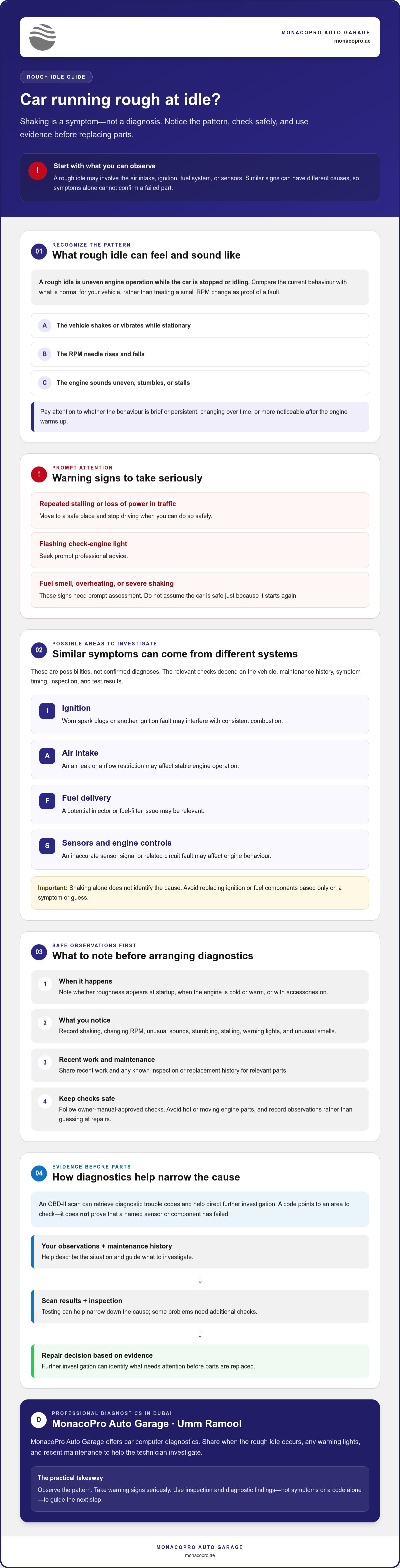
A rough idle is uneven engine operation while your car is stopped or idling. You might feel the vehicle shake, see the RPM needle fluctuate, hear an unusual noise, or notice the engine stumble or stall. These signs describe what the car is doing, but they don’t identify a specific failed component.
At idle, the engine runs without the car moving under normal driving load. The exact engine idle speed varies by vehicle and conditions, so a small change in RPM isn’t automatically a fault. Focus on whether the behaviour is unusual for your car, how strongly it occurs, and whether it changes over time. That context helps guide a car running rough at idle fix without jumping to a parts replacement.
Notice the full pattern, not just the vibration. Does the engine sound uneven? Does the RPM rise and fall? Does the car stumble briefly, or does it repeatedly threaten to stall? Also note whether the check-engine light is on or flashing. These details can help a technician decide what to investigate, but they aren’t proof of a particular cause.
How to tell normal engine variation from a rough idle
Compare the current behaviour with what you’re used to in the same vehicle. A brief change just after startup may differ from persistent shaking that continues after the engine warms, or roughness that is becoming more pronounced. When safe, note whether the car is stationary, whether the engine is cold, and whether it has warmed up. Record what you observe rather than trying to diagnose the cause.
Which warning signs mean you should stop driving?
If the engine repeatedly stalls or loses power in traffic, move to a safe place and stop driving when you can do so safely. A flashing check-engine light warrants prompt professional advice. Fuel smell, overheating, or severe shaking also needs prompt assessment. Don’t assume the car is safe to drive just because it starts again after a warning sign appears.
These symptoms can range from a brief irregularity to a problem that affects safe, dependable operation. Note when the roughness began, whether it is getting worse, and any warning lights or unusual smells. If you’re unsure whether it’s safe to continue, seek professional guidance rather than risking a stall in traffic.
Why Does a Car Run Rough at Idle? Common Causes Explained
A rough idle can have several possible causes, and similar symptoms may come from different systems. Uneven combustion, disrupted airflow, inconsistent fuel delivery, or misleading sensor readings can all affect how smoothly an engine runs while stationary. These are starting points for investigation, not confirmed diagnoses. The most useful shortlist depends on the vehicle’s design, maintenance history, when the symptoms occur, and what inspection and testing reveal.
Ignition, air, and fuel issues that may affect idle
In the ignition system, worn spark plugs or another ignition fault may interfere with consistent combustion. On the air-intake side, a leak can allow air to enter where the engine’s controls don’t account for it, while an airflow restriction may also affect stable operation. Fuel delivery concerns, including a potential injector or fuel-filter issue, may be relevant too. Shaking alone doesn’t confirm any of these possibilities.
Maintenance records can help narrow down what to investigate. Note when relevant parts were last inspected or replaced, if known. Avoid replacing ignition or fuel components based only on a symptom or a guess. A technician can assess the vehicle and confirm which system needs attention before recommending a repair.
Sensors and engine controls: when electronic faults matter
The engine control unit uses information from sensors to manage engine operation. If a sensor signal is inaccurate or a related circuit has a fault, engine behaviour may be affected. An OBD-II scan can retrieve diagnostic trouble codes that help direct further investigation, but a code points to an area to check. It doesn’t, by itself, prove that a named sensor or component has failed.
A scan also isn’t a complete diagnosis on its own. Some problems require additional checks, and the appropriate test depends on the vehicle and its symptoms. A car running rough at idle fix should follow evidence from inspection and diagnostic testing, not just a code reader’s result or a parts list found online.
When the cause isn’t clear from your observations or service history, professional assessment can help connect symptoms with test results. MonacoPro Auto Garage in Umm Ramool, Dubai, offers car computer diagnostics. You can review its car computer diagnostic service as a possible next step, then share when the rough idle occurs, any warning lights, and recent maintenance with the technician. Repair recommendations should follow the findings and the vehicle’s specific requirements.
How to Narrow Down a Rough Idle Without Guessing at Repairs
A symptom pattern can help a technician choose what to investigate, but it can’t confirm the cause by itself. The same roughness may point toward different possibilities in different vehicle models, so use these comparisons as clues, not as a parts-replacement guide.
| What you notice | Broad areas to investigate |
|---|---|
| Roughness mainly at startup | Ignition, air intake, fuel delivery, or engine-management systems may warrant assessment. |
| Roughness continues or changes after the engine warms | Airflow, fuel delivery, ignition, or sensor readings could be relevant. |
| Idle changes when an accessory is switched on | The engine’s response to the added load may be worth checking. Vehicle design affects what’s normal. |
| Roughness is more noticeable during acceleration | Because the symptom isn’t limited to idle, a technician may need to assess engine operation across conditions. |
What to observe before arranging a diagnostic check
Keep a short record rather than trying to recreate the problem repeatedly. Note when the roughness starts, how long it lasts, whether it happens again, and whether the engine is cold or warm. Include warning lights, unusual sounds or smells, recent maintenance, and any change in fuel use. These details put the symptom in context and make a car running rough at idle fix less dependent on guesswork.
Leave components connected and don’t clear fault codes before an inspection. Disconnecting parts or erasing stored information can remove useful clues. Follow the owner’s manual for any checks you make, and avoid touching hot or moving components.
How diagnostic codes and physical checks work together
A diagnostic code can identify a system or condition that needs attention, but it isn’t a verdict that a particular part has failed. Technicians interpret codes alongside available live data, the reported symptom pattern, and a physical inspection. Depending on the vehicle and findings, areas to assess may include airflow, ignition, fuel delivery, and possible vacuum leaks.
The precise checks vary by model, so one scan or standard procedure won’t answer every question. If observations alone don’t narrow down the cause, professional car computer diagnostics can help direct the next checks. Electronic testing can guide an investigation, but it doesn’t replace a complete assessment.
What You Can Check Safely Before Seeking a Rough-Idle Fix
A few careful observations can help a technician understand the problem, but they won’t confirm the cause. Keep checks simple and follow the owner’s manual. Park in a safe place, switch off the engine, and let it cool before looking under the hood. Keep clear of hot or moving parts.
A simple observation checklist for drivers
- Note the warning lights. From the driver’s seat, record which lights appear and whether any stay on or flash. Don’t try to diagnose a fault from the light alone.
- Describe the symptom. Write down when the roughness starts, how long it lasts, whether it repeats, and whether the engine is cold or warm. Note any unusual sounds, smells, or changes in fuel use.
- Look for an obvious loose intake duct. Only inspect when the engine is off and cool. Don’t pull, disconnect, or reposition components. Leave anything uncertain for a technician.
- Review recent changes. Record recent refuelling, maintenance, or repairs, along with when the rough idle began. These details may help connect the timing with the symptoms.
- Check the manual. Follow only owner-manual-approved checks. Don’t work on the fuel system, perform live electrical testing, swap parts speculatively, or clear diagnostic codes before an inspection.
When DIY checks are not enough
Persistent shaking, repeated stalling, or unexplained warning lights call for professional assessment. Stop driving if the car stalls repeatedly or loses power in traffic. A flashing check-engine light also warrants prompt advice. Modern vehicles can require model-specific scan data and hands-on testing, so a basic visual check may not reveal what’s behind the symptom.
A car running rough at idle fix should be based on findings, not trial and error. Technicians may interpret diagnostic information alongside physical checks, with the exact approach depending on the vehicle. If simple observations haven’t explained the rough idle, MonacoPro Auto Garage in Umm Ramool offers car computer diagnostics. Arrange a car computer diagnostic assessment and share your notes with the technician.
Getting a Rough Idle Diagnosed and Fixed in Dubai
When a rough idle persists or remains unexplained, a professional assessment can help distinguish likely causes from confirmed findings. Before arranging an inspection, prepare a concise account of what the car does: when the symptom began, whether it occurs at startup or after warming, how often it happens, and whether it changes while driving. Mention warning lights, unusual sounds or smells, recent maintenance, or work carried out on the vehicle. These details give the technician a useful starting point without locking the diagnosis to one suspected part.
What to expect from a professional diagnostic appointment
A technician will generally begin by reviewing your description and assessing the vehicle. Diagnostic testing may include checking stored fault codes and relevant live data, followed by inspection of systems that could relate to the symptoms. Codes offer clues, not automatic proof that a component has failed. Ask what findings support the diagnosis, what additional checks are recommended, and how the proposed repair relates to the evidence.
The process can vary by vehicle and by what the initial assessment reveals. A scan may need to be followed by hands-on checks before a repair recommendation is made. You can ask for the findings and proposed work to be explained before approving repairs. Diagnosis time, repair duration, and cost depend on the specific issue, so avoid assuming these in advance.
Arrange help for a rough-idling car in Umm Ramool
For drivers in Dubai, MonacoPro Auto Garage is located in Umm Ramool and offers car computer diagnostics and mechanical repairs for multiple vehicle brands. Diagnostic testing can be a measured next step when simple observations haven’t clarified the cause. The results can guide a repair recommendation, but the right action depends on the technician’s assessment and the vehicle’s requirements.
Bring your symptom notes and relevant service history, and ask the workshop to explain the evidence behind its recommendation. If you’re considering professional assessment, Contact MonacoPro Auto Garage about professional diagnostics.
Choose an Evidence-Led Next Step
A rough idle is a symptom, not a parts diagnosis. The most useful clues are when it happens, whether warning lights appear, and how the behaviour changes as the engine warms or the car is driven. Safe observations can help, but persistent shaking, repeated stalling, or a flashing warning light calls for professional advice.
The right car running rough at idle fix starts with checking the evidence before approving repairs. Share your observations and recent maintenance with the technician, then ask how diagnostic findings support the recommended work. This helps you make an informed decision instead of replacing parts on a hunch.
For Dubai drivers, MonacoPro Auto Garage in Umm Ramool offers car computer diagnostics and mechanical repair services for multiple vehicle brands. To discuss a professional assessment, contact MonacoPro Auto Garage about professional diagnostics. Share what you’ve observed and ask the workshop to explain the findings and recommended next steps.
Frequently Asked Questions
Can I keep driving if my car is running rough at idle?
It depends on how severe the symptoms are and whether they affect safe control. If the engine repeatedly stalls or loses power in traffic, stop somewhere safe and seek professional advice. A flashing check-engine light, fuel smell, overheating, or severe shaking also needs prompt attention. If the roughness is mild but persistent, arrange an assessment rather than assuming the car is safe because it still drives.
What is the most common cause of a rough idle?
There isn’t one cause that can be identified as the most common for every vehicle. Rough idle can relate to ignition, air intake, fuel delivery, or engine-control systems, and similar symptoms may have different causes in different models. Maintenance history and when the roughness occurs help narrow down what to investigate. Inspection and diagnostic results are needed to confirm the cause before choosing a repair.
Can bad spark plugs make a car run rough at idle?
Yes. Worn or faulty spark plugs can interfere with consistent combustion and may contribute to shaking, uneven engine speed, or stumbling at idle. Other ignition faults can cause similar symptoms, so roughness alone doesn’t prove the plugs are bad. A technician can consider the vehicle’s maintenance history and inspect or test the relevant system before recommending replacement. Avoid changing parts based only on a hunch.
Why does my car idle rough but drive smoothly?
A problem may be more noticeable while the engine is running at idle than during driving, when engine speed and operating conditions change. Some faults may also be intermittent or more apparent when the car is stationary. Smooth driving doesn’t rule out an issue, and rough idle doesn’t identify one specific component. Note when the symptom occurs and arrange an assessment if it persists or worsens.
Can a dirty mass airflow sensor cause a rough idle?
It can, if the vehicle uses a mass airflow sensor and its readings are inaccurate, since the engine control system uses incoming-air information to manage operation. But a rough idle can also have other causes, including intake, ignition, or fuel-delivery concerns. Don’t assume the sensor is faulty or clean it without checking your vehicle’s guidance. Testing can help distinguish a sensor issue from similar symptoms.
Will a diagnostic scan tell me exactly why my car is idling rough?
Not necessarily. A scan can reveal stored fault codes and, depending on the vehicle and equipment, provide live data that helps guide investigation. A code is a clue, not automatic proof that a particular component has failed. Technicians interpret scan results alongside the symptoms and physical checks. A professional car running rough at idle fix should be based on the combined findings, not a code alone.
Can Dubai heat make a car run rough at idle?
Hot conditions and using the air conditioning can change the load on an idling engine, so you may notice a change in how the car behaves. That doesn’t establish heat as the cause of persistent roughness. Compare the symptom with the air conditioning on and off only when safe, and watch for an overheating warning. If the rough idle continues, have the vehicle assessed rather than attributing it to Dubai’s climate alone.