
Did you know that mechanical failures contribute to 22% of road accidents in the UAE? When you’re cruising down a Dubai highway and your steering wheel starts to shudder, it’s more than just a nuisance; it’s a significant safety concern. You likely feel a mix of anxiety about your vehicle’s stability and confusion over whether the issue stems from your tyres, brakes, or engine. Dealing with a shaking car is stressful, especially when you’re worried about the technical complexity of car vibration repair or finding a garage you can actually trust.
We understand that your priority is a smooth, safe commute without the fear of being overcharged. This article provides a comprehensive look at why your vehicle shakes and how professional diagnostics in Dubai can restore your driving experience. You’ll learn to identify the source of the vibration, from wheel alignment issues to suspension wear, and discover why our specialized team in Umm Ramool is the reliable choice for getting you back on the road with confidence. We’ll guide you through the common mechanical culprits and the logical steps to a permanent, professional solution.
Key Takeaways
- Identify the specific symptoms of mechanical disharmony, such as rhythmic shudders in the steering wheel or seat, before they escalate into safety risks.
- Learn why unbalanced tyres are the primary culprit for shaking at high speeds and how precision car vibration repair restores stability on the highway.
- Recognize how Dubai’s harsh climate and abrasive sand degrade rubber bushings and steering racks, requiring specialized maintenance for local conditions.
- Discover the hidden costs of delay, including increased fuel consumption and secondary damage to wheel bearings and vehicle fasteners.
- Understand our professional diagnostic workflow in Umm Ramool, which combines road tests and computer scans to provide a definitive one-stop solution.
Understanding Car Vibrations: Symptoms and Early Warning Signs
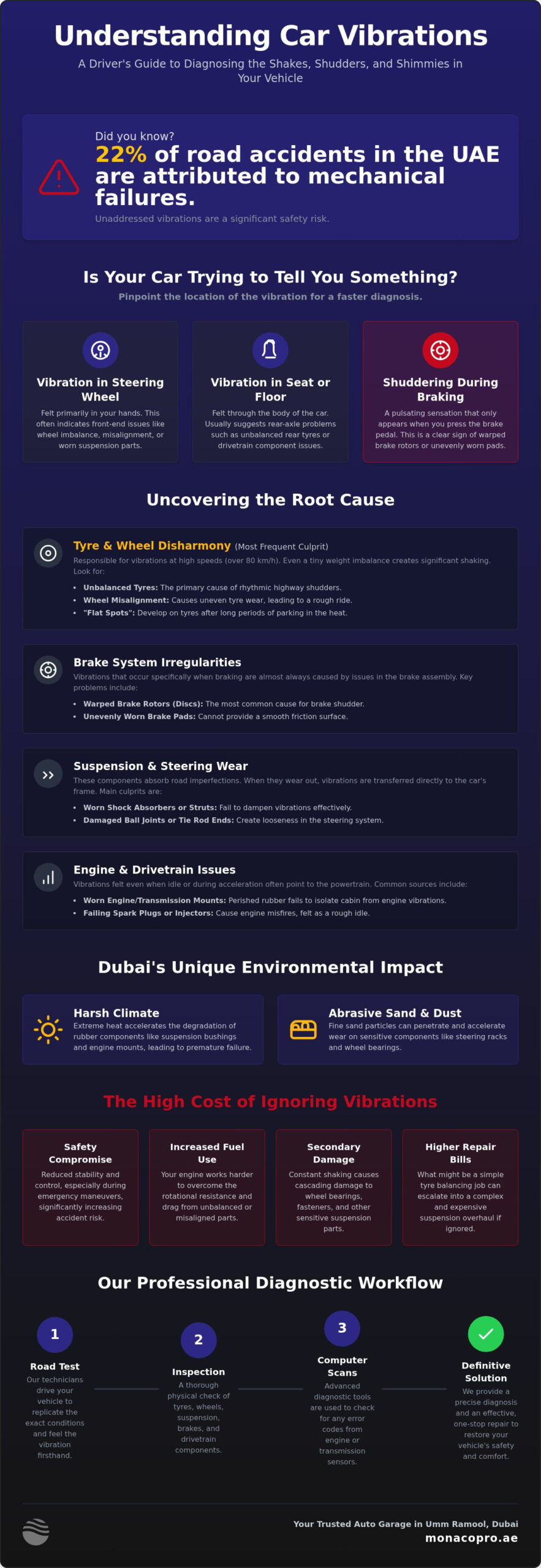
Car vibration is effectively any rhythmic shudder felt through your steering wheel, floorboard, or seat. In the automotive engineering world, these sensations are often categorized under the study of Noise, vibration, and harshness (NVH). While every vehicle has a specific “road feel,” a distinct, recurring shudder is rarely normal. It almost always indicates a state of mechanical disharmony where components are no longer working in perfect sync. Ignoring these early warning signs can lead to much more expensive car vibration repair needs as the shaking puts extra stress on your vehicle’s frame.
Knowing exactly when the shake occurs is vital for an accurate diagnosis. Does it happen while you’re sitting at a red light in Downtown Dubai, or only when you hit 100km/h on Sheikh Zayed Road? Vibrations at idle often suggest engine-related issues like worn mounts, dirty fuel injectors, or failing spark plugs. Conversely, high-speed vibrations are typically tied to the rotating assembly, such as your tyres, wheels, or driveshaft. We encourage every driver to pay close attention to the exact speed or driving condition when the shuddering begins. This level of detail helps our technicians pinpoint the root cause much faster and ensures a more efficient repair process.
Is the Vibration in the Steering Wheel or the Seat?
The location of the sensation provides a major clue about which part of the car is struggling. If you feel the vibration primarily in your hands, you’re likely dealing with front-end issues. These often involve problems with wheel alignment and balancing or worn suspension components. A steering shimmy is a common front-axle symptom where the steering wheel oscillates back and forth rapidly at specific speed ranges. Vibrations felt through your seat or the floor of the cabin usually suggest rear tyre imbalances or drivetrain problems. Identifying this distinction helps us narrow down the search area during a professional inspection at our Umm Ramool facility.
Identifying Shuddering During Braking
Another common scenario involves a shudder that only appears when you apply pressure to the brake pedal. This pulsating sensation is a clear indicator of issues within your stopping system. It’s usually caused by warped brake rotors or unevenly worn pads that can’t provide a smooth friction surface for the calipers. Because your safety depends on consistent stopping power, this symptom requires an immediate disc and brake service. Addressing this early prevents the vibration from damaging other sensitive suspension parts through constant, high-frequency rattling.
Common Causes of Vehicle Shaking and Shuddering
Understanding the root cause is the first step toward effective car vibration repair. While many drivers assume a shake always means a tyre issue, the reality is often more complex. A vehicle is a symphony of moving parts; when one component loses its balance, the entire chassis feels the impact. Mechanical failures contribute to 22% of road accidents in the UAE, making it vital to address these shudders before they compromise your control on the road.
Unbalanced tyres remain the most frequent culprit, typically manifesting as a rhythmic shudder at speeds exceeding 80km/h. However, misaligned wheels also play a significant role, causing the vehicle to pull to one side and creating uneven tyre wear that eventually leads to a rough ride. Beyond the wheels, worn engine or transmission mounts can fail to isolate the cabin from the natural vibrations of the powertrain. When these rubber components perish, you’ll feel a constant hum or thrumming sensation even while idling. Brake system irregularities, such as warped discs, also cause high-frequency shudders that appear specifically during deceleration.
Tyre and Wheel Disharmony
Even a tiny weight imbalance on a wheel assembly generates massive centrifugal force at highway speeds. This force translates into the shaking you feel through the steering wheel or floor. If the vibration persists despite balancing, it might be time to consider tyre replacement Dubai experts recommend. We often see “flat spots” on vehicles that have been parked for extended periods in the heat, causing temporary morning shakes that usually smooth out after a few kilometers of driving.
One often overlooked factor is the role of the Tyre Pressure Monitoring System (TPMS). Incorrect inflation or a faulty sensor can lead to uneven contact patches, which mimics the sensation of a mechanical failure. Maintaining vehicle safety standards requires keeping these sensors calibrated to prevent premature tyre degradation. If you’re noticing a persistent warning light alongside a shake, understanding the full process of tpms sensor programming can help you resolve both the electronic alert and the underlying pressure issue before they escalate. Our specialists can program new sensors to resolve the issue.
Suspension and Steering Component Wear
When your car feels loose or unstable at high speeds, the issue often lies within the suspension. Worn ball joints, tie rods, or bushings create “play” in the steering system, allowing the wheels to move independently of your input. This lack of precision not only causes vibrations but also compromises your ability to react in an emergency. Shocks and struts that have lost their damping ability will fail to absorb road impacts, leading to a “bouncy” ride that amplifies every imperfection on the asphalt.
If your car no longer feels planted on the road, consulting a car suspension repair dubai specialist is the most direct path to restoring your vehicle’s original handling characteristics. If you aren’t sure where the shake is coming from, our team at MonacoPro Auto Garage can perform a comprehensive diagnostic to find the exact source of the disharmharmony.
The Impact of Dubai’s Environment on Car Vibrations
Operating a vehicle in the UAE presents a unique set of challenges that standard maintenance schedules often fail to address. While car vibration repair in other regions might focus purely on mechanical age, in Dubai, the environment is the primary catalyst for component failure. Summer temperatures frequently exceed 50°C, creating a brutal thermal stress test for every rubber and plastic component under your bonnet and chassis.
These extreme heat cycles cause significant fluctuations in tyre pressure as the air expands and contracts rapidly between the midday sun and the cooler evening air. This constant movement can lead to a TPMS malfunction diagnosis being necessary to ensure your sensors are reading accurately. When pressures are uneven, the contact patch on the asphalt becomes inconsistent, which triggers rhythmic shudders that drivers often mistake for permanent wheel imbalance. In many cases, even after correcting the pressure, the amber warning icon remains illuminated, and knowing how to reset the TPMS light correctly for your specific vehicle is the essential next step to confirm the system is reading accurately again.
High-speed commuting on major arteries like the E11 also amplifies even the smallest mechanical imperfection. A minor imbalance that feels negligible at 60km/h through a residential area becomes a violent, distracting shudder when you reach highway speeds of 120km/h. The combination of heat and high velocity means that small issues escalate into safety concerns much faster than they would in more temperate climates.
Heat-Induced Rubber Degradation
Engine mounts and suspension bushings are designed to isolate the cabin from vibrations, but the intense UAE heat accelerates their perishing. In cooler climates, these parts might last a decade; here, they often dry out, crack, and lose their elasticity within a few years. When an engine mount fails, it no longer effectively separates the powertrain’s movement from the chassis, often resulting in a distinct “clunk” sound when you shift gears or accelerate. This rapid degradation is a leading reason why many drivers seek professional car vibration repair after just a few years of local ownership.
Sand Ingress and Mechanical Friction
The fine desert sand found throughout Dubai is highly invasive and acts as a potent abrasive when it enters mechanical assemblies. If a steering rack boot or CV joint boot develops even a tiny tear, sand quickly mixes with the internal grease to create a destructive grinding paste. This mixture rapidly wears down precision metal surfaces, leading to high-frequency vibrations during turns or heavy acceleration. Because of these harsh desert conditions, we recommend shorter inspection intervals for all underbody boots and seals to catch tears before the sand causes permanent damage.
The Risks of Ignoring Unresolved Car Vibrations
Ignoring a shaking steering wheel is a gamble with your vehicle’s structural integrity. While the initial shudder might seem like a minor inconvenience, the constant oscillation acts as a hammer against your car’s most sensitive components. This persistent energy eventually rattles fasteners loose and accelerates the wear of critical bearings. Beyond the physical damage, unresolved issues lead to increased fuel consumption. Your engine must work significantly harder to overcome the added rolling resistance caused by misalignment and constant vibration, costing you more at the pump every week.
The safety implications are even more severe. A vibrating tyre does not maintain a consistent contact patch with the road surface. During emergency maneuvers or heavy braking, this lack of stable friction can lead to increased stopping distances or a total loss of control. Mechanical failures contribute to 22% of road accidents in the UAE, and many of these incidents begin as “minor” vibrations that were simply left too long. Premature tyre failure is the final, most dangerous stage; uneven wear patterns lead to bald spots that are prone to sudden blowouts at highway speeds.
Drivetrain and Transmission Stress
A vibrating wheel assembly places immense lateral stress on wheel bearings. These components are designed for smooth rotational movement, not the constant horizontal pounding caused by an unbalanced wheel. If left unaddressed, this excessive drivetrain movement can compromise transmission seals, leading to fluid leaks that are far more complex to resolve. From a logistical standpoint, the long-term cost of ignoring a straightforward car vibration repair is significant. What could be a manageable maintenance task today often evolves into a major mechanical overhaul if the vibrations are allowed to rattle the drivetrain for months.
Compromised Safety and Handling
Your vehicle’s safety systems, including ABS and traction control, rely on precise data from wheel speed sensors. High-frequency vibrations cause the tyre to “micro-bounce,” which prevents these electronic aids from functioning at peak efficiency during a crisis. This instability is often a precursor to the car pulling to one side Dubai drivers frequently experience on the highway. Beyond the mechanical risk, there is a significant psychological toll. Driving a vehicle that feels unstable at 120km/h creates constant anxiety, turning your daily commute into a source of stress. To ensure your vehicle remains a safe, dependable partner on the road, we recommend booking a professional inspection at MonacoPro Auto Garage as soon as a shudder appears.
Professional Car Vibration Repair at MonacoPro Auto Garage
Resolving a vehicle shudder requires more than just a quick look under the bonnet; it demands a methodical, technical approach that addresses both mechanical and electronic components. At MonacoPro Auto Garage, we position ourselves as a one-stop solution for drivers in Umm Ramool and across Dubai. We understand that your time is valuable, and our workflow is designed to provide a definitive answer to your vehicle’s instability. Our car vibration repair process is built on precision, using a combination of high-accuracy machinery and the seasoned intuition of our senior technicians.
Every vehicle that enters our facility undergoes a structured diagnostic journey. We begin with a professional road test to experience the vibration firsthand, noting the exact speed and conditions under which it occurs. This is followed by a comprehensive lift inspection to check for physical wear in the suspension and drivetrain. Finally, we integrate electronic verification to ensure that no hidden sensor faults are contributing to the issue. This sequential approach ensures that we don’t just treat the symptoms, but restore the factory-standard harmony of your vehicle.
Advanced Computer Diagnostics and Mechanical Inspection
Modern vehicles are complex ecosystems where a small electronic fault can mimic a mechanical vibration. We utilize car computer diagnostics to scan for error codes related to engine misfires or transmission sensor failures that might be felt as a shudder. Alongside these digital checks, our senior mechanics perform a manual “shake test” on the lift. By applying specific pressure to the wheels and suspension links, we can identify microscopic “play” in ball joints or tie rods that a computer might miss. This dual-layered inspection provides the most accurate assessment possible for any brand of vehicle.
Precision Wheel Balancing and TPMS Programming
Standard wheel balancing often only addresses static weight distribution, but our facility utilizes advanced machinery for dynamic balancing. This process accounts for weight distribution across the entire width of the tyre, which is essential for eliminating high-speed shudders on Dubai’s highways. We also specialize in TPMS sensor programming, a critical step that many general garages overlook. After any tyre service or car vibration repair, we calibrate your sensors to ensure correct pressure monitoring. This prevents the uneven contact patches that lead to future vibrations, keeping your vehicle compliant with RTA safety standards and ensuring a consistently smooth ride. If you are ready to restore your vehicle’s performance, the team at MonacoPro Auto Garage is ready to help.
Restore Your Vehicle’s Smooth Performance Today
Addressing a vehicle shudder early is the most effective way to prevent secondary drivetrain damage and ensure your safety on high-speed highways like the E11. Dubai’s unique climate of extreme heat and invasive sand makes regular inspections of rubber bushings and TPMS sensors essential for maintaining stability. A professional car vibration repair doesn’t just fix a noise; it preserves your vehicle’s longevity and your peace of mind during every commute. Ignoring these signs can turn a simple fix into a costly mechanical overhaul.
Our facility is equipped with specialized suspension tooling and the technical expertise required to handle complex mechanical disharmony. Whether you need expert TPMS programming or a precision wheel balance, we provide a seamless experience that values your time and safety. Our convenient Umm Ramool location makes it easy to access the comprehensive care your car deserves. Don’t let a minor vibration compromise your driving experience or vehicle health.
Book Your Professional Vibration Diagnostic at MonacoPro Umm Ramool and enjoy the confidence of a perfectly balanced ride. We look forward to restoring your vehicle to its factory-standard comfort and ensuring you stay safe on the road.
Frequently Asked Questions
Why does my car vibrate only when I reach 100 km/h?
Vibrations that appear specifically at high speeds are almost always caused by unbalanced wheels. Even a tiny weight discrepancy in your tyre assembly becomes amplified by centrifugal force at 100 km/h, creating a rhythmic shudder through the steering wheel. This is a common trigger for car vibration repair in Dubai because our high-speed road network makes these minor imbalances feel much more severe. A precision dynamic balance is the most effective solution.
Can low tyre pressure cause my car to shake?
Low tyre pressure can certainly cause your vehicle to shake by creating an inconsistent contact patch with the road. When one tyre is significantly lower than the others, it changes the vehicle’s rolling resistance and geometry. This imbalance often mimics the sensation of a mechanical fault. Maintaining the correct PSI is critical in Dubai’s heat, where air pressure fluctuates rapidly between the midday sun and cooler evening cycles.
Is it safe to drive with a vibrating steering wheel in Dubai?
It isn’t safe to ignore a vibrating steering wheel, especially on high-speed arteries like Sheikh Zayed Road. The vibration indicates that your tyres aren’t maintaining steady contact with the asphalt, which reduces your traction during emergency maneuvers. Over time, the constant shaking can rattle other suspension components loose, leading to more dangerous mechanical failures. We recommend a professional diagnostic as soon as the shuddering begins to ensure your safety.
How much does car vibration repair usually cost in Umm Ramool?
The cost of car vibration repair depends entirely on whether the root cause is a simple wheel balance or a more complex suspension restoration. Every diagnostic at our Umm Ramool facility begins with a thorough inspection to identify the exact source, ensuring you don’t pay for unnecessary parts. While simple balancing is an affordable fix, replacing perished engine mounts or warped brake discs requires a more detailed technical assessment and a specific quote.
Why does my car shudder when I step on the brakes?
Shuddering during braking is typically a sign of warped brake rotors or unevenly worn pads. As the calipers grip the uneven surface of the disc, the feedback is sent directly through the brake pedal and steering system. This high-frequency vibration reduces your stopping efficiency and puts extra stress on your front suspension. A comprehensive disc and brake service is the standard professional solution to restore smooth, predictable deceleration and control.
Can worn engine mounts cause the car to vibrate while idling?
Yes, worn engine or transmission mounts are the primary cause of vibrations felt while the car is stationary. These rubber components are designed to isolate the cabin from the powertrain’s natural movement, but they perish quickly in the extreme UAE summer heat. When the rubber cracks or collapses, the engine’s vibration is transferred directly into the chassis. Replacing these mounts restores the quiet, refined cabin experience you expect from a premium vehicle.
How long does a professional wheel alignment and balancing take?
A professional wheel alignment and balancing service typically takes between 45 and 90 minutes. This timeframe allows our technicians to perform a digital scan of your vehicle’s geometry and apply precision weights to each wheel assembly. While you wait in our comfortable facility, we ensure every adjustment meets factory specifications. It’s a highly efficient process that provides an immediate and noticeable improvement in your car’s handling, stability, and overall smoothness.
What should I do if my TPMS light is on and the car is shaking?
If your TPMS light is on while the car is shaking, you should check your tyre pressures immediately. This combination often indicates a significant pressure loss or a damaged tyre that is no longer safe for highway driving. If the pressures are correct, the vibration might be caused by a faulty sensor or an internal tyre failure. After confirming your pressures are at the correct level, following the proper steps to reset the TPMS light will help you determine whether the system clears or if a deeper sensor fault requires professional attention. Our team specializes in TPMS sensor programming to resolve these electronic and mechanical conflicts quickly.