
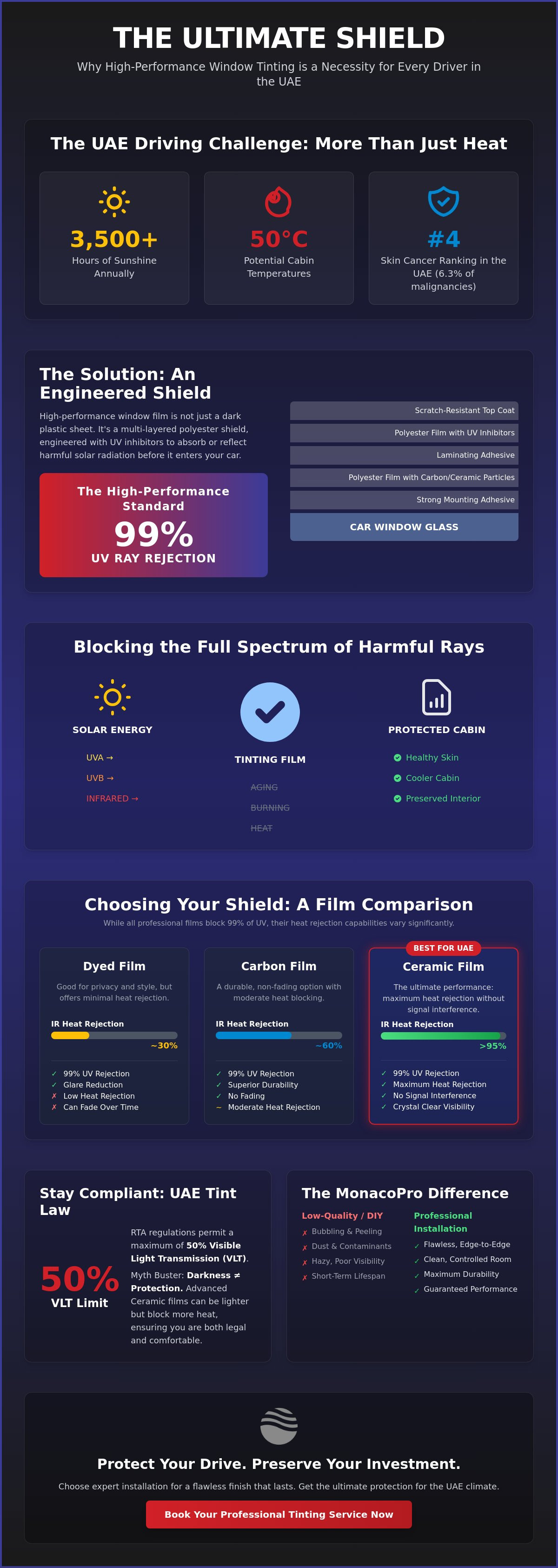
Did you know that skin cancer is the fourth most common cancer in the UAE, accounting for 6.3% of all malignancies? With more than 3,500 hours of sunshine hitting our roads every year, your daily commute exposes you to intense radiation that standard glass simply can’t block, making high-performance UV protection car tinting a health necessity rather than a luxury.
We understand the frustration of stepping into a cabin that feels like an oven or watching a premium leather interior begin to crack under the relentless 50°C heat. It’s a challenge every driver in the region faces, but it doesn’t have to be your reality. This guide explains how the right film serves as a critical shield for your health and your vehicle’s long-term value. You’ll discover how to maintain a cooler cabin, protect your skin from invisible rays, and stay fully compliant with the RTA’s 50% VLT regulations. We’ve compiled everything you need to know to make an informed choice for a more comfortable, road-ready journey.
Key Takeaways
- Understand how advanced window films act as a critical shield for your skin, blocking invisible rays that cause long-term damage during your daily commute.
- Preserve your car’s resale value by preventing “cracked dashboard” syndrome and the chemical breakdown of leather upholstery caused by intense solar heat.
- Stay compliant with current RTA regulations while choosing high-performance UV protection car tinting to keep your cabin significantly cooler.
- Compare the performance of dyed, carbon, and ceramic films to find the most efficient heat-rejection solution for the extreme UAE climate.
- Learn why professional installation at MonacoPro Auto Garage in a temperature-controlled environment is essential to avoid the bubbling and peeling common with low-quality DIY kits.
What is UV Protection Car Tinting and How Does it Work?
Think of high-quality automotive window film as a precision-engineered shield for your vehicle. It isn’t just a dark sheet of plastic; it’s a sophisticated, multi-layered polyester coating designed to manage solar energy. Each layer serves a specific purpose, from scratch-resistant coatings on the outside to specialized adhesive layers that bond firmly to your glass. When we talk about UV protection car tinting, we’re referring to films that incorporate chemical inhibitors directly into the polyester. These inhibitors don’t just block light; they actively absorb or reflect the harmful portions of the solar spectrum before they ever reach your cabin.
Quality matters here. While many basic films focus on aesthetics, high-performance “auto care” films aim for a 99% UV rejection benchmark. This specific number is critical because even a small percentage of leaked radiation can cause cumulative damage over years of driving. By choosing a film that hits this standard, you’re investing in a durable barrier that maintains its performance even after years of exposure to the intense desert sun. It’s about precision and long-term reliability for your vehicle.
The Spectrum of Solar Energy: UVA, UVB, and Infrared
Solar energy hits your car in three distinct ways. UVA rays are the “aging” rays. They penetrate deep through glass and into your skin, leading to long-term health concerns and interior fading. UVB rays are the “burning” rays. While standard glass blocks most UVB, it doesn’t stop it all. Finally, there’s Infrared (IR) radiation. This is the primary source of the stifling heat you feel when you open your door after a day of parking in the sun. Effective UV protection car tinting addresses all three, ensuring you stay cool and protected regardless of the time of day.
VLT Explained: Visible Light Transmission vs. Protection
One of the biggest myths in car care is that a darker tint provides better protection. This isn’t necessarily true. Visible Light Transmission (VLT) measures the percentage of light that passes through the film. A 5% VLT film is very dark, while a 70% VLT film is nearly clear. However, advanced ceramic technology allows clear films to provide the same 99% UV rejection as their darker counterparts. When selecting your tint, consider these factors:
- Visibility: Ensure your VLT choice allows for safe night-time driving and clear sightlines.
- Compliance: Stick to the RTA limits to avoid fines and inspection failures.
- Purpose: Use darker VLTs for privacy in the rear, but rely on high-tech clear films for the front if you prefer a factory look without sacrificing heat rejection.
Don’t assume darkness equals safety. Focus on the specifications of the film’s construction to get the results you actually need. You can achieve a road-ready result that balances style with maximum safety by choosing the right technology over just a darker shade.
Health and Comfort: Why UAE Drivers Require High-Performance Tinting
Driving in the UAE presents a unique set of physiological challenges. With over 3,500 hours of annual sunshine, your daily commute isn’t just a drive; it’s a period of sustained exposure to intense solar radiation. Standard automotive glass is designed for structural integrity, not for blocking the full spectrum of harmful rays. Without high-performance UV protection car tinting, you’re effectively sitting in a greenhouse. This exposure leads to cumulative health risks and significant physical discomfort that can’t be solved by air conditioning alone.
Glare is another silent contributor to driver fatigue. The harsh reflection of the desert sun off the asphalt and surrounding glass buildings forces your eyes to work harder, leading to headaches and reduced concentration. By filtering out this intensity, professional window films provide a more relaxed driving environment. This is especially vital for passengers in the rear seats. Children and pets are particularly susceptible to “hot spots” where the sun’s heat radiates directly through the side windows, creating localized temperature spikes even when the cabin air is cool.
Skin Protection for Daily Commuters
Most drivers in Dubai face a higher risk of UV-related skin damage on the left side of their face and arms due to the angle of exposure through the driver-side window. High-quality UV protection car tinting acts as a secondary, invisible sunscreen that never needs reapplication. According to The Skin Cancer Foundation, window film is a recommended part of a comprehensive sun protection program. It provides a reliable barrier against UVA rays that penetrate deep into the skin, helping you maintain your health during every kilometer of your journey.
Reducing Air Conditioning Strain and Fuel Consumption
Beyond personal health, thermal comfort directly impacts your vehicle’s efficiency. When your car’s interior reaches temperatures exceeding 50°C, your air conditioning system must work at maximum capacity for extended periods. This puts immense pressure on the blower motor and cooling components. By rejecting a significant portion of solar heat before it enters the cabin, high-performance films allow your AC to maintain a stable temperature with less effort.
Your car’s fuel economy or EV battery range benefits directly from this reduced load. A cooler cabin means you don’t have to keep the fans on full blast, preserving energy and extending the lifespan of your cooling system. To ensure your vehicle remains a sanctuary of comfort, consider the benefits of professional tinting, polishing & upholstery services. These solutions work together to keep your interior “road-ready” and protected from the harsh Middle Eastern climate. It’s a proactive step that pays dividends in both comfort and long-term vehicle health.
Asset Protection: Saving Your Interior from the Dubai Sun
Your vehicle is a significant investment. In the UAE, the environment is actively working to depreciate that asset from the moment you drive it off the lot. While most owners focus on engine maintenance, the interior is often neglected until the damage is visible. High-performance UV protection car tinting is your first line of defense against photodegradation. This is the chemical process where UV radiation breaks down the molecular bonds in plastics, vinyl, and leather, leading to structural failure and aesthetic ruin.
We’ve all seen the “cracked dashboard” syndrome common in older UAE vehicles. This happens because the intense solar energy dries out the essential oils in the materials, making them brittle. Once a dashboard cracks, the repair is often expensive and requires complete removal of the front cabin components. By blocking these rays early, you preserve the supple texture of your surfaces and maintain a higher resale value. A car with a pristine, unfaded interior always commands a premium in the pre-owned market.
Upholstery Restoration and Prevention
Tinting works as a partner to your regular maintenance routine. While conditioners keep leather hydrated, they can’t stop the bleaching effect of the sun. Professional UV protection car tinting prevents color fading in fabric and Alcantara interiors, ensuring your seats look as vibrant as the day you bought them. It also helps maintain a healthier cabin environment by reducing “off-gassing.” This is the release of volatile organic compounds from plastics and adhesives when they get hot, which often creates that intense “new car smell” that can actually be harmful over long periods of exposure.
Electronics and Infotainment Longevity
Modern cars are essentially computers on wheels. High heat is the enemy of electronics, specifically the delicate touchscreen displays and dashboard sensors that dominate modern interiors. Sustained thermal stress can lead to “boot-loops,” hardware failure, or unresponsive navigation systems. Even your internal computer diagnostics can be affected by the extreme temperatures found in a car parked in the sun. Protecting these components is vital for the long-term reliability of your vehicle.
If your interior has already suffered from sun exposure, you can learn more about our upholstery for all cars to see how restoration can bring back that road-ready feel. Combining restorative work with high-quality tinting ensures that once your car is back to its best, it stays that way. If your leather seats have already developed cracks or peeling from the intense heat, our guide on car leather seat repair in Dubai explains how expert restoration can return them to showroom condition. It’s a proactive approach to asset management that keeps your vehicle comfortable and technologically sound for years to come.
Understanding UAE Tinting Regulations and Film Types
Choosing the right window film is a balancing act between maximizing safety and staying within the law. In the UAE, these rules are strictly enforced to ensure road safety and driver visibility. While the primary goal of UV protection car tinting is to shield you from the sun, you must ensure your chosen film meets the specific criteria set by the Roads and Transport Authority (RTA). Failing to comply doesn’t just result in a failed vehicle inspection; it can lead to significant penalties on the road.
Identifying high-quality films from cheap imitations is essential for long-term satisfaction. Low-grade films often use simple dyes that break down under the intense Middle Eastern sun, leading to the “purple-fading” effect and unsightly bubbling. Professional-grade films are engineered to withstand extreme temperatures without losing their structural integrity or clarity. Investing in the right technology ensures your car remains road-ready and legally compliant for years to come.
Dubai Legal Limits: What You Need to Know
For private vehicles in Dubai, the current regulation allows for a maximum of 50% Visible Light Transmission (VLT) on the side and rear windows. This means at least 50% of external light must be able to pass through the glass. It’s a common misconception that the front windshield can be tinted; in reality, no tint is permitted on the front windshield. However, you can apply specialized clear films that offer maximum UV rejection without changing the glass’s transparency. Exceeding these limits is a serious offense that carries a fine of AED 1,500. Commercial vehicles often face stricter requirements, so it’s vital to confirm the specific rules for your vehicle type before application.
Film Technology Comparison
Not all films are created equal. Understanding the materials used in construction helps you choose the best protection for your lifestyle:
- Ceramic Films: These represent the gold standard for the UAE. They use nano-ceramic particles that are non-metallic, meaning they won’t interfere with your GPS, mobile signals, or TPMS sensors. They offer the highest heat rejection, blocking up to 85% of solar heat.
- Carbon Films: These provide a sleek matte finish and are highly resistant to fading. They offer excellent mid-range heat protection and contain no metal, ensuring clear electronic communication.
- Dyed Films: These are the most budget-friendly option but are primarily for aesthetics. They offer the lowest heat rejection and are prone to turning purple as the dye reacts to UV exposure over time.
For those seeking the ultimate balance of heat rejection and legal compliance, ceramic IR films are the superior choice. They keep your cabin significantly cooler even at the legal 50% VLT limit. If you want to ensure your vehicle is equipped with the best possible protection, explore our professional tinting, polishing & upholstery services. Our experts will guide you through the selection process to ensure your car stays cool, legal, and protected.
Professional Installation at MonacoPro Auto Garage: Peace of Mind in Umm Ramool
Achieving a flawless finish with UV protection car tinting requires more than just high-quality film; it demands a strictly controlled environment. In the dusty and often humid climate of the UAE, even a single microscopic particle trapped under the film can cause unsightly bubbling and peeling over time. This is why professional application at MonacoPro Auto Garage occurs in a dust-free, temperature-controlled facility. While DIY kits found on platforms like Amazon might seem like a quick fix, they often lack the industrial-grade adhesives and precision cutting tools needed for a “road-ready” result that lasts.
Precision is our hallmark. Our technicians utilize edge-to-edge filing to ensure a gapless finish that looks like factory-installed glass. We don’t just apply a film; we ensure it integrates seamlessly with your vehicle’s specific glass curvature. If you’re in the process of buying a used vehicle, combining your tinting service with a professional pre-purchase inspection at MonacoPro Auto Garage ensures that your new asset is both mechanically sound and fully protected from the sun before you hit the road. It’s a comprehensive approach to car care that saves you time and future headaches.
The MonacoPro Auto Garage Installation Process
Our method is methodical and transparent, designed to instill confidence in every customer. We begin with a deep glass decontamination process to remove every trace of residue. After precision cutting the film to your vehicle’s exact specifications, we use specialized heat shrinking techniques to contour the film to the glass. This step is critical for rear windows with defroster lines. We use high-grade adhesives that bond securely without damaging these sensitive electrical components. Once the application is complete, we provide specific curing advice tailored to Dubai’s humidity, ensuring the film sets perfectly without any optical distortion.
Comprehensive Auto Care in Dubai
We believe in a holistic approach to vehicle maintenance that prioritizes your comfort. You can pair your new UV protection car tinting with a professional polishing service for a total interior and exterior refresh. Our facility in Umm Ramool is designed to be a convenient hub for Dubai drivers who value expertise and reliability. We handle the technical complexities so you can enjoy the peace of mind that comes with a job well done. Our team acts as your supportive guide, ensuring every detail of your car’s protection is handled with craftsmanship and care.
Ready to upgrade your driving experience and protect your health? You can book your professional UV protection tinting at MonacoPro Auto Garage today and let our team of experts deliver the results you deserve. We’re here to ensure your journey is cooler, safer, and more comfortable for years to come.
Drive Protected and Comfortable in the Dubai Sun
Your daily commute shouldn’t feel like a health risk or a threat to your vehicle’s value. By choosing high-performance UV protection car tinting, you’re investing in long-term safety and cabin comfort. You’ve seen how advanced film technology blocks harmful rays while keeping your interior pristine and your driving experience within RTA legal limits. It’s a simple step that transforms your relationship with the intense UAE heat and preserves your asset for the years ahead.
At MonacoPro Auto Garage, our expert technicians in Umm Ramool provide the precision your vehicle deserves. We utilize premium-grade ceramic films to ensure maximum heat rejection without interfering with your car’s vital electronics or sensor systems. Our facility is a one-stop hub for comprehensive auto care, including professional upholstery restoration and reliable mechanical repair. We handle the technical details so you can enjoy the peace of mind that comes with a perfectly protected car.
Protect your car and health—Get a tinting quote from MonacoPro Auto Garage. Let’s make your next journey your most comfortable one yet.
Frequently Asked Questions
Is UV protection car tinting legal in Dubai?
Yes, car tinting is legal for private vehicles in Dubai provided you adhere to the 50% Visible Light Transmission (VLT) limit. This regulation applies specifically to the side and rear windows. Exceeding this limit can result in a fine of AED 1,500 and will cause your vehicle to fail its annual RTA inspection. It’s essential to choose a professional installer who understands these local requirements to ensure your car stays compliant.
Can I tint my front windshield in the UAE?
You aren’t permitted to apply any colored or darkened tint to your front windshield in the UAE. However, you can install specialized clear films that offer maximum UV protection without changing the glass’s transparency. These clear films are highly effective at blocking the heat and radiation that enters through the largest piece of glass in your car. It’s a smart way to protect your dashboard and skin while staying within legal boundaries.
How long does professional car tinting take to install?
A professional installation typically takes between 2 to 4 hours depending on your vehicle’s size and the number of windows being treated. This timeframe allows our technicians to perform deep glass decontamination, precision cutting, and heat shrinking for a perfect fit. We recommend leaving your windows rolled up for at least 48 hours afterward. This allows the adhesive to cure completely in Dubai’s humidity for a bubble-free finish.
Does window tinting interfere with my car’s TPMS or mobile signal?
High-quality ceramic and carbon films don’t interfere with your car’s TPMS sensors, GPS, or mobile phone signals. These films are non-metallic, which is a major advantage over older metallic tints that often caused connectivity issues. If you rely on modern navigation or have integrated tire pressure monitoring, choosing a ceramic UV protection car tinting solution is the most reliable way to maintain full vehicle functionality without interruptions.
What is the difference between cheap tint and ceramic tint?
The main difference lies in heat rejection and long-term durability. Cheap tints are often just dyed polyester that provides shade but offers very little actual heat protection; they also tend to turn purple or bubble within a year. Ceramic tint uses nano-ceramic particles to block up to 85% of solar heat and 99% of UV rays. It’s far more durable and maintains its color and clarity even under extreme UAE sun exposure.
How do I clean my tinted windows without damaging the film?
You should only use ammonia-free glass cleaners and a soft microfiber cloth to clean your tinted windows. Ammonia is a harsh chemical that can break down the film’s protective layers and lead to cloudiness or peeling over time. Avoid using paper towels or abrasive sponges that could scratch the surface. Simple soapy water is often the safest and most effective choice for maintaining a streak-free, professional result for years.
Will tinting prevent my leather seats from cracking in the summer?
Yes, high-performance UV protection car tinting is one of the most effective ways to prevent leather seats from drying out and cracking. By blocking 99% of the UV radiation that breaks down chemical bonds in upholstery, the film preserves the natural oils in the leather. While it doesn’t replace the need for regular conditioning, it significantly slows the aging process caused by the intense summer heat trapped inside your cabin. If your seats have already sustained damage, a professional car leather seat repair Dubai specialist can restore them to their original condition before you apply tinting as a preventive measure going forward.
How long does a high-quality window tint last in the Dubai heat?
A high-quality ceramic or carbon window tint can last between 5 to 10 years in the Dubai heat when installed professionally. Unlike budget films that fail after a single summer, premium films are specifically engineered to resist bubbling, peeling, and color shifting. Choosing a reputable service provider ensures you receive a product that withstands the region’s 50°C temperatures while maintaining its protective properties and a clean, road-ready appearance.